VIENNA (AP) — Iran has further increased its stockpile of uranium enriched to near weapons-grade levels, a confidential report by the U.N. nuclear watchdog said Saturday. In a separate report, the agency called on Tehran to urgently change course and comply with its years-long probe.
The report comes at a sensitive time, as the administration of U.S. President Donald Trump seeks to reach a deal with Tehran to limit its nuclear program. The two sides have held several rounds of talks, so far without agreement.
The report by the Vienna-based International Atomic Energy Agency — which was seen by The Associated Press — says that as of May 17, Iran has amassed 408.6 kilograms (900.8 pounds) of uranium enriched up to 60%.
That’s an increase of 133.8 kilograms (294.9 pounds) — or almost 50% — since the IAEA’s last report in February. The 60% enriched material is a short, technical step away from weapons-grade levels of 90%. A report in February put this stockpile level at 274.8 kilograms (605.8 pounds).
The IAEA report raised a stern warning, saying that Iran is now “the only non-nuclear-weapon state to produce such material" — something the agency said was of "serious concern.”
Approximately 42 kilograms of 60% enriched uranium is theoretically enough to produce one atomic bomb, if enriched further to 90%, according to the watchdog.
The IAEA report, a quarterly, also estimated that as of May 17, Iran’s overall stockpile of enriched uranium — which includes uranium enriched to lower levels — stood at 9,247.6 kilograms (20,387.4 pounds). That's an increase of 953.2 kilograms (2,101.4 pounds) since February's report.
Iran has maintained its nuclear program is for peaceful purposes only, but the IAEA chief, Rafael Mariano Grossi, has warned that Tehran has enough uranium enriched to near-weapons-grade levels to make “several” nuclear bombs if it chose to do so.
Iranian officials have increasingly suggested that Tehran could pursue an atomic bomb.
U.S. intelligence agencies assess that Iran has yet to begin a weapons program, but has “undertaken activities that better position it to produce a nuclear device, if it chooses to do so.”
Iran’s Foreign Ministry and the Atomic Energy Organization of Iran said in a joint statement that the IAEA report was based on “unreliable and differing information sources” and accused it of being biased, unprofessional and lacking crucial, updated information.
“The Islamic Republic of Iran expresses its disappointment about the report, which was prepared by imposing pressure on the agency for political purposes, and expresses its obvious objection about its content,” the statement read.
The statement reiterated that the country’s Supreme Leader Ayatollah Ali Khamenei, who has final say on all state matters, issued a religious decree that nuclear weapons would not be part of the country’s defense arsenal. However, Iran stressed that under international law, the country has a right to a peaceful nuclear program, including uranium enrichment. The statement said the uranium enrichment was under “transparent” monitoring by the IAEA, which the IAEA denies.
The statement also accused the IAEA of turning a blind eye toward the U.S.’s 2018 withdrawal from the nuclear deal.
Omani Foreign Minister Badr al-Busaidi, who is mediating the U.S.-Iran talks was in Tehran on Saturday to present the latest U.S. proposal for ongoing talks, Foreign Minister Abbas Araghchi wrote on X. The talks seek to limit Iran’s nuclear program in exchange for the lifting of some of the crushing economic sanctions the U.S. has imposed on the Islamic Republic, which have strained relations for almost 50 years. The fifth round of talks between the U.S. and Iran concluded in Rome last week with “some but not conclusive progress,” al-Busaidi said at the time.
Israel said Saturday's report was a clear warning sign that "Iran is totally determined to complete its nuclear weapons program,” according to a statement from Prime Minister Benjamin Netanyahu's office.
It said IAEA's report “strongly reinforces what Israel has been saying for years — the purpose of Iran’s nuclear program is not peaceful.”
It also added that Iran's level of enrichment “has no civilian justification whatsoever” and appealed on the international community to “act now to stop Iran.”
It is rare for Netanyahu to make statements on Saturday, the Jewish day of rest, underlying the urgency with which he sees the matter.
Grossi said Saturday that he “reiterates his urgent call upon Iran to cooperate fully and effectively” with the IAEA's years long investigation into uranium traces discovered at several sites in Iran.
The IAEA also circulated to member states on Saturday a second, 22-page confidential report, also seen by the AP, that Grossi was asked to produce following a resolution passed by the 35-member IAEA Board of Governors last November.
In this so-called “comprehensive report,” the IAEA said that Iran’s cooperation with the agency has "been less than satisfactory” when it comes to uranium traces discovered by IAEA inspectors at several locations in Iran that Tehran has failed to declare as nuclear sites.
Western officials suspect that the uranium traces discovered by the IAEA could provide evidence that Iran had a secret military nuclear program until 2003.
One of the sites became known publicly in 2018 after Netanyahu revealed it at the United Nations and called it a clandestine nuclear warehouse hidden at a rug-cleaning plant.
Iran denied this but in 2019 IAEA inspectors detected the presence of manmade uranium particles there.
After initially blocking IAEA access, inspectors were able to collect samples in 2020 from two other locations where they also detected the presence of manmade uranium particles.
The three locations became known as Turquzabad, Varamin and Marivan.
A fourth undeclared location named as Lavisan-Shian is also part of the IAEA probe but IAEA inspectors never visited the site because it was razed and demolished by Iran after 2003.
In Saturday’s comprehensive report, the IAEA says the “lack of answers and clarifications provided by Iran" to questions the watchdog had regarding Lavisan-Shian, Varamin and Marivan "has led the agency to conclude that these three locations, and other possible related locations, were part of an undeclared structured nuclear program carried out by Iran until the early 2000s and that some activities used undeclared nuclear material.”
Saturday’s comprehensive report could be a basis for possible further steps by European nations, leading to a potential escalation in tensions between Iran and the West.
European countries could move to trigger snap-back sanctions against Iran that were lifted under the original 2015 nuclear deal ahead of October, when the deal formally expires.
On Thursday, senior Iranian officials dismissed speculation about an imminent nuclear deal with the United States, emphasizing that any agreement must fully lift sanctions and allow the country’s nuclear program to continue.
The comments came a day after Trump said he has told Netanyahu to hold off on striking Iran to give the U.S. administration more time to push for a new deal with Tehran.
White House press secretary Karoline Leavitt said Saturday that Trump has made it clear that Iran can never obtain a nuclear bomb.
“Special Envoy Witkoff has sent a detailed and acceptable proposal to the Iranian regime, and it’s in their best interest to accept it,” she said. "Out of respect for the ongoing deal, the Administration will not comment on details of the proposal to the media.”
Associated Press writers Nasser Karimi in Tehran, Melanie Lidman in Dubai, United Arab Emirates, and Darlene Superville in Washington contributed to this report.
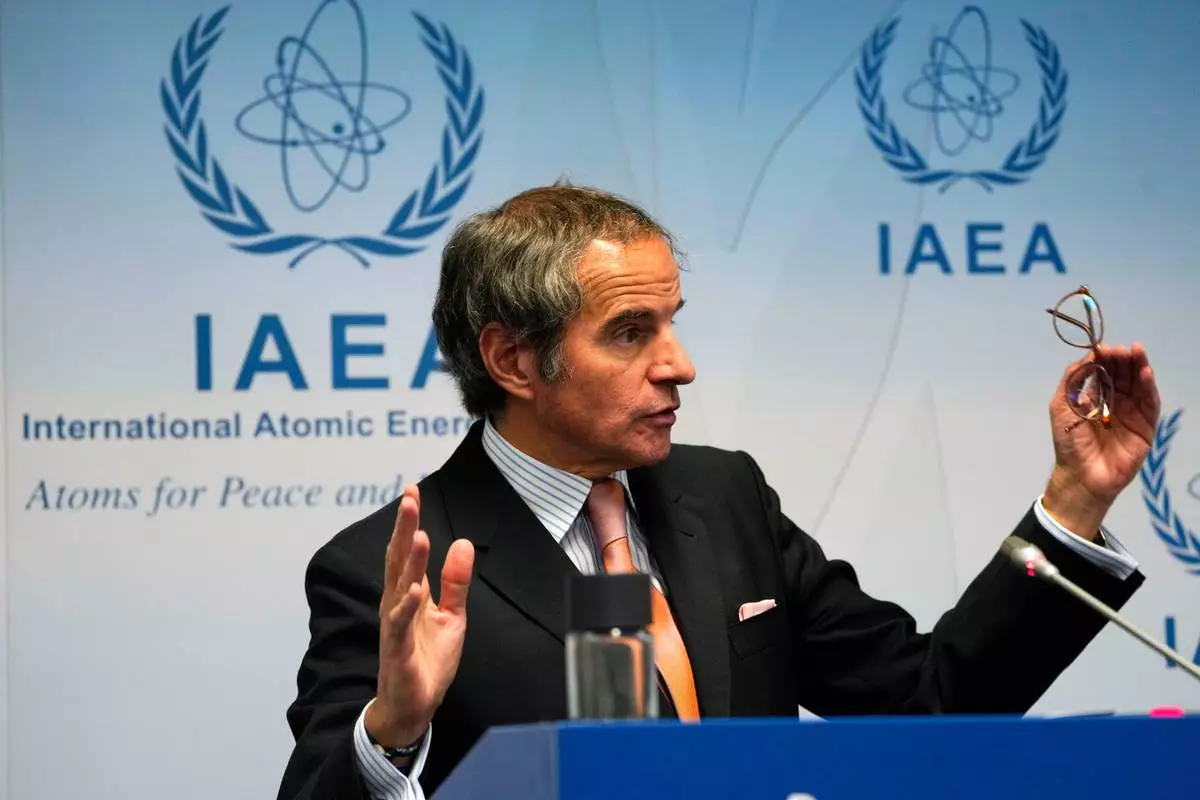
Rafael Mariano Grossi, the director-general of the International Atomic Energy Agency, speaks to journalists attending a weeklong seminar at the agency in Vienna, Austria, Wednesday, May 28, 2025. (AP Photo/Jon Gambrell)