TOKYO--(BUSINESS WIRE)--Jun 3, 2025--
Yokogawa Electric Corporation (TOKYO: 6841) announces the unveiling of the next-generation Release 7 concept and the launch of Release 7.01 of the CENTUM TM VP integrated production control system, a core product in the OpreX TM Control and Safety System lineup. This is the 10th generation of the CENTUM series, and its release coincides with the 50th anniversary of the announcement of CENTUM as the world’s first *1 distributed control system (DCS), on June 19, 1975.
This press release features multimedia. View the full release here: https://www.businesswire.com/news/home/20250602970172/en/
Development Background
In addition to the dynamic changes in supply chains over recent years, countries have been strengthening regulations in response to a growing awareness of the need to protect the environment. At the same time, with the increasing use of digital technologies for complex applications such as the management of the utilization of renewable energy and the analysis of data in cloud-based environments, security risks have become a greater concern. Also, while utilizing existing tangible assets, there is a growing need to pass on to others the expertise of seasoned operators, and to reduce the workload and mental burden for personnel who are responsible for systems that must be kept operating around the clock. Amidst the growing complexity of these industry challenges, management and frontline personnel are required to increase competitiveness and strike a balance between the stable manufacturing of superior products and the need to improve efficiency and profitability.
The Concept behind CENTUM VP Release 7
In response to these issues, Yokogawa has based its development of CENTUM VP Release 7 on the concept of enabling autonomous operations *2. With CENTUM, Yokogawa is helping its customers attain sustainability by improving energy efficiency, accelerating decarbonization, and providing a safe and secure working environment. While maintaining the reliability, stability, continuity, robust security, and comprehensive engineering and service network that have been hallmarks of the CENTUM series since its inception, Yokogawa will drive innovations for the future in the following three areas:
Main Features of Release 7.01
To achieve autonomous operations, it is essential to leverage AI while ensuring safety and security. Release 7.01 helps to establish the necessary foundation for this goal. The key features are as follows.
1. Enhanced security
To achieve data-driven operations, it is crucial to ensure the security of critical infrastructure. This release adopts industry security benchmarks to strengthen the cybersecurity of the components that make up control systems and enhance the overall security level of the system.
2. Expansion of control and monitoring scope with CENTUM
By integrating OPC Unified Architecture (OPC UA) connectivity, the range of plant equipment and devices that can be controlled and monitored by CENTUM is expanded. OPC UA is a platform-independent standard that enables data exchange between devices from different manufacturers in the industrial automation field. In this update, OPC UA client functionality has been added to CENTUM.
3. Enhanced engineering capabilities for large-scale projects
To promote operational optimization by integrating various systems within the plant, a feature has been added that allows the merging and testing of multiple engineering databases related to CENTUM. This enhancement will enable high-quality and efficient engineering, contributing to the rapid startup of new plants and restart of upgraded plants.
Mitsuhiro Yamamoto, Vice President, Executive Officer, and head of the Systems Business Division at Yokogawa Electric stated, “In this VUCA *4 era, the conditions required for manufacturing sites and management are becoming ever more complex. By realizing stable operations and expanding the scope of autonomy, CENTUM VP Release 7 will help our customers achieve a more sustainable society and sustainable business growth.”
*1 CENTUM has been recognized as the world’s first DCS by Japan’s National Museum of Nature and Science, which in 2012 designated CENTUM as such in the document “Important Material for the History of Science and Technology (Heritage of Future Technology) ” (Japanese). This status was also confirmed by the Denki no Ishizue (Foundation of Electric Technology) 14th Electric Technology Awards (Japanese).
*2 Yokogawa is advocating the transition from industrial automation to industrial autonomy (IA2IA), and defines industrial autonomy as a state where plant assets and operations possess learning and adaptive capabilities that allow responses with minimal human interaction, empowering operators to perform higher-level optimization tasks. Autonomous operations is the final stage of industrial autonomy, representing an ideal state where operations function with complete autonomy throughout a value chain.
*3 The Factorial Kernel Dynamic Policy Programming (FKDPP) reinforcement learning AI algorithm. Yokogawa defines autonomous control AI as "a robust system capable of deriving optimal control methods and autonomously responding to unexperienced situations to a certain extent." Yokogawa already has experience in integrating the use of an autonomous control AI and CENTUM VP, and this has been officially adopted for use in controlling operations at a chemical plant. For this achievement, which has reduced environmental impact, lessened workloads, and improved safety, Yokogawa has received the Prime Minister's Prize, the highest of the 2023’s Japan Industrial Technology Awards (Nihon Sangyo Gijyutsu Taisho), which was established in 1972.
*4 An acronym that stands for volatility, uncertainty, complexity, and ambiguity
Major Target Markets
Various process industries, including oil and gas, petrochemicals, chemicals, steel, pulp and paper, electric power, and water treatment
Applications
Operation monitoring and automatic control of plants and manufacturing equipment
More Information
CENTUM VP
https://www.yokogawa.com/solutions/products-and-services/control/distributed-control-systems-dcs/centum-vp/
CENTUM 50 th Anniversary website
https://www.yokogawa.com/special/centum-50th/index.htm
About CENTUM
CENTUM was announced as the world’s first distributed control system by Yokogawa Electric on June 19, 1975, and is celebrating its 50th anniversary this year. Since its launch, more than 30,000 systems have been deployed in more than 100 countries around the world, supporting a wide range of industries such as oil refining, petrochemicals, specialty chemicals, textiles, steel, pharmaceuticals, food, water, electric power, and gas. It’s development was made possible by Yokogawa’s experience in providing safe and stable control technologies. For over 50 years, CENTUM has continued to evolve as a core plant operations system characterized by reliability, stability, and continuity. By enhancing control functions, it has played a significant role in increasing product functionality, reducing energy consumption, and improving plant productivity. With “trust” as the design theme during development, CENTUM is leading the safe and secure operation of industry, supported by Yokogawa’s global service network.
About OpreX
OpreX is the comprehensive brand for Yokogawa's industrial automation (IA) and control business. The OpreX name stands for excellence in the technologies and solutions that Yokogawa cultivates through the co-creation of value with its customers, and encompasses the entire range of Yokogawa's IA products, services, and solutions. This brand comprises the following five categories: OpreX Transformation, OpreX Control, OpreX Measurement, OpreX Execution, and OpreX Lifecycle. One of the product groups that make up the OpreX Control category is the OpreX Control and Safety System family, which includes CENTUM VP. With its various OpreX Control solutions, Yokogawa is able to quickly effect changes for its customers that lead to a transformation in such areas as management and operations, and provides highly reliable control technology that ensures high efficiency, high quality, and safe and stable plant operations.
With the OpreX brand, Yokogawa will deliver integrated solutions that address specific needs and support its customers in their efforts to transform and grow their businesses.
About Yokogawa
Yokogawa provides advanced solutions in the areas of measurement, control, and information to customers across a broad range of industries, including energy, chemicals, materials, pharmaceuticals, and food. Yokogawa addresses customer issues regarding the optimization of production, assets, and the supply chain with the effective application of digital technologies, enabling the transition to autonomous operations.
Founded in Tokyo in 1915, Yokogawa continues to work toward a sustainable society through its 17,000+ employees in a global network of 128 companies spanning 62 countries.
For more information, visit www.yokogawa.com
The names of corporations, organizations, products, services and logos herein are either registered trademarks or trademarks of Yokogawa Electric Corporation or their respective holders.

Yokogawa Announces Release of Next-Generation of the CENTUM VP Integrated Production Control System
Semiofficial news agencies in Iran published a chart Thursday suggesting the country’s paramilitary Revolutionary Guard put sea mines into the Strait of Hormuz during the war, as uncertainty hangs over a two-week ceasefire and further negotiations are expected in Pakistan.
The shaky ceasefire has been largely holding between the U.S., Israel and Iran, although Tehran and Washington have offered vastly different explanations of the initial terms.
Israel insists the agreement does not apply to their war against Iran-backed Hezbollah militants in Lebanon and have escalated deadly strikes there, leading Iran to claim it is violating the deal. U.N. Secretary-General António Guterres “unequivocally” condemned Israeli strikes in Lebanon that killed and injured hundreds on Wednesday after the ceasefire was announced.
Sirens sounded in northern Israel early Thursday as Hezbollah claimed it was attacking with rocket fire.
Meanwhile, U.S. President Donald Trump said on social media that his surge of warships and troops will remain around Iran “until such time as the REAL AGREEMENT reached is fully complied with.” He also insisted Iran would not be able to build nuclear weapons and “the Strait of Hormuz WILL BE OPEN & SAFE.”
Iran closed the Strait of Hormuz again on Wednesday in response to Israeli attacks against Hezbollah in Lebanon.
Here is the latest:
The Lebanese army said Thursday it cleared the Qasmieh bridge after Israel hit it on Wednesday, and deployed a unit nearby.
The bridge is the last direct crossing for most traffic into the coastal city of Tyre over the Litani River, the strategic line separating southern Lebanon from the rest of the country.
Israel has struck several bridges in the area, accusing Hezbollah of moving fighters and equipment, but the crossings are also vital for civilians and humanitarian aid. The strikes come as Israel seeks a “buffer zone” to protect its northern towns, raising fears of long-term occupation and displacement.
Speaking in a video message, the head of the U.S. military’s Central Command said Thursday his forces “remain present” in the Middle East as a two-week ceasefire has taken effect.
“Iran has suffered a generational military defeat,” U.S. Navy Adm. Brad Cooper said. “The United States and Israel systematically destroyed Iran’s ability to conduct large-scale military operations for years to come.”
Lebanon’s Prime Minister Nawaf Salam announced the decision on Thursday following Israeli strikes a day earlier that killed over 200 people.
He said the surge of attacks was a “blatant violation” of international and humanitarian law and undermines ongoing efforts to halt the war.
He added that the cabinet has also ordered security forces to tighten control over the capital by “enhancing the state’s full authority across Beirut and restricting arms to legitimate forces.”
The Israeli army on Wednesday accused Hezbollah members of moving north of the capital and blending into civilian areas.
Iran’s parliament speaker warned Thursday on X that continued Israeli attacks on Hezbollah in Lebanon would bring “explicit costs and STRONG responses.”
Like other Iranian officials, Mohammad Bagher Qalibaf insisted that the two-week ceasefire extended to Lebanon, something denied by both Israel and the U.S.
“Ceasefire violations carry explicit and STRONG responses,” he wrote. “Extinguish the fire immediately.”
Qalibaf has been discussed as a possible negotiator who could meet U.S. Vice President JD Vance this weekend for talks in Islamabad, the capital of Pakistan.
A day after intense Israeli strikes pounded Lebanon’s capital, survivors recounted scenes of carnage as hospitals struggled to cope with a surge of casualties.
“I thought I was dead. What happened? A big flash of light was in my face and eyes, and I found someone flying over and landing next to me. He was dead,” said Rabee Koshok from his bed at the Makassed hospital in Beirut, recalling the moment of impact. “Suddenly, while we are walking, a rocket could come and hit us,” he added.
Wednesday marked the deadliest day in Lebanon in more than five weeks of renewed war between Israel and the Lebanese militant group Hezbollah.
Wael Jarrosh, a doctor, said the hospital received around 70 injured patients within 10 minutes of the blasts.
“This has destroyed us psychologically,” Jarrosh said. “We have to stay prepared so that we can serve our families and the injuries that come in.”
The head of the United Arab Emirates’ major oil company on Thursday sharpened his rhetoric against Iran over the Strait of Hormuz being closed off, saying “the weaponization of this vital waterway, in any form, cannot stand.”
Sultan al-Jaber, the CEO of the state-run Abu Dhabi National Oil Co. in the United Arab Emirates, said online that some 230 vessels “sit loaded with oil and ready to sail” through the Strait of Hormuz, now in a chokehold by Iran.
“They, and every vessel that follows, must be free to navigate this corridor without condition,” al-Jaber said. “No country has a legitimate right to determine who may pass and under what terms.”
He added: “Iran has made clear — through both its statements and actions — that passage is subject to permission, conditions and political leverage. That is not freedom of navigation. That is coercion.”
Lebanon’s health ministry said Thursday that at least 203 people were killed in widespread Israeli strikes in central Beirut and other areas of Lebanon on Wednesday. It said more than 1,000 were wounded.
The death toll Wednesday was the highest for a single day in Lebanon during more than five weeks of renewed war between Israel and the Lebanese militant group Hezbollah.
The Israeli military said it targeted Hezbollah sites. However, several of the buildings that were struck without warning during the afternoon rush hour were in densely packed commercial and residential areas, leading to widespread civilian casualties. Lebanese President Joseph Aoun called the strikes “barbaric.”
Israeli Prime Minister Benjamin Netanyahu said Thursday that his country will continue its strikes against the Iran-backed Hezbollah militant group in Lebanon “with force, precision and determination,” as Israeli strikes continued across southern Lebanon on Thursday morning.
“Whoever acts against the citizens of Israel will be harmed,” Netanyahu wrote on his social media.
Israel intensified its strikes in Lebanon on Wednesday, saying that its fight with Hezbollah is not part of the two-week ceasefire deal with Iran. Hundreds were killed and wounded.
“I’ve given instructions today to our ambassador in Tehran to return during this time in which a hope for peace is rekindled,” Spanish Foreign Minister José Manuel Albares told legislators Thursday.
Spain temporarily closed the embassy at the start of the war and evacuated its personnel.
Israel criticized Spain for the decision, with Foreign Minister Gideon Saar calling the country “an eternal disgrace” on X.
China’s Defense Ministry has denied reports that it offered support to Iran’s military, including alleged intelligence on U.S. forces’ location amid the war.
“We firmly oppose the dissemination of speculative and insinuating false information targeting China,” Defense Ministry spokesman Zhang Xiaogang said during a briefing on Thursday.
The Washington Post recently reported that some Chinese private companies, including some with ties to the People’s Liberation Army, had been marketing intelligence about the movements of U.S. forces during the war.
Reuters has reported that China’s largest chipmaker had sent equipment used to make chips to Iran’s military, citing U.S. sources.
“China has always been open and aboveboard on the Iran issue, maintaining an objective and impartial stance,” Zhang said, adding that the country has never engaged “in any activities that could incite conflict.”
The main border crossing between Lebanon and Syria returned to service Thursday, five days after the Israeli military warned of plans to strike it, alleging that Hezbollah was using it to smuggle military equipment.
Both Lebanese and Syrian authorities denied the claim.
The threatened strike never took place. Lebanese officials have said that the U.S. and Egypt interceded to halt it. Syria’s port and customs authority announced the “resumption of normal traffic flow” at the crossing known as Masnaa on the Lebanese side and Jdeidet Yabous on the Syrian side, “following the elimination of the risks that necessitated its temporary closure.”
Travelers had been rerouted to another crossing in the north, making the trip from Beirut to Damascus several hours longer.
The chief of Iran’s nuclear agency said Thursday that protecting Tehran’s right to enrich uranium is “necessary” for any ceasefire talks with the United States.
Mohammad Eslami, who leads the Atomic Energy Organization of Iran, made the remarks to journalists, including one from The Associated Press, in Tehran, Iran, during commemorations for the late Supreme Leader Ayatollah Ali Khamenei.
“It is a part of the necessary (things) that nobody speaks about,” Eslami said, referring to the U.S. refusal to acknowledge enrichment as one part of Iran’s 10-point plan for a permanent ceasefire.
The U.S. and Iran are due to meet in Islamabad, the capital of Pakistan, for talks this weekend.
Iran’s Foreign Minister Abbas Araghchi had a call with his Saudi counterpart, Prince Faisal bin Farhan, on Thursday.
French Foreign Minister Jean-Noël Barrot said European and other partners are “finalizing” plans to set up a mission to escort ships in the Strait of Hormuz as soon as fighting effectively ends.
Barrot said Thursday “planning for this mission is currently being finalized between French military officials and countries that have volunteered,” speaking on France Inter radio.
Shipping traffic will likely be able to cross the strait safely once an agreement is reached between the belligerents and “with an escort system,” he said.
“Work is well advanced” for the mission to be deployed “once calm has been fully restored,” he said.
On Wednesday, French President Emmanuel Macron said about 15 nations are ready to participate in such a mission.
In a speech to Parliament on Thursday, Italian Prime Minister Giorgia Meloni warned that any extra Iranian duties in the Strait of Hormuz would have “unpredictable economic consequences,” stressing that a full restoration of freedom of movement is needed in the area.
Meloni indicated that as the most critical point of the agreement between the U.S. and Iran.
“Full restoration of freedom of movement in the Strait of Hormuz is needed, and it must not be subject to any restrictions, as appears to have happened in recent hours,” she said.
The Italian prime minister also suggested that, if the crisis in Iran worsens, the European Union should consider suspending the stability and growth pact — a set of rules governing public finances within the EU.
Britain’s foreign minister said Lebanon must be included in a Middle East ceasefire, adding Israel’s continuing attacks on the country are causing mass displacement and dire humanitarian consequences.
Foreign Secretary Yvette Cooper told Sky News she is “deeply troubled about the escalating attacks that we saw from Israel in Lebanon yesterday.”
She told the BBC the attacks are “completely wrong.”
Britain and other European countries have called for Israel to stop its strikes on Lebanon and for Iran to reopen the Strait of Hormuz to commercial shipping.
Cooper said it’s “crucial” that Iran is not allowed to apply tolls in the strait.
Israel said Thursday it killed an aide to Hezbollah leader Naim Kassem in its intense airstrikes that hit Lebanon’s capital, Beirut, on Wednesday.
It identified the man killed as Ali Yusuf Harshi, a secretary and nephew to Kassem.
Hezbollah did not immediately respond to a request for comment.
Iran’s deputy foreign minister said his country will allow ships to pass through the Strait of Hormuz in accordance with “international norms and international law” once the United States ends its “aggression” in the Middle East and Israel stops attacking Lebanon.
Saeed Khatibzadeh told the BBC on Thursday that Iran had closed the strait after U.S. ally Israel committed an “intentional grave violation of the ceasefire.”
He said, “You cannot have a cake and eat it at the same time. That was the message that Iran sent quite clearly, crystal-clearly, to Washington and to the Oval Office last night.”
Khatibzadeh added: “Definitely we are going to provide security for safe passage, and it is going to happen after the United States actually withdraws this aggression. Does it mean that Iran is going to control the Strait of Hormuz in terms of letting ship by ship to go through that?
“I think that we have shown to everybody that energy security is pivotal for Iran, is pivotal for this body of water in the Persian Gulf, and we are going to be abided by the international norms and international law.”
Mourners across Iran began mourning ceremonies Thursday, marking the 40th day after the death of Supreme Leader Ayatollah Ali Khamenei, who was killed at the start of the Iran war.
In Iran’s capital, Tehran, mourners wearing black began their rally from Jomhouri Eslami Square to the neighborhood of the office of Khamenei, 86.
Iranian state television aired similar commemorations in other cities. It said the ceremonies will continue into the night.
Khamenei’s body has yet to be buried since his death Feb. 28.
His son, Ayatollah Mojtaba Khamenei, now serves as Iran’s supreme leader.
The strike in the southern Lebanese village of Abbasiyeh also wounded others, the National News Agency reported Thursday morning, in what it said was a preliminary toll.
The Israeli military did not immediately acknowledge the strike.
Israel intensified its strikes in Lebanon on Wednesday, saying that its fight with the Iran-backed Hezbollah militant group is not part of the two-week ceasefire deal with Iran.
Lebanon’s Health Ministry said the strikes Wednesday killed at least 182 people and wounded 890 others, the highest single-day death toll in the latest Israel-Hezbollah war.
French President Emmanuel Macron has called for “each of the belligerents” to fully respect the ceasefire, including in Lebanon, as he spoke separately with Iran’s President Masoud Pezeshkian and U.S. President Donald Trump.
Macron said he “told both of them that their decision to accept a ceasefire was the best possible one,” and “must open the way to comprehensive negotiations,” in a message posted on X late Wednesday.
Macron also said he spoke with Lebanon’s President Joseph Aoun and Prime Minister Nawaf Salam to express “France’s full solidarity in the face of the indiscriminate strikes carried out by Israel” in the country.
“We condemn these strikes in the strongest possible terms,” Macron said, stressing they pose a direct threat to the sustainability of the ceasefire.
Pakistan’s Interior Minister Mohsin Naqvi met U.S. Chargé d’Affaires Natalie Baker on Thursday to discuss the situation in the Middle East and upcoming high-level talks between the United States and Iran in Islamabad, according to an official statement.
During the meeting, they also reviewed arrangements for the talks being held in Islamabad later this week.
The statement quoted Naqvi as saying that the visiting foreign dignitaries, including U.S. Vice President JD Vance, Steve Witkoff and Jared Kushner, would be “special guests” and assured that a comprehensive security plan had been put in place to provide full protection to all foreign guests.
Iran’s ambassador to Pakistan has deleted an online post saying that Tehran’s negotiating team would arrive Thursday night in Islamabad.
Reza Amiri Moghadam made the initial comment on X, without identifying who was on the Iranian team.
Then he deleted it without comment.
Pakistan has shut schools and government offices for two days in the capital, Islamabad, to keep people off the roads as authorities ramp up security ahead of U.S.-Iran talks later this week.
Officials have imposed sweeping restrictions across the city, including blocking key roads connecting Islamabad with neighboring Rawalpindi.
Shipping containers have been placed at multiple points to restrict movement and limit public access to sensitive areas.
Islamabad appeared unusually quiet Thursday, with many residents staying home as traffic diversions forced longer commutes between Islamabad and Rawalpindi.
The restrictions follow recent unrest in March, when protests by Shiite groups erupted across the country in response to U.S. and Israeli strikes on Iran.
The widespread Israeli strikes Wednesday killed at least 182 people and wounded 890 others, according to Lebanon’s Health Ministry.
Civil Defense spokesperson Elie Khairallah told The Associated Press that a wounded woman was found alive under the rubble overnight in the seaside Beirut neighborhood of Ain Mreisseh.
A man whose building collapsed after strikes in the capital’s southern suburbs was also found alive in rubble.
“The others so far have been killed,” Khairallah said.
Meanwhile, others like Mohammad Chehab, a Syrian man from Deir el-Zour, are anxiously waiting.
Six of his 10 family members have been found, but others are still missing. He tries to stay hopeful.
“They’ve been searching all day,” he said nervously, watching rescue workers dig through the rubble.
Pakistani authorities have stepped up security in the capital, Islamabad, deploying hundreds of additional police and paramilitary forces ahead of much-awaited peace talks between the United States and Iran.
The talks, seen as a potentially significant diplomatic opening to end the war in the region, will begin later this week.
On Thursday, authorities also moved to seal off parts of the city by placing shipping containers along key roads leading to the city’s Red Zone, a heavily fortified enclave that houses the president and prime minister’s office, the Foreign Ministry, and foreign embassies.
A nearby hotel, where the delegations are expected to stay, has also been brought under tight security.
Iran has not said who will represent its delegation, which is due to arrive in Islamabad later Thursday.
The White House has confirmed that Vice President JD Vance will lead the U.S. negotiating team in talks with Iran.
Iran’s negotiating team for talks with the United States will arrive Thursday night in Islamabad, the Iranian ambassador there said.
Reza Amiri Moghadam made the comment on the social platform X, without identifying who was on the Iranian team.
He wrote that the “Iranian delegation arrives tonight in Islamabad for serious talks based on 10 points proposed by Iran.”
Those points include Iran enriching uranium, maintaining its control of the Strait of Hormuz and other issues that have been nonstarters in the past for U.S. President Donald Trump.
The White House has repeatedly described the 10 points issued by Iran as false.
Moghadam wrote that the Iranians would come to Islamabad despite “skepticism of Iranian public opinion due to repeated ceasefire violations by Israeli regime to sabotage the diplomatic initiative.”
That refers to Israel’s strikes on Lebanon, which Israel and the U.S. have said wasn’t included in the shaky ceasefire.
Ship-tracking data from trade data and analytics platform Kpler showed only four vessels with their Automatic Identification System trackers on passing through the Strait of Hormuz on Wednesday, the first day of the ceasefire.
However, this total does not include so-called “dark fleet” vessels — those with their AIS trackers turned off.
Many of those “dark fleet” ships carry sanctioned Iranian crude oil out to the open market.
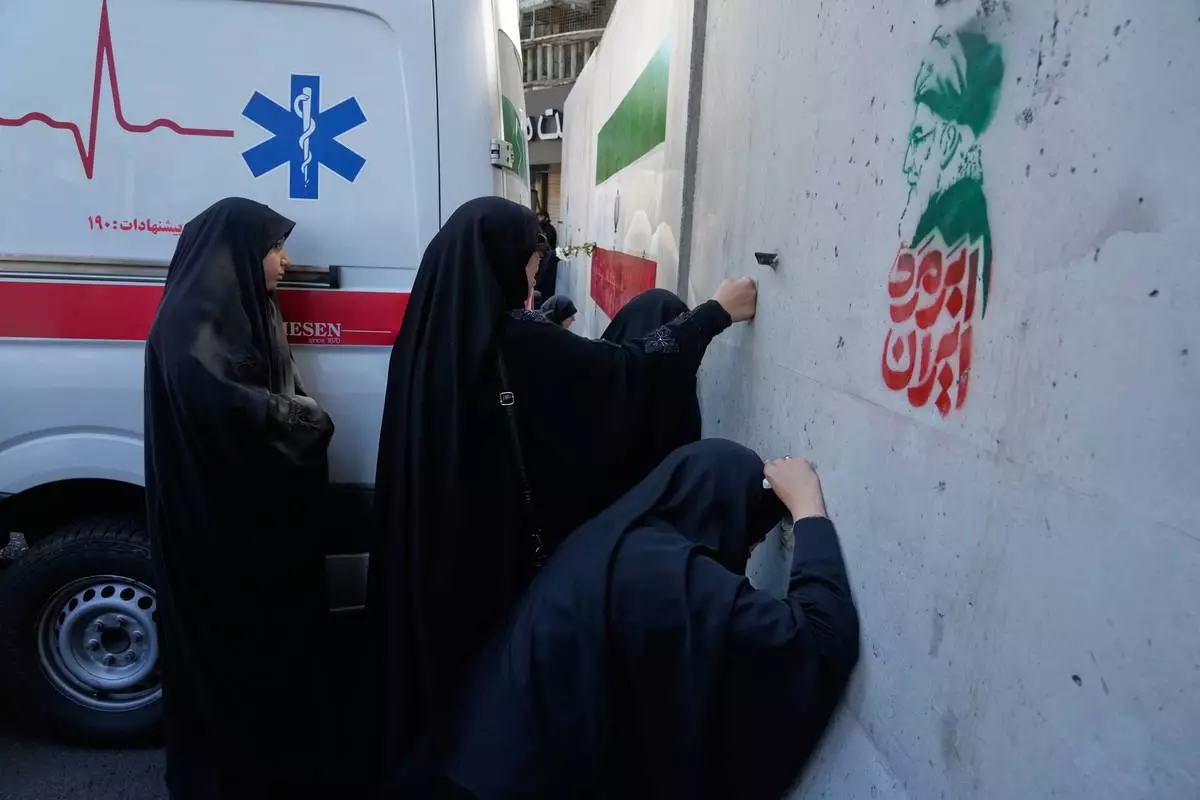
Women mourn during a ceremony marking the 40th day since the killing of the Iranian Supreme Leader Ayatollah Ali Khamenei, as the cement barricades are placed on the street leading to his residence in Tehran, Iran, Thursday, April 9, 2026. (AP Photo/Vahid Salemi)
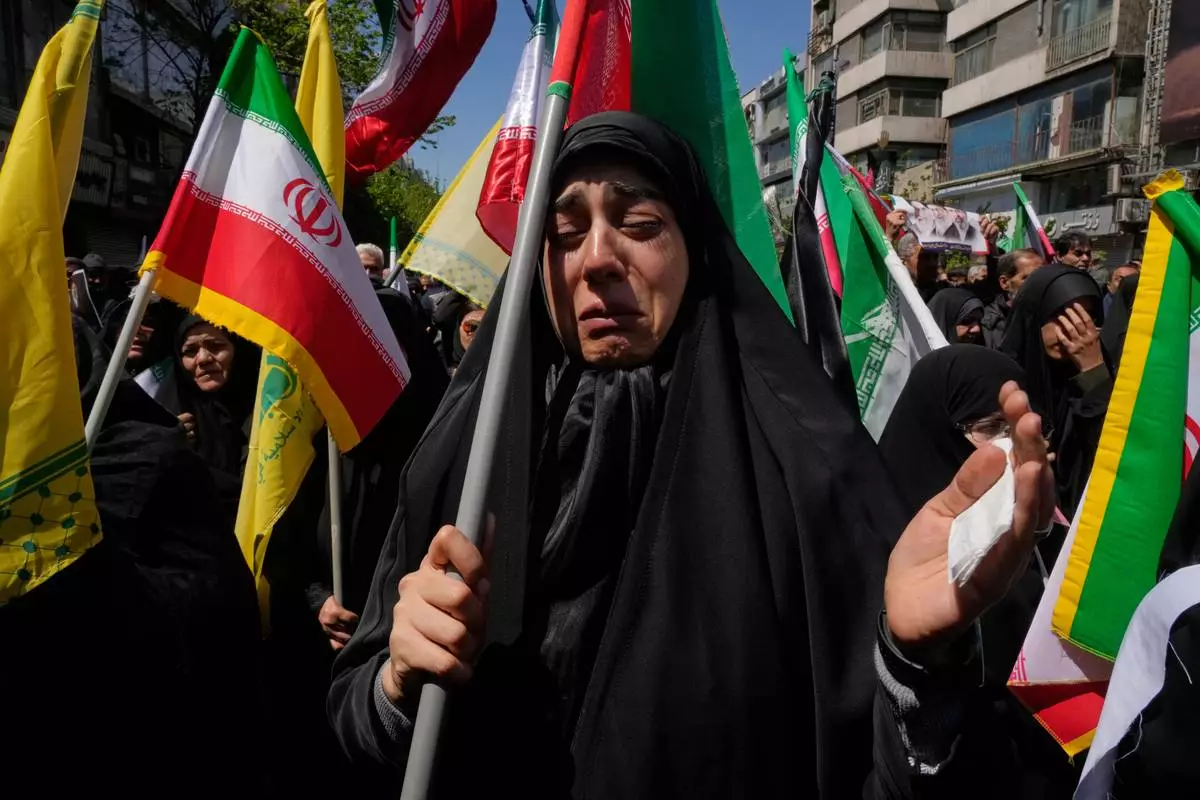
A government supporter weeps during a mourning ceremony marking the 40th day since the death of Iranian Supreme Leader Ayatollah Ali Khamenei, who was killed in the U.S. and Israel strikes in Tehran, Iran, Thursday, April 9, 2026. (AP Photo/Vahid Salemi)
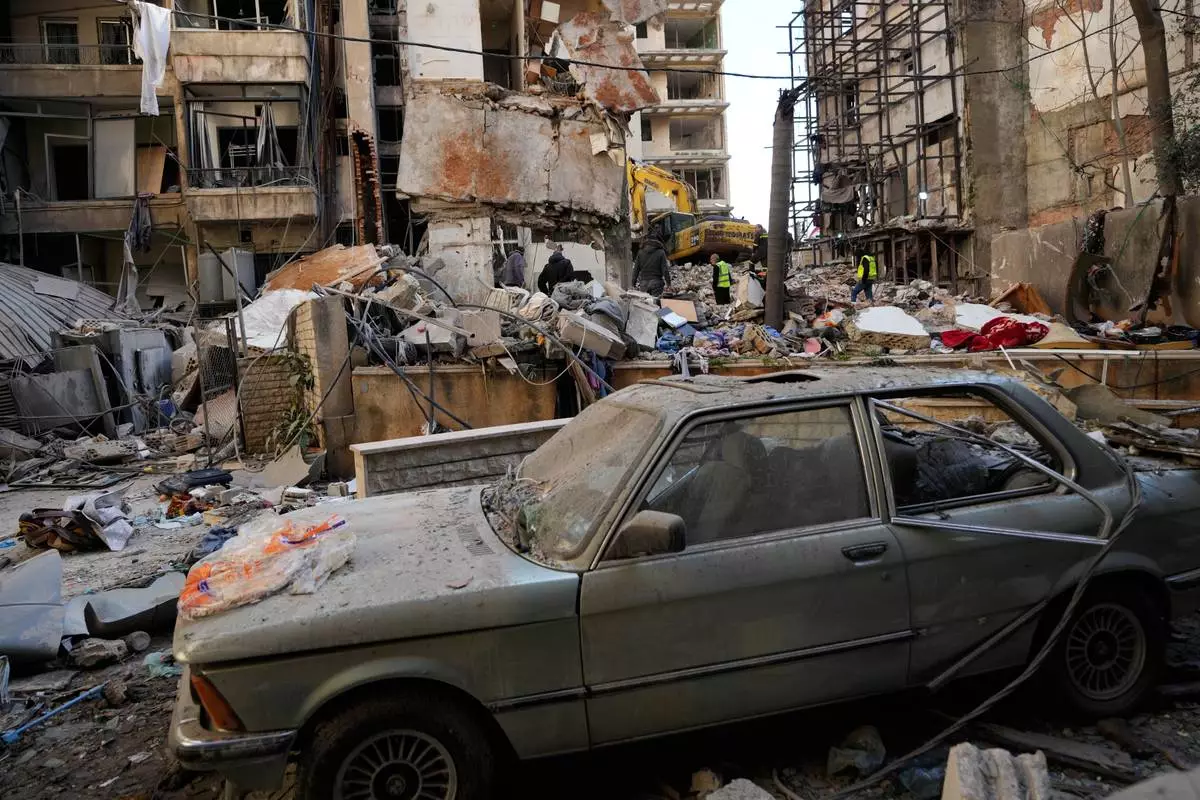
A damaged car is seen in an area as Lebanese civil defense workers search for victims in the rubble of a building destroyed in an Israeli airstrike a day earlier in central Beirut, Lebanon, Thursday, April 9, 2026. (AP Photo/Hussein Malla)
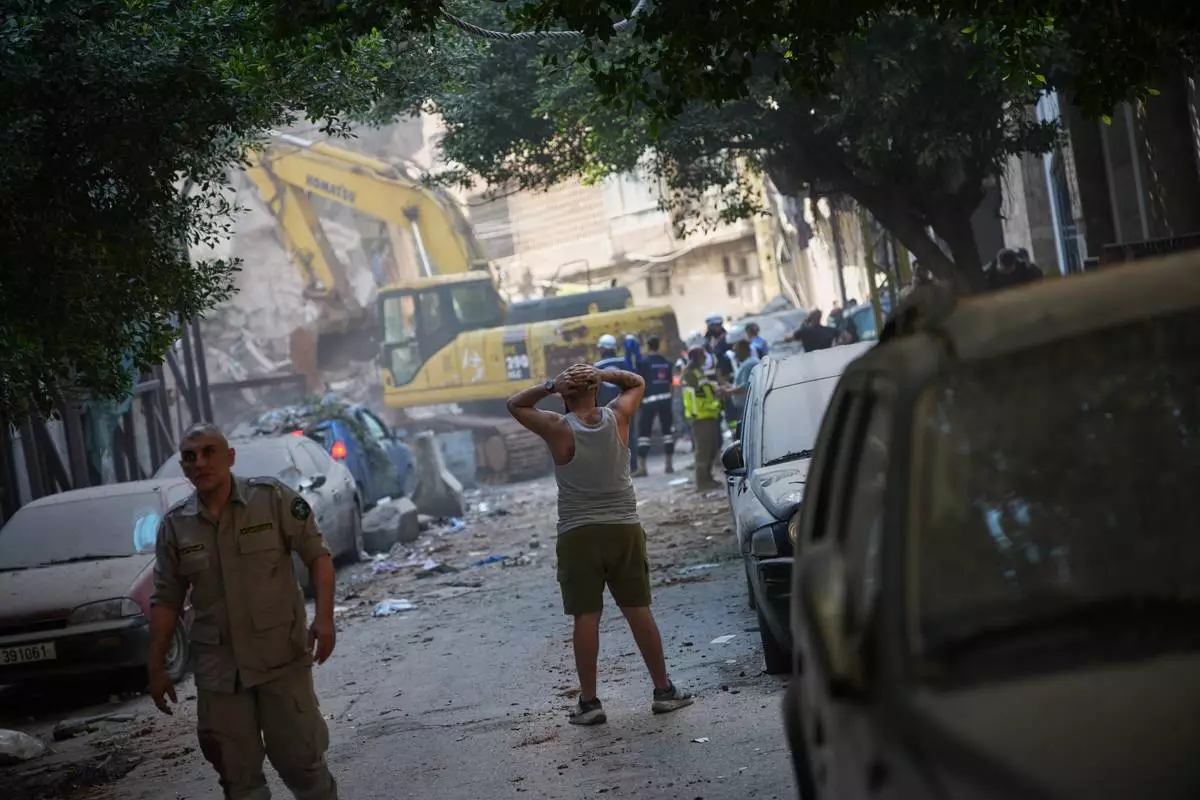
A man reacts as he watches an excavator remove debris at the site of an Israeli airstrike in Beirut, Lebanon, Wednesday, April 8, 2026. (AP Photo/Emilio Morenatti)
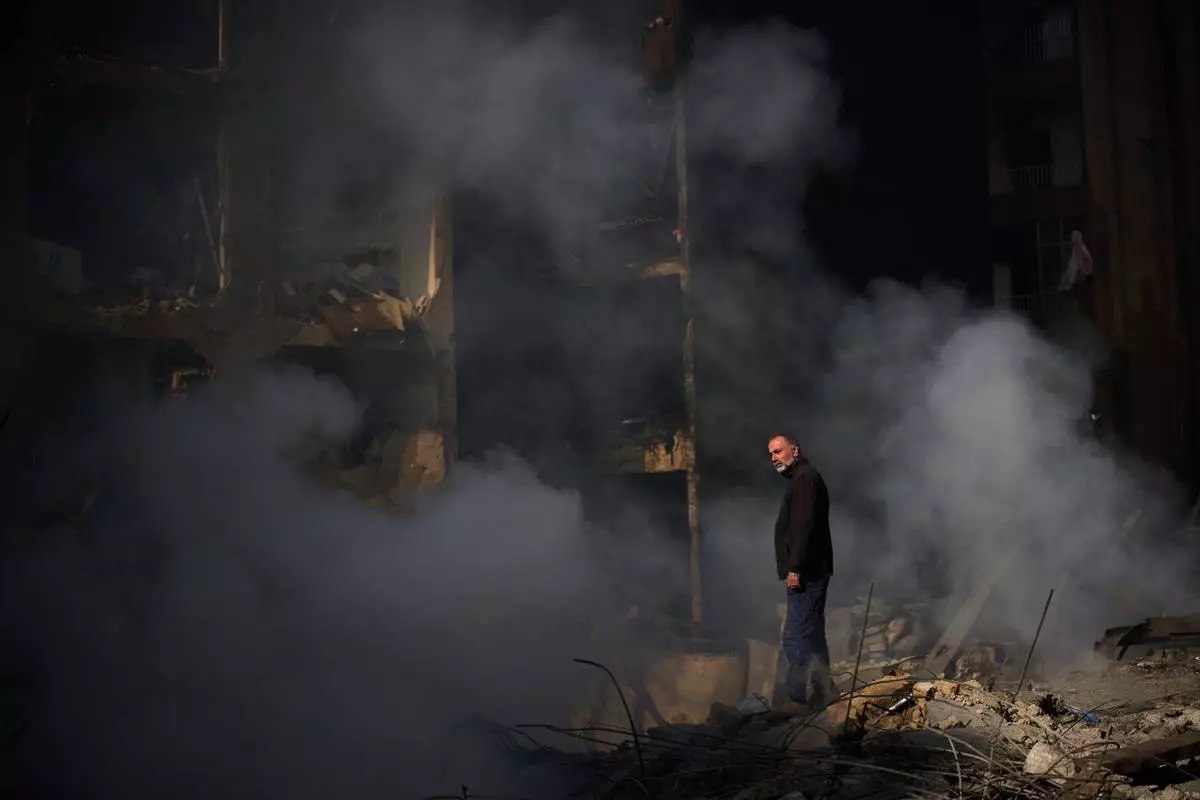
A man stands next to an apartment building destroyed in an Israeli airstrike a day earlier in Beirut, Lebanon, Thursday, April 9, 2026. (AP Photo/Emilio Morenatti)
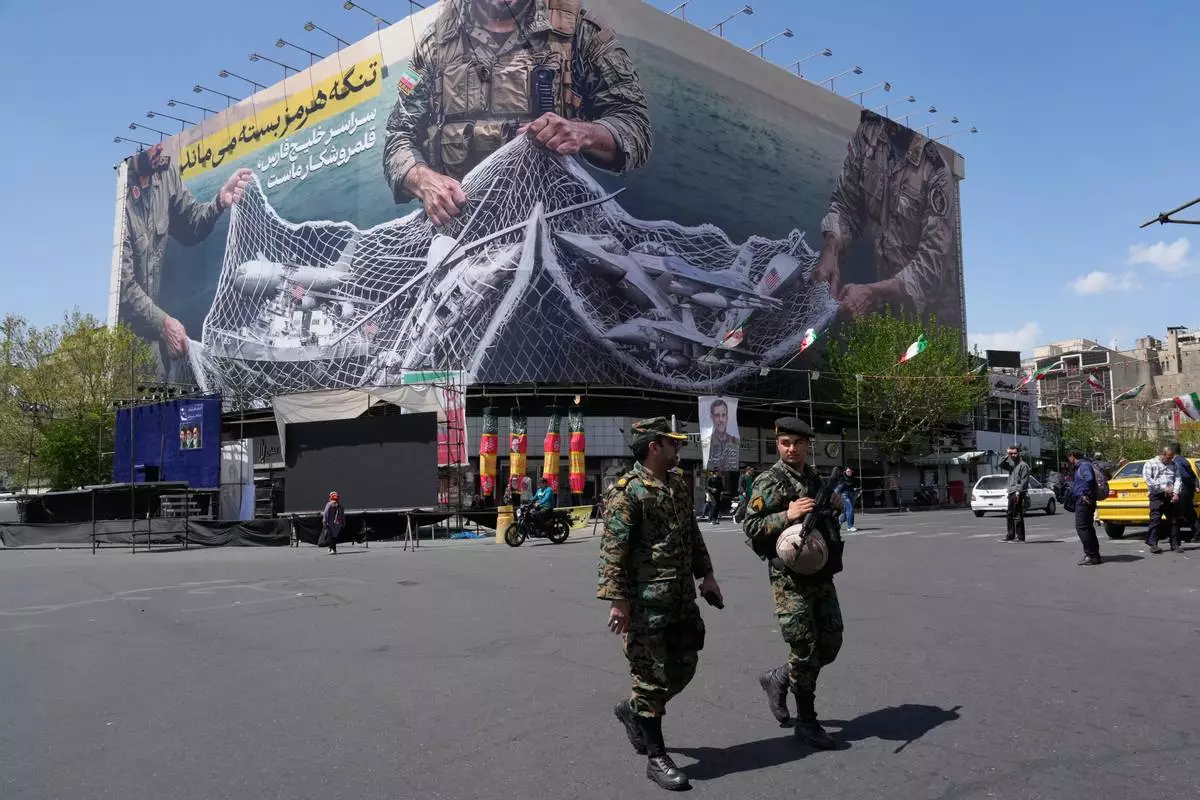
FILE - Two police officers walk in front of an anti-U.S. billboard depicting American aircraft being caught by Iranian armed forces in a fishing net beneath the words in Farsi, "The Strait of Hormuz will remain closed, The entire Persian Gulf is our hunting ground," in Tehran, Iran, Sunday, April 5, 2026. (AP Photo/Vahid Salemi, File)
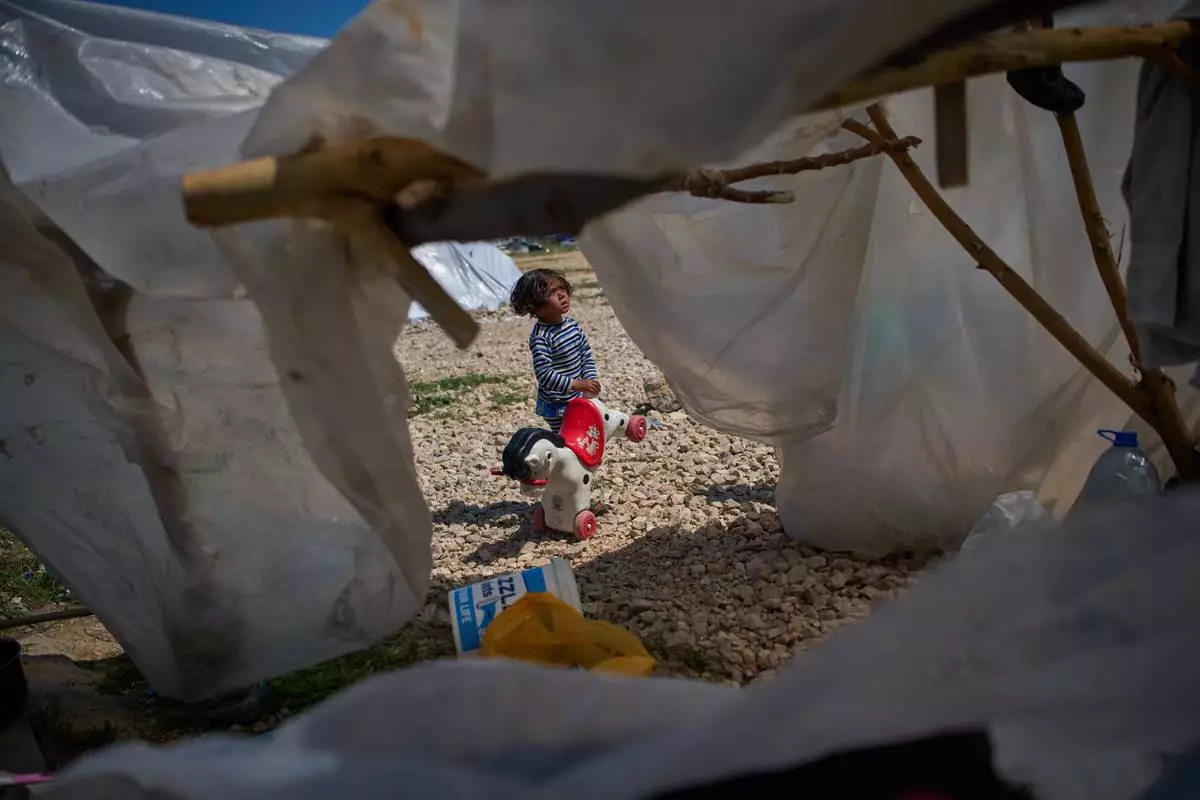
Ali, 4, holds a toy horse next to the tent his family uses as a shelter after fleeing Israeli bombardment in southern Lebanon, in Beirut, Lebanon, Wednesday, April 8, 2026. (AP Photo/Emilio Morenatti)
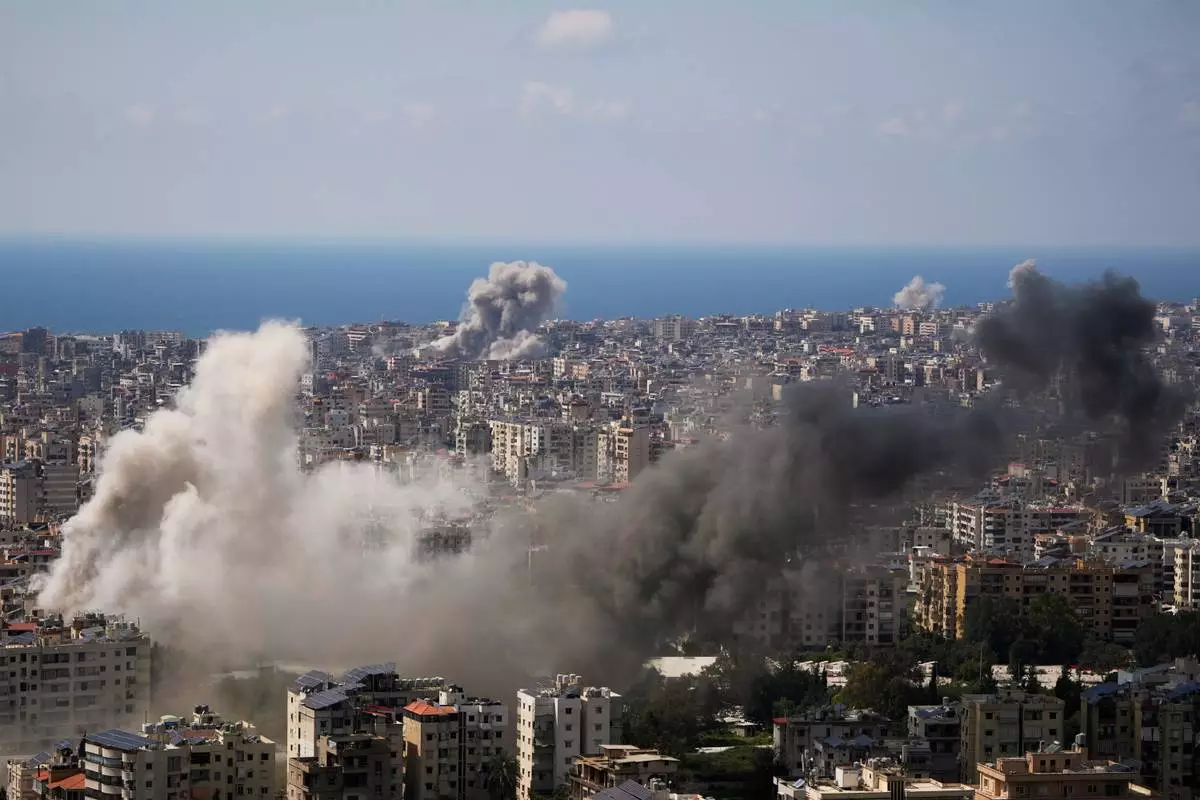
Smoke rises following several Israeli airstrikes in Beirut, Lebanon, Wednesday, April 8, 2026. (AP Photo/Hassan Ammar)
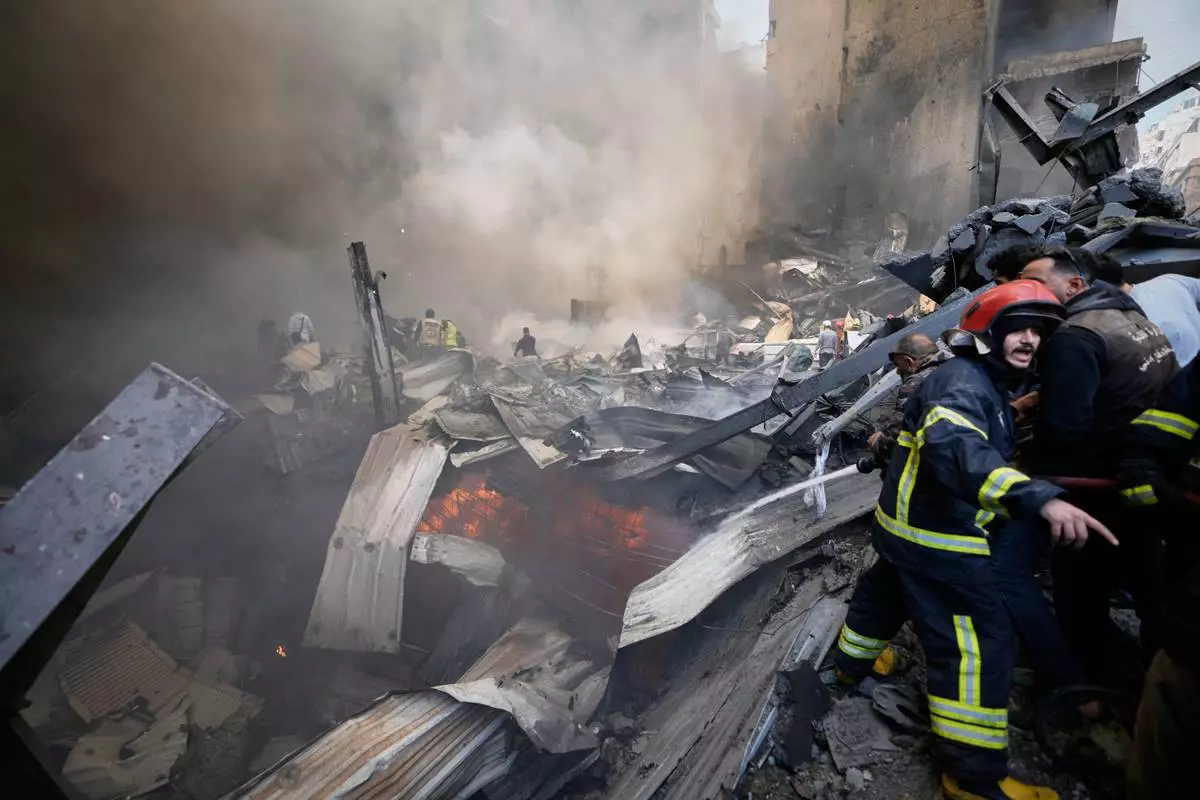
Firefighters, first responders, and volunteers work on smoldering debris at the site of an Israeli airstrike that struck an apartment building in Beirut, Lebanon, Wednesday, April 8, 2026. (AP Photo/Bilal Hussein)