Chinese internet giants such as Tencent and Didi are rolling out ambitious plans to bolster job creation and workforce resilience for this year's graduates and job seekers as the country focuses on stabilizing employment amid global uncertainties.
In April, Tencent unveiled what it describes as its largest campus recruitment campaign to date, aiming to provide 28,000 positions over the next three years.
"At Tencent, graduates have always been a key talent source -- and with the rapid rise of large models, fresh young minds are more important than ever to shape our future in this space," said Kenny Luo, head of Global Recruitment at Tencent.
Zhang Yating, a college junior and campus recruitment intern at Tencent, is brainstorming ways with her colleagues to attract young talent better.
"Tencent's online recruitment marketing is really effective. They constantly update across social media, so we can easily track which departments are hiring and how many positions are open," she said.
Official data shows that the number of college graduates in China is likely to reach 12.22 million in 2025, an increase of 430,000 from the previous year.
China's ride-hailing giant Didi has committed two billion yuan (about 277 million U.S. dollars) to expand job opportunities across the country.
"We're investing one billion yuan (about 139 million U.S. dollars) to boost driver subsidies, raise incomes, strengthen protections, and lower entry barriers. Another billion will be used to subsidize passengers, which in turn boosts driver income," said Yan Hui, head of Platform Driver Operation in China at Didi.
From April to May this year, Didi recruited over 770,000 new drivers nationwide.
"I used to run a cross-border e-commerce business, but capital turnover became an issue. Now with Didi, I get paid daily -- which helps with my cash flow," said Chen Fei, a new driver at Didi.
China's urban surveyed unemployment rate dropped to 5.1 percent in April, down 0.1 percentage point from March, marking a steady two-month decline, according to government data.

Chinese tech giants ramp up recruitment efforts for this year's graduates
From cutting-edge technology exhibitions to retail stores thousands of kilometers away from Europe and Southeast Asia, China-made robot vacuum cleaners are increasingly becoming a popular choice among consumers worldwide.
At electronics retailers in Berlin, Germany, Chinese brands such as Roborock and Dreame occupy prominent positions in dedicated robot vacuum sections, offering a wide range of products priced between 200 and 2,000 euros.
Many local consumers said that when purchasing smart home appliances including robot vacuum cleaners, they tend to give priority to Chinese-made products.
"It's a good price and good quality. It's also the innovation. I have a feeling that the European brands are not innovating enough," said one customer.
"I think they're always on top of the other technologies. They are getting them out faster. A lot of us are switching to the Chinese technology," another consumer said.
Germany is one of the most important overseas markets for China's floor-cleaning robots.
According to data from market research firm GfK, from January to November 2025, more than six out of 10 robot vacuum cleaners sold in Western Europe were Chinese brands.
Industry data also point to a strong global momentum.
According to the International Data Corporation (IDC), global shipments of smart robot vacuum cleaners reached 17.424 million units in the first three quarters of 2025, representing a year-on-year increase of 18.7 percent.
Chinese brands including Roborock, Ecovacs, Dreame, Xiaomi and Narwal ranked among the world's top five in terms of shipment volume, with a combined share of nearly 70 percent of the global market.
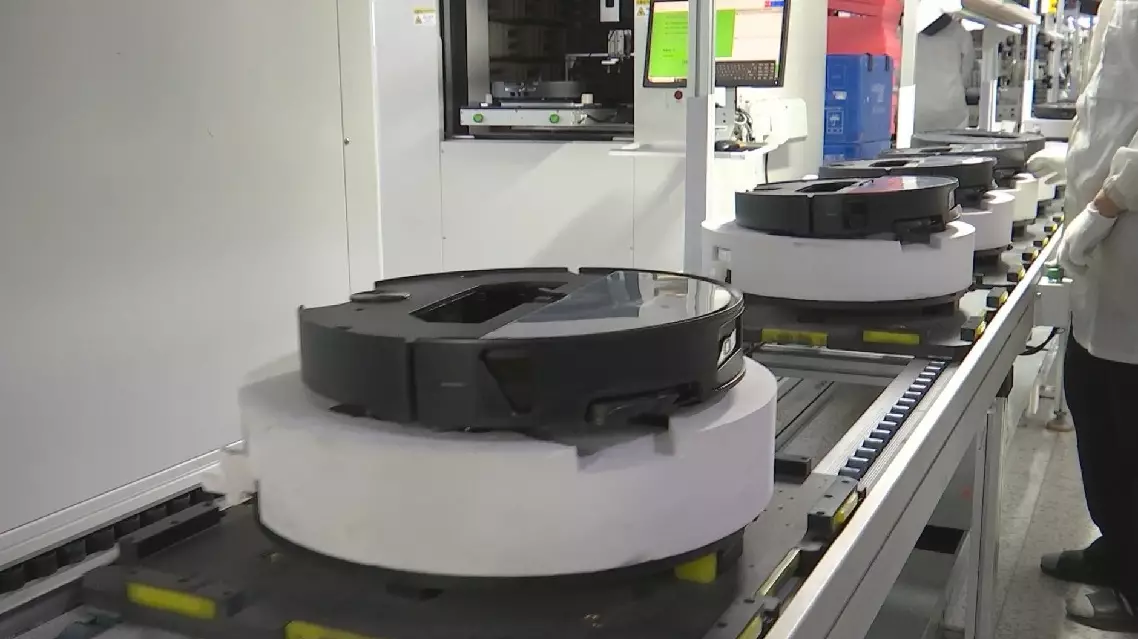
At a robot vacuum cleaner manufacturing plant in Huizhou, south China's Guangdong Province, workers were seen stepping up production of newly launched models that recently debuted at the Consumer Electronics Show in the United States, which concluded Friday in Las Vegas, Nevada.
The factory adjusted its production lines as early as December 2025 and stocked inventory in advance for overseas markets to ensure that new products could be delivered to global consumers at the earliest possible time.
"In 2025, Roborock's global shipments exceeded 7.2 million units. Since 2024, overseas revenue has accounted for more than 50 percent of our total revenue. Our products have now been sold to more than 170 countries and regions, serving more than 20 million households worldwide," said Quan Gang, president of Roborock.
At another robot vacuum cleaner manufacturing facility in Dongguan, Guangdong, rising overseas orders have prompted the company to upgrade its production lines with intelligent technologies to further boost capacity. The factory is currently operating at full load to meet a growing demand.
"For 2026, we have already obtained overseas orders worth at least 300 million to 400 million yuan (around 43 million to 57.3 million U.S. dollars). In addition, we've engaged in strategic cooperation with European home appliance group Cebos Group, and our total confirmed orders have exceeded 600 million yuan (around 86 million U.S. dollars)," said Zhang Junbin, founder and CEO of Narwal Robotics.
Chinese robot vacuum brands gain strong global traction