The China-Tajikistan Highway, now being upgraded by Chinese contractors, is cutting through the rugged Pamir Mountains, boosting trade and weaving new bonds between the two nations in one of Central Asia's most remote regions.
The road is the only direct route connecting Tajikistan's capital Dushanbe to the high-altitude Badakhshan region within the Pamir Mountains and onward to China via the Karakoram Highway.
China Road and Bridge Corporation (CRBC) is undertaking the project to upgrade the road and expects to complete construction in 2026. At its most complex section, Chinese engineers are excavating up to 67 meters vertically to widen the roadway.
"We've reached the most challenging point on the entire route, the K54+400 meters. We literally have to lower this entire mountain to achieve the roadbed widening we need," said Jiang Shulin, a CRBC project manager.
Despite the hardship, this road represents profound progress for the Tajik workers. Once a grueling 18-hour journey, key sections of the route now take just 10 hours -- a lifeline for communities long isolated by harsh terrain.
"Thanks to this road, travel time has already been cut by eight hours. This road has been broken for so many years. The Chinese came, and now it will be fixed. This is such a noble thing!" said Sadriddin Nilobekov, a construction worker.
The road also brings economic opportunities for China and Tajikistan, as villagers along the route report unprecedented easier access to goods.
"Without this road, it would take me four days to get things from Dushanbe. Yesterday, I just ordered, and it arrived today! These Chinese workers are my friends! My children, right from birth, will see such a good road," said Kishvarsho Kabirov, a villager.
Jiang, the project manager, has been working on overseeing construction for 12 years. He has seen accelerated volume of Chinese exports from daily necessities to electric cars.
"There's a remarkable surge in Chinese self-driving tourists, And a flood of Chinese goods, especially electric vehicles, now flows through daily, marking a significant shift in trade," said Jiang.
When completed next year, the upgraded highway will further cement China’s Belt and Road Initiative footprint in Tajikistan. The route serves as a critical overland corridor between western China and Central Asia's markets.
As night falls over the Pamirs, the highway remains alive with trucks navigating switchbacks -- a testament to how a single road is rewriting the region’s economic economy and human geography.
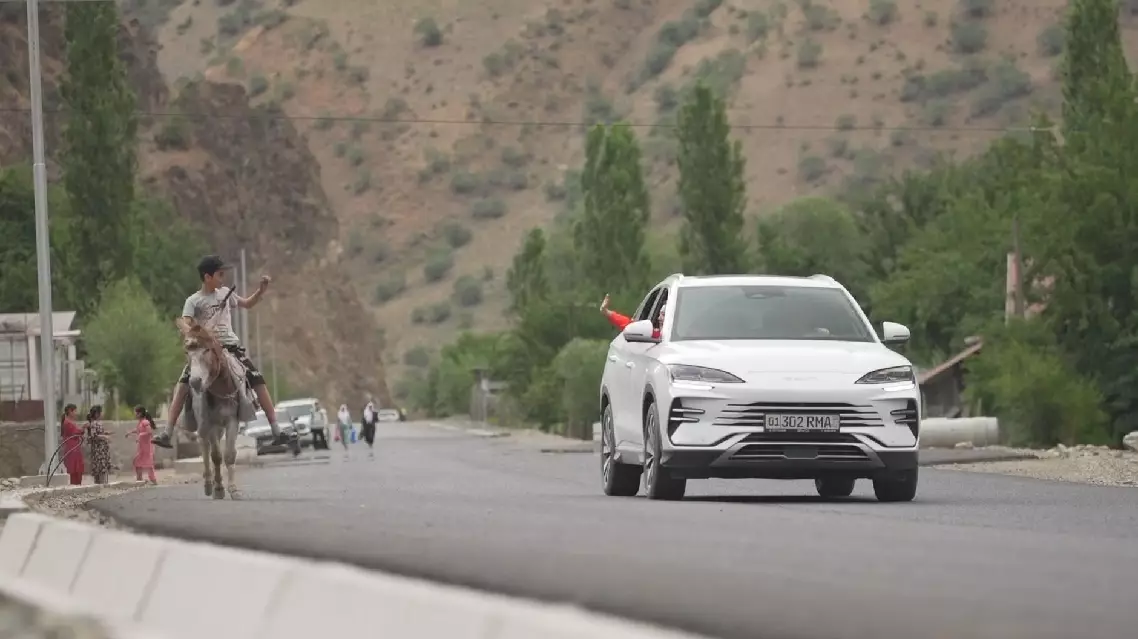
China-Tajikistan Highway under renovation transforms travel, trade in remote mountains