Skip to Content Facebook Feature Image

Lifelong Learning: UWG Begins Three-Year Partnership With The Birches on Maple

News

Lifelong Learning: UWG Begins Three-Year Partnership With The Birches on Maple
News

News

Lifelong Learning: UWG Begins Three-Year Partnership With The Birches on Maple

2025-06-07 00:10 Last Updated At:00:21

CARROLLTON, Ga.--(BUSINESS WIRE)--Jun 6, 2025--

At the University of West Georgia, collaboration and partnership are cornerstones of a thriving and engaged community. Through a new three-year agreement with The Birches on Maple, a 55+ living community developed in partnership with Tanner Health, UWG will offer residents meaningful cultural experiences, educational programming and new ways to engage with the institution.

This press release features multimedia. View the full release here: https://www.businesswire.com/news/home/20250606584880/en/

Designed to foster lifelong learning and creativity, the partnership includes an exciting calendar of annual activities for Birches residents and augments an already robust offering of engaging outings and experiences – curated by the community’s onsite Lifestyle Director and Activities Director. It also builds on Tanner’s Get Healthy, Live Well program, which provides a variety of classes and resources that strengthen the connection between healthy habits and personal well-being.

Each year, residents will have the opportunity to take part in a curated international trip centered on the arts and culture of a specific region. These trips, which are thoughtfully planned to be both fun and educational, are safe and all-inclusive. The inaugural adventure will take travelers to Italy to explore Italian history, art and culture through a variety of immersive experiences.

“Travel is a powerful way to spark curiosity, build community, and deepen our understanding of the world,” said Brandy Barker, UWG’s chief creative officer and assistant vice president for placemaking. “By connecting global experiences with UWG’s academic strengths, we’re creating something truly unique for residents of The Birches.”

In addition to global travel, the collaboration brings the best of UWG directly to The Birches. Over the course of each year, UWG will host six creative workshops and six lectures on-site, offering opportunities for residents to explore topics ranging from memoir-writing and history of Southern language to gardening, painting and archeology. These sessions will be led by UWG faculty, staff and experts in their respective fields.

“We’re thrilled about the partnership with UWG and what it means for our residents,” said Wayne Senfeld, executive vice president at Tanner Health. “We know that staying physically and mentally active is a vital aspect of overall well-being, and we’re excited for our seniors at The Birches on Maple to be able to engage in these special events and learning opportunities. They will undoubtedly provide them with another outlet for creativity, social interaction, education and — most importantly — fun.”

This relationship doesn’t end at The Birches. Residents will be hosted on campus throughout the year, including events overlooking RA-LIN Field in University Stadium during home UWG football games, reserved seating at home men’s and women’s basketball games and opportunities to attend campus lectures, holiday events and more.

Adding to the beauty and inspiration of the community, each year will also see the installation of two new public art pieces at The Birches, developed in collaboration with UWG.

“The relationship between Tanner and the University of West Georgia is so important,” said Loy Howard, president and CEO of Tanner Health. “We work together in countless ways to give back to and support the local community – and what we’re doing at The Birches is no different. This partnership will enrich the lives of these residents, allowing them to make the most of this next phase of their lives, and will help to create a stronger, healthier community for all.”

As UWG continues to expand its commitment to placemaking and community engagement, partnerships like this one with The Birches on Maple demonstrate how higher education can play a role in enhancing quality of life for people of all ages.

“At the heart of this partnership is a belief in the power of experiences to inspire discovery and connection,” said Dr. Ashwani Monga, UWG’s interim president. “By bringing the university’s academic offerings and experiential learning activities into the daily lives of The Birches residents, we’re creating opportunities for lifelong learning for members of the Carrollton community.”
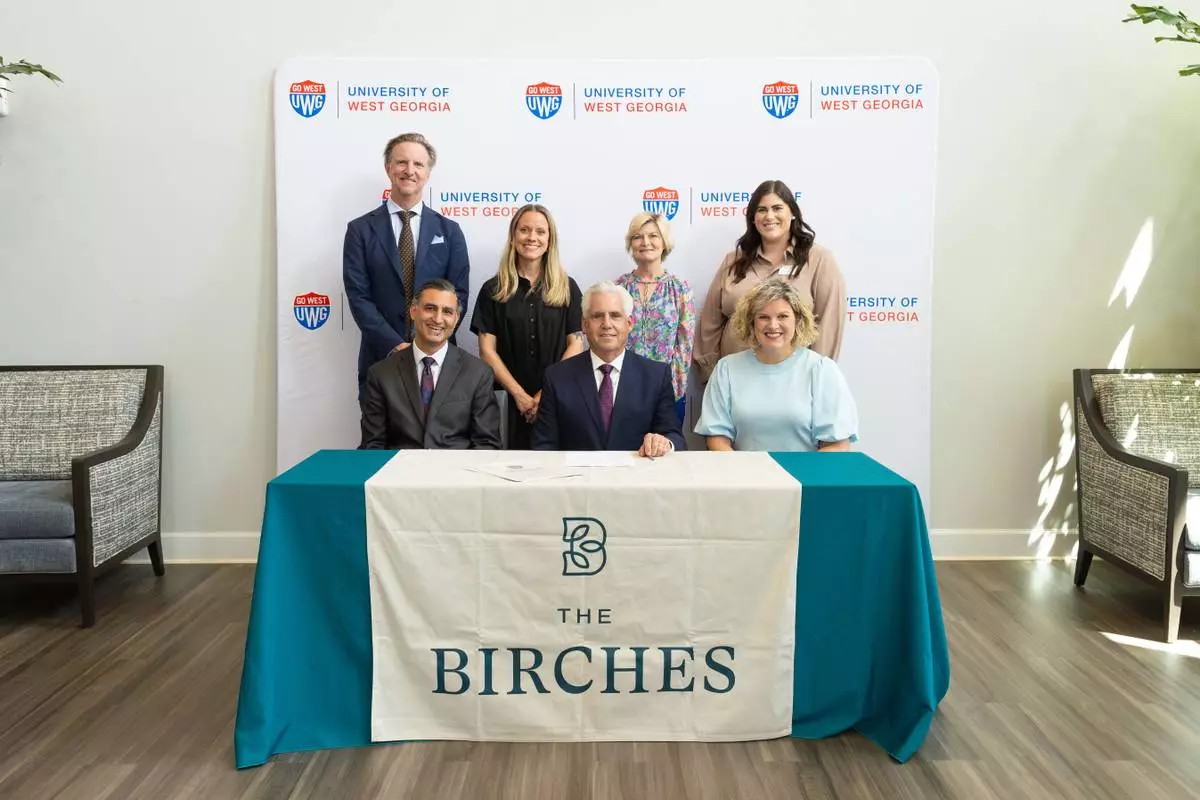
Front row, left to right: Dr. Ashwani Monga, interim president, UWG; Wayne Senfeld, executive vice president, Tanner Health; Allyson Bretch, vice president for university advancement and CEO of the university’s philanthropic foundations, UWG. Back row, left to right: Chad Davidson, executive director of global engagements and cultural programming, UWG; Brandy Barker, chief creative officer and assistant vice president for placemaking, UWG; Jillian Walker, lifestyle director, The Birches on Maple; Savannah Lively, executive director, the Birches on Maple

Front row, left to right: Dr. Ashwani Monga, interim president, UWG; Wayne Senfeld, executive vice president, Tanner Health; Allyson Bretch, vice president for university advancement and CEO of the university’s philanthropic foundations, UWG. Back row, left to right: Chad Davidson, executive director of global engagements and cultural programming, UWG; Brandy Barker, chief creative officer and assistant vice president for placemaking, UWG; Jillian Walker, lifestyle director, The Birches on Maple; Savannah Lively, executive director, the Birches on Maple

CARACAS, Venezuela (AP) — Venezuela’s government accused the United States of attacking civilian and military installations in multiple states after at least seven explosions and low-flying aircraft were heard around 2 a.m. local time Saturday in the capital, Caracas.

The Pentagon and White House did not immediately respond to requests for comment.

Smoke could be seen rising from the hangar of a military base in Caracas. Another military installation in the capital was without power.

People in various neighborhoods rushed to the streets. Some could be seen in the distance from various areas of Caracas.

“The whole ground shook. This is horrible. We heard explosions and planes,” said Carmen Hidalgo, a 21-year-old office worker, her voice trembling. She was walking briskly with two relatives, returning from a birthday party. “We felt like the air was hitting us.”

Venezuela’s government, in the statement, called on its supporters to take to the streets.

“People to the streets!” the statement said. “The Bolivarian Government calls on all social and political forces in the country to activate mobilization plans and repudiate this imperialist attack.”

The statement added that President Nicolás Maduro had “ordered all national defense plans to be implemented” and declared “a state of external disturbance.”

This comes as the U.S. military has been targeting, in recent days, alleged drug-smuggling boats. On Friday, Venezuela said it was open to negotiating an agreement with the U.S. to combat drug trafficking.

Maduro also said in a pretaped interview aired Thursday that the U.S. wants to force a government change in Venezuela and gain access to its vast oil reserves through the monthslong pressure campaign that began with a massive military deployment to the Caribbean Sea in August.

Maduro has been charged with narco-terrorism in the U.S. The CIA was behind a drone strike last week at a docking area believed to have been used by Venezuelan drug cartels in what was the first known direct operation on Venezuelan soil since the U.S. began strikes on boats in September.

U.S. President Donald Trump for months had threatened that he could soon order strikes on targets on Venezuelan land. The U.S. has also seized sanctioned oil tankers off the coast of Venezuela, and Trump ordered a blockade of others in a move that seemed designed to put a tighter chokehold on the South American country’s economy.

The U.S. military has been attacking boats in the Caribbean Sea and the eastern Pacific Ocean since early September. As of Friday, the number of known boat strikes is 35 and the number of people killed is at least 115, according to numbers announced by the Trump administration.

They followed a major buildup of American forces in the waters off South America, including the arrival in November of the nation’s most advanced aircraft carrier, which added thousands more troops to what was already the largest military presence in the region in generations.

Trump has justified the boat strikes as a necessary escalation to stem the flow of drugs into the U.S. and asserted that the U.S. is engaged in an “armed conflict” with drug cartels.

Meanwhile, Iranian state television reported on the explosions in Caracas on Saturday, showing images of the Venezuelan capital. Iran has been close to Venezuela for years, in part due to their shared enmity of the U.S.

Pedestrians walk past the Miraflores presidential palace after explosions and low-flying aircraft were heard in Caracas, Venezuela, Saturday, Jan. 3, 2026. (AP Photo/Cristian Hernandez)

Pedestrians walk past the Miraflores presidential palace after explosions and low-flying aircraft were heard in Caracas, Venezuela, Saturday, Jan. 3, 2026. (AP Photo/Cristian Hernandez)

Residents evacuate a building near the Miraflores presidential palace after explosions and low-flying aircraft were heard in Caracas, Venezuela, Saturday, Jan. 3, 2026. (AP Photo/Cristian Hernandez)

Residents evacuate a building near the Miraflores presidential palace after explosions and low-flying aircraft were heard in Caracas, Venezuela, Saturday, Jan. 3, 2026. (AP Photo/Cristian Hernandez)

Smoke raises at La Carlota airport after explosions and low-flying aircraft were heard in Caracas, Venezuela, Saturday, Jan. 3, 2026. (AP Photo/Matias Delacroix)

Smoke raises at La Carlota airport after explosions and low-flying aircraft were heard in Caracas, Venezuela, Saturday, Jan. 3, 2026. (AP Photo/Matias Delacroix)

Pedestrians run after explosions and low-flying aircraft were heard in Caracas, Venezuela, Saturday, Jan. 3, 2026. (AP Photo/Matias Delacroix)

Pedestrians run after explosions and low-flying aircraft were heard in Caracas, Venezuela, Saturday, Jan. 3, 2026. (AP Photo/Matias Delacroix)

Smoke raises at La Carlota airport after explosions and low-flying aircraft were heard in Caracas, Venezuela, Saturday, Jan. 3, 2026. (AP Photo/Matias Delacroix)

Smoke raises at La Carlota airport after explosions and low-flying aircraft were heard in Caracas, Venezuela, Saturday, Jan. 3, 2026. (AP Photo/Matias Delacroix)

Smoke raises at La Carlota airport after explosions and low-flying aircraft were heard in Caracas, Venezuela, Saturday, Jan. 3, 2026. (AP Photo/Matias Delacroix)

Smoke raises at La Carlota airport after explosions and low-flying aircraft were heard in Caracas, Venezuela, Saturday, Jan. 3, 2026. (AP Photo/Matias Delacroix)

Pedestrians run after explosions and low-flying aircraft were heard in Caracas, Venezuela, Saturday, Jan. 3, 2026. (AP Photo/Matias Delacroix)

Pedestrians run after explosions and low-flying aircraft were heard in Caracas, Venezuela, Saturday, Jan. 3, 2026. (AP Photo/Matias Delacroix)

Recommended Articles