CAMPBELL, Calif., June 11, 2025 /PRNewswire/ -- WEKA, the AI-native data platform company, and Nebius (NASDAQ: NBIS), a leading AI infrastructure company, today announced a partnership that delivers a powerful GPU-as-a-Service (GPUaaS) solution integrating WEKA's advanced data storage software with Nebius' full-stack AI cloud platform. The collaboration enables customers to scale compute and storage resources on demand with ultra-high performance and microsecond latency for efficient AI model training and precision AI inference.
Organizations that run AI model training and inference processes at scale often face challenges related to compute, memory, storage, and data management, which can impede innovation. As demand for modern AI infrastructure grows, organizations are embracing specialized neoclouds for access to turnkey infrastructure that can power their AI ambitions. In turn, neoclouds are seeking innovative ways to optimize the performance and efficiency of their GPU data center infrastructure.
Nebius AI Cloud delivers a cutting-edge, cost-optimized neocloud environment that empowers innovators of all sizes — from enterprises to startups to research institutions — to operationalize AI workloads. To fuel the premium tier of its next-generation platform, Nebius selected WEKA's high-performance storage software to turbocharge its AI Cloud performance while effortlessly scaling from petabytes to exabytes of data.
A leading research institution selected Nebius' purpose-built AI infrastructure to power its large-scale experimentation and model development efforts, reserving a multi-thousand-GPU cluster and leaning on Nebius AI Cloud's developer-friendly platform optimized for AI/ML workloads.
To further tailor the environment to its exacting operational needs, the customer requested the integration of WEKA's data platform, citing previous success with WEKA and the need for features such as user and directory quotas. With 2PB of WEKA storage deployed alongside Nebius' compute infrastructure, the institution now benefits from a high-performance, scalable, and fully managed platform that supports the rigorous demands of cutting-edge AI research.
"WEKA exceeded every expectation and requirement we had," said Danila Shtan, CTO at Nebius. "The WEKA solution not only delivers outstanding throughput, IOPS, and low latency at scale while effortlessly managing mixed read and write workloads, but it also provides exceptional metadata management and streamlined multitenancy."
"We are proud to be collaborating with Nebius to deliver high-performance, cloud-based solutions that maximize their AI innovation while minimizing infrastructure complexity," said Liran Zvibel, cofounder and CEO at WEKA. "Together, Nebius and WEKA are redefining what's possible when high-performance storage meets AI-first infrastructure, providing a unified solution that is a catalyst for enterprise AI and agentic AI innovation."
Learn more about the Nebius AI Cloud solution powered by WEKA: https://www.weka.io/customers/nebius/.
About Nebius
Nebius is a technology company building full-stack infrastructure to service the explosive growth of the global AI industry, including large-scale GPU clusters, an AI-native cloud platform, and tools and services for developers. Headquartered in Amsterdam and listed on Nasdaq, the Company has a global footprint with R&D hubs across Europe, North America and Israel.
â€The Nebius AI Cloud platform has been built from the ground up for intensive AI workloads. With proprietary cloud software architecture and hardware designed in-house, Nebius gives AI builders the compute, storage, managed services and tools they need to build, tune and run their models.
To learn more, visit www.nebius.com
About WEKA
WEKA is architecting a new approach to the enterprise data stack built for the era of agentic AI. The WEKA® Data Platform sets the standard for AI infrastructure, providing a cloud and AI-native foundation for enterprise AI that can be deployed anywhere with seamless data portability across on-premises, cloud, and edge environments. It transforms legacy data silos into dynamic data pipelines that dramatically increase GPU utilization and make AI model training, inference, and HPC workloads run faster and more efficiently, delivering microsecond latency performance at scale. WEKA is helping the world's most innovative enterprises and research organizations to accelerate time to market, discovery, and insights with AI, including 12 of the Fortune 50. Visit www.weka.io to learn more, or connect with WEKA on LinkedIn and X.
WEKA and the WEKA logo are registered trademarks of WekaIO, Inc. Other trade names used herein may be trademarks of their respective owners.
** The press release content is from PR Newswire. Bastille Post is not involved in its creation. **
WEKA and Nebius Partner to Catalyze AI Innovation With Ultra-High-Performance Cloud Infrastructure Solution
WEKA and Nebius Partner to Catalyze AI Innovation With Ultra-High-Performance Cloud Infrastructure Solution
|
SHENZHEN, China, Dec. 19, 2025 /PRNewswire/ --
"Technology is not just a tool. It becomes part of our lives."
This is the line in Her, a film about a future where technology feels less like a machine and more like an extension of human emotion. And in many ways, the future that once lived in imagination is no longer fiction. We're living in a moment where tools that used to feel distant, cold, or intimidating are quietly becoming warmer, simpler, and more integrated into daily routines.
Not long ago, 3D printers were exactly the opposite: complex, technical devices reserved for experts and makers. But today, the whole landscape is shifting rapidly. The gap between complicated technology and ordinary life is narrowing. Creation no longer requires expertise, it simply needs a spark of curiosity.
The Spark that makes Spark X exist
Not just for makers or experts, Spark X stands for moving faster, focusing on simplicity, and reliability that makes creation effortless.
Why make users learn 3D printing when the product itself can handle complexity? By rethinking the 3D printing experience around immediate usability, Spark X makes it possible for anyone to move from idea to creation without being held back by technical barriers or steep learning curves.
Our perspective on this opportunity comes from thousands of conversations over the years of building with our users. Spending countless hours across all social platforms, seeing how people learn, struggle, and celebrate their first successes, has shaped our understanding of what truly matters most to 3D printer users. It became clear to us to find the path of 3D printing: Ready-to-use.
Ready to Use: The Principle Behind Every Spark X Decision
True "ready-to-use" experience comes from understanding exactly where beginners struggle. Every potential sticking point, from unboxing to the first print, is anticipated. Complex calibration, repeated tests, and confusing setup are removed, letting users focus on creation immediately. Intelligent algorithms reduce multi-color waste by 50%, so beginners can experiment freely without worrying about materials, while experienced users retain advanced options for precision and control.
AI acts as a creative partner, taking over tasks that once required experience. It searches globally for models, generates 3D designs from text or images, monitors prints in real time, and intervenes automatically when issues arise. Frequent updates integrate the latest AI capabilities, ensuring the printer grows smarter over time and every print remains reliable and inspiring.
The hotend is one of the most frequently handled parts of a desktop printer, but traditional replacements are risky and intimidating. Users often need to swap nozzles for wear, material changes, performance needs, or troubleshooting—but conventional designs involve heated disassembly, screws, wires, thermal paste, and fragile parts. Many users avoid it entirely, limiting flexibility and efficiency.
Spark X's quick-change hotend was shaped through eight full design cycles and a complete structural rethink. Early prototypes still relied on threaded retention and partial wiring, which solved speed but not reliability. Later versions explored magnetic coupling, multi-point latches, anti-rotation keys, and finally a floating alignment system capable of repeatedly positioning within 0.05mm. Each iteration exposed new failure modes—from thermal creep affecting connectors, to repeated insertion loosening tolerances, to material expansion shifting alignment. By the final rounds, the team rebuilt the module from the inside out: relocating stress points, isolating heat, reinforcing the datum surfaces, and designing a locking motion that is intuitive yet mechanically robust.
The result is a mechanism that lets users replace a nozzle in three seconds—no tools, no wires, hot-swap supported up to 220°C, and over 500 verified insertion cycles. Maintenance becomes instinctive rather than technical, allowing anyone to change materials freely, recover from issues quickly, and treat the printer like a dependable tool instead of a fragile device.
Every design choice in Spark X, from effortless onboarding to AI-assisted printing to intuitive maintenance, removes barriers between curiosity and creation, setting the stage for the story of how Spark X truly began.
Minds Behind Spark X, Where the Idea Truly Began
Spark X didn't begin with a single breakthrough or a moment of sudden clarity. It began with a small team that kept returning to the same question:
"Why is 3D printing still hard for so many people? Why can't the product itself solve the problems, so users can focus directly on ideas?"
Inside the Spark X team, discussions often started from personal stories. The biggest inspiration came from my own family and friends.
I love printing small gifts for loved ones, keychains, tiny avatars, and custom tools. Every time we met, they would look at those prints with curiosity and say, "I really want to try this too. Which printer should I get? And every time, the hesitation arises. Because I knew what recommending a "beginner-friendly" printer really meant: a complicated unboxing, learning slicer software, material differences, parameter setting, and even further troubleshooting. Inevitably, I will be their "free tech support," guiding them through every step. So after a moment of silence, I usually ended up saying, "Maybe… consider another hobby?"
Yet Spark X was shaped not only by frustrations, but by a few moments that made us feel what a truly effortless 3D printing experience could be. One of the earliest and clearest moments came from the quick-swap hotend. The first time we removed the entire nozzle module in just a few seconds during an internal demo, the room went completely still before anyone reacted. The operation was so simple, so unexpectedly natural, that even our own engineers were momentarily confused, "Wait… It's already done?" That brief silence told us something important: when a task that used to be intimidating finishes in a snap, creativity becomes possible for far more people. It was the first time we felt how deeply meaningful "effortless" could be.
Another defining moment came when someone went from an idea to a finished print using only the mobile app. Seeing a user generate a design with AI, send it to print, and hold the object in their hand without touching a computer, configuring parameters, or learning a slicer, made the entire team pause. It was a glimpse into a world where creativity truly starts with curiosity, not technical knowledge. That moment became one of the emotional anchors of Spark X: lowering the barrier not by teaching more.
Other moments left their marks in quieter ways. Like watching the machine run steadily during long prints in extreme temperatures, giving us confidence that reliability could be something users feel rather than think about. Or the day a simple ambient glow light transformed the printer from a cold tool into something warm and welcoming, reminding us that people don't just interact with machines; they live with them, create beside them, and often find comfort in the process itself.
These moments shaped our belief that 3D printing should never demand courage or expertise. Spark X was built on a different idea: Technology removes friction and respects the user's feelings, and creativity becomes a natural part of life.
Spark X continues to evolve, combining user-centred design, AI-assisted printing, and effortless maintenance. Our goal is to make 3D creation universally accessible, reliable, and inspiring, so anyone can turn curiosity into creation, today and in the future.
About Spark X:
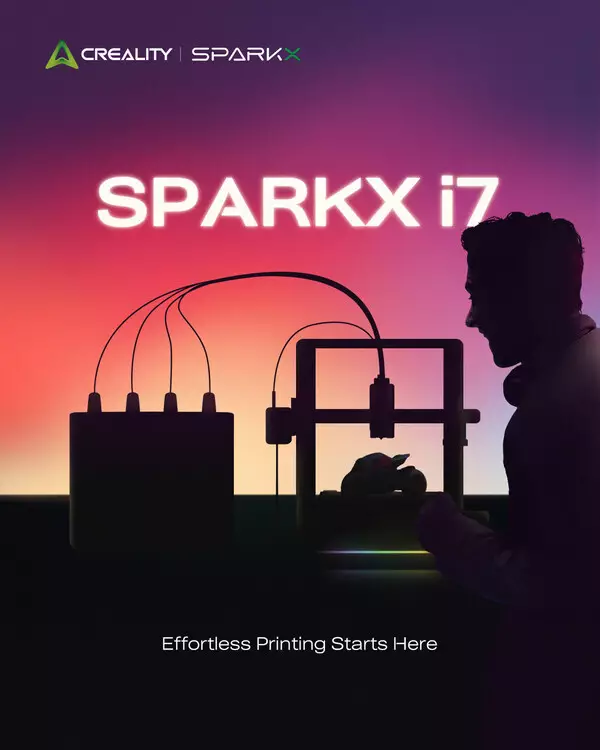
SPARKX is a new 3D printing brand born from Creality's technical legacy, but engineered for a new generation. We've moved beyond intimidating, overly technical machines to create a product you can unbox and start using right away—one that looks cool on your desk and becomes genuinely addictive to play with.
Why did we create this? Because we noticed many young people are actually curious about 3D printing, but are held back by the same thoughts: "It's too hard to use", "It looks out of place on my desk", "I'm just not sure what to do with it." So we decided to start something new.
With AI that turns selfies into 3D models with one tap, RGB ambient lighting that elevates your desk vibe, and an ultra-simple process that gets you printing in just a few clicks. We wanted to turn the 3D printer into something you're proud to keep on your desk, something you don't want to turn off, something that makes your friends say, "Wow."
That vision could only come to life by truly listening — So we did. We started with a simple mission: build what users actually asked for. We listened to the hopes of experienced creators and the pain points of newcomers. We validated them through rigorous research with thousands of users. Then, we built the SPARKX i7 to bridge that gap. Every feature, from its whisper-quiet operation to its AI-assisted setup, responds directly to your voice. This is 3D printing, redefined by users.
SHENZHEN, China, Dec. 19, 2025 /PRNewswire/ --
"Technology is not just a tool. It becomes part of our lives."
This is the line in Her, a film about a future where technology feels less like a machine and more like an extension of human emotion. And in many ways, the future that once lived in imagination is no longer fiction. We're living in a moment where tools that used to feel distant, cold, or intimidating are quietly becoming warmer, simpler, and more integrated into daily routines.
Not long ago, 3D printers were exactly the opposite: complex, technical devices reserved for experts and makers. But today, the whole landscape is shifting rapidly. The gap between complicated technology and ordinary life is narrowing. Creation no longer requires expertise, it simply needs a spark of curiosity.
The Spark that makes Spark X exist
Not just for makers or experts, Spark X stands for moving faster, focusing on simplicity, and reliability that makes creation effortless.
Why make users learn 3D printing when the product itself can handle complexity? By rethinking the 3D printing experience around immediate usability, Spark X makes it possible for anyone to move from idea to creation without being held back by technical barriers or steep learning curves.
Our perspective on this opportunity comes from thousands of conversations over the years of building with our users. Spending countless hours across all social platforms, seeing how people learn, struggle, and celebrate their first successes, has shaped our understanding of what truly matters most to 3D printer users. It became clear to us to find the path of 3D printing: Ready-to-use.
Ready to Use: The Principle Behind Every Spark X Decision
True "ready-to-use" experience comes from understanding exactly where beginners struggle. Every potential sticking point, from unboxing to the first print, is anticipated. Complex calibration, repeated tests, and confusing setup are removed, letting users focus on creation immediately. Intelligent algorithms reduce multi-color waste by 50%, so beginners can experiment freely without worrying about materials, while experienced users retain advanced options for precision and control.
AI acts as a creative partner, taking over tasks that once required experience. It searches globally for models, generates 3D designs from text or images, monitors prints in real time, and intervenes automatically when issues arise. Frequent updates integrate the latest AI capabilities, ensuring the printer grows smarter over time and every print remains reliable and inspiring.
The hotend is one of the most frequently handled parts of a desktop printer, but traditional replacements are risky and intimidating. Users often need to swap nozzles for wear, material changes, performance needs, or troubleshooting—but conventional designs involve heated disassembly, screws, wires, thermal paste, and fragile parts. Many users avoid it entirely, limiting flexibility and efficiency.
Spark X's quick-change hotend was shaped through eight full design cycles and a complete structural rethink. Early prototypes still relied on threaded retention and partial wiring, which solved speed but not reliability. Later versions explored magnetic coupling, multi-point latches, anti-rotation keys, and finally a floating alignment system capable of repeatedly positioning within 0.05mm. Each iteration exposed new failure modes—from thermal creep affecting connectors, to repeated insertion loosening tolerances, to material expansion shifting alignment. By the final rounds, the team rebuilt the module from the inside out: relocating stress points, isolating heat, reinforcing the datum surfaces, and designing a locking motion that is intuitive yet mechanically robust.
The result is a mechanism that lets users replace a nozzle in three seconds—no tools, no wires, hot-swap supported up to 220°C, and over 500 verified insertion cycles. Maintenance becomes instinctive rather than technical, allowing anyone to change materials freely, recover from issues quickly, and treat the printer like a dependable tool instead of a fragile device.
Every design choice in Spark X, from effortless onboarding to AI-assisted printing to intuitive maintenance, removes barriers between curiosity and creation, setting the stage for the story of how Spark X truly began.
Minds Behind Spark X, Where the Idea Truly Began
Spark X didn't begin with a single breakthrough or a moment of sudden clarity. It began with a small team that kept returning to the same question:
"Why is 3D printing still hard for so many people? Why can't the product itself solve the problems, so users can focus directly on ideas?"
Inside the Spark X team, discussions often started from personal stories. The biggest inspiration came from my own family and friends.
I love printing small gifts for loved ones, keychains, tiny avatars, and custom tools. Every time we met, they would look at those prints with curiosity and say, "I really want to try this too. Which printer should I get? And every time, the hesitation arises. Because I knew what recommending a "beginner-friendly" printer really meant: a complicated unboxing, learning slicer software, material differences, parameter setting, and even further troubleshooting. Inevitably, I will be their "free tech support," guiding them through every step. So after a moment of silence, I usually ended up saying, "Maybe… consider another hobby?"
Yet Spark X was shaped not only by frustrations, but by a few moments that made us feel what a truly effortless 3D printing experience could be. One of the earliest and clearest moments came from the quick-swap hotend. The first time we removed the entire nozzle module in just a few seconds during an internal demo, the room went completely still before anyone reacted. The operation was so simple, so unexpectedly natural, that even our own engineers were momentarily confused, "Wait… It's already done?" That brief silence told us something important: when a task that used to be intimidating finishes in a snap, creativity becomes possible for far more people. It was the first time we felt how deeply meaningful "effortless" could be.
Another defining moment came when someone went from an idea to a finished print using only the mobile app. Seeing a user generate a design with AI, send it to print, and hold the object in their hand without touching a computer, configuring parameters, or learning a slicer, made the entire team pause. It was a glimpse into a world where creativity truly starts with curiosity, not technical knowledge. That moment became one of the emotional anchors of Spark X: lowering the barrier not by teaching more.
Other moments left their marks in quieter ways. Like watching the machine run steadily during long prints in extreme temperatures, giving us confidence that reliability could be something users feel rather than think about. Or the day a simple ambient glow light transformed the printer from a cold tool into something warm and welcoming, reminding us that people don't just interact with machines; they live with them, create beside them, and often find comfort in the process itself.
These moments shaped our belief that 3D printing should never demand courage or expertise. Spark X was built on a different idea: Technology removes friction and respects the user's feelings, and creativity becomes a natural part of life.
Spark X continues to evolve, combining user-centred design, AI-assisted printing, and effortless maintenance. Our goal is to make 3D creation universally accessible, reliable, and inspiring, so anyone can turn curiosity into creation, today and in the future.
About Spark X:
SPARKX is a new 3D printing brand born from Creality's technical legacy, but engineered for a new generation. We've moved beyond intimidating, overly technical machines to create a product you can unbox and start using right away—one that looks cool on your desk and becomes genuinely addictive to play with.
Why did we create this? Because we noticed many young people are actually curious about 3D printing, but are held back by the same thoughts: "It's too hard to use", "It looks out of place on my desk", "I'm just not sure what to do with it." So we decided to start something new.
With AI that turns selfies into 3D models with one tap, RGB ambient lighting that elevates your desk vibe, and an ultra-simple process that gets you printing in just a few clicks. We wanted to turn the 3D printer into something you're proud to keep on your desk, something you don't want to turn off, something that makes your friends say, "Wow."
That vision could only come to life by truly listening — So we did. We started with a simple mission: build what users actually asked for. We listened to the hopes of experienced creators and the pain points of newcomers. We validated them through rigorous research with thousands of users. Then, we built the SPARKX i7 to bridge that gap. Every feature, from its whisper-quiet operation to its AI-assisted setup, responds directly to your voice. This is 3D printing, redefined by users.
** The press release content is from PR Newswire. Bastille Post is not involved in its creation. **
Spark X: The Journey to Ready-to-Use 3D Creation
Spark X: The Journey to Ready-to-Use 3D Creation
Spark X: The Journey to Ready-to-Use 3D Creation