WhatsApp said Monday that users will start seeing ads in parts of the app, as owner Meta Platforms moves to cultivate a new revenue stream by tapping the billions of people that use the messaging service.
Advertisements will be shown only in the app's Updates tab, which is used by as many as 1.5 billion people each day. However, they won't appear where personal chats are located, developers said.
“The personal messaging experience on WhatsApp isn’t changing, and personal messages, calls and statuses are end-to-end encrypted and cannot be used to show ads,” WhatsApp said in a blog post.
It’s a big change for the company, whose founders Jan Koum and Brian Acton vowed to keep the platform free of ads when they created it in 2009.
Facebook purchased WhatsApp in 2014 and the pair left a few years later. Parent company Meta Platforms Inc. has long been trying to generate revenue from WhatsApp.
WhatsApp said ads will be targeted to users based on information like their age, the country or city where they're located, the language they're using, the channels they're following in the app, and how they're interacting with the ads they see.
WhatsApp said it won't use personal messages, calls and groups that a user is a member of to target ads to the user.
It's one of three advertising features that WhatsApp unveiled on Monday as it tries to monetize the app's user base. Channels will also be able to charge users a monthly fee for subscriptions so they can get exclusive updates. And business owners will be able to pay to promote their channel's visibility to new users.
Most of Meta's revenue comes from ads. In 2025, the Menlo Park, California-based company's revenue totaled $164.5 billion and $160.6 billion of it came from advertising.

FILE - A WhatsApp icon is displayed on an iPhone, Nov. 15, 2018, in Gelsenkirchen, Germany. (AP Photo/Martin Meissner, File)
WASHINGTON (AP) — Defense Secretary Pete Hegseth said Thursday that he will allow service members to carry personal weapons onto military installations, citing the Second Amendment and recent shootings at bases across the country.
In a video posted to X, Hegseth said he is signing a memo that will direct base commanders to allow requests for troops to carry privately owned firearms “with the presumption that it is necessary for personal protection.”
He said any denial of a service member's request must be explained in detail and in writing.
“Effectively, our bases across the country were gun-free zones,” Hegseth said. “Unless you're training or unless you are a military policeman, you couldn't carry, you couldn't bring your own firearm for your own personal protection onto post.”
Questions about why service members lacked access to weapons have often emerged following shootings on the nation's military bases. Such shootings have ranged from isolated events between service members to mass casualty events, such as the shootings by an Army psychiatrist at Texas’ Ford Hood in 2009 that left 13 people dead.
Hegseth cited some of the events in his video, including a shooting that injured five soldiers at Fort Stewart in Georgia last year. Officials said the shooter, an Army sergeant who worked at the base, used his personal handgun before he was tackled by fellow soldiers and arrested.
“In these instances, minutes are a lifetime,” Hegseth said. “And our service members have the courage and training to make those precious, short minutes count.”
Defense Department policy has prohibited military personnel from carrying personal weapons on base without permission from a senior commander, with strict protocol for how the firearms must be stored.
Typically, military personnel must officially check their guns out of secure storage to go to on-base hunting areas or shooting ranges, then check all firearms back in promptly after their sanctioned use. Military police are often the only armed personnel on base, outside of shooting ranges, hunting areas or in training, where soldiers can wield their service weapons without ammunition.
Tanya Schardt, senior counsel at the Brady gun violence prevention organization, said in a statement that Defense Department leaders and the military’s top brass have opposed relaxing the current policy, which was originally enacted under President George H.W. Bush.
Schardt noted that most active duty service members who die by suicide do so with a weapon they own personally, not one military-issued, and argued that there will “undoubtedly be an increase in gun suicide and other gun violence.”
While fewer American service members died by suicide in 2024, the suicide rates among active duty troops overall still have gradually increased between 2011 and 2024, according to a Pentagon report released Tuesday.
“Our military installations are among the most guarded, protected properties in the world, and they’ve never been ‘gun-free zones,’” Schardt said. “If there is a problem with violent crime on these installations, then the Secretary of Defense has an obligation to alert the American people and describe how he’s working to prevent that crime.”
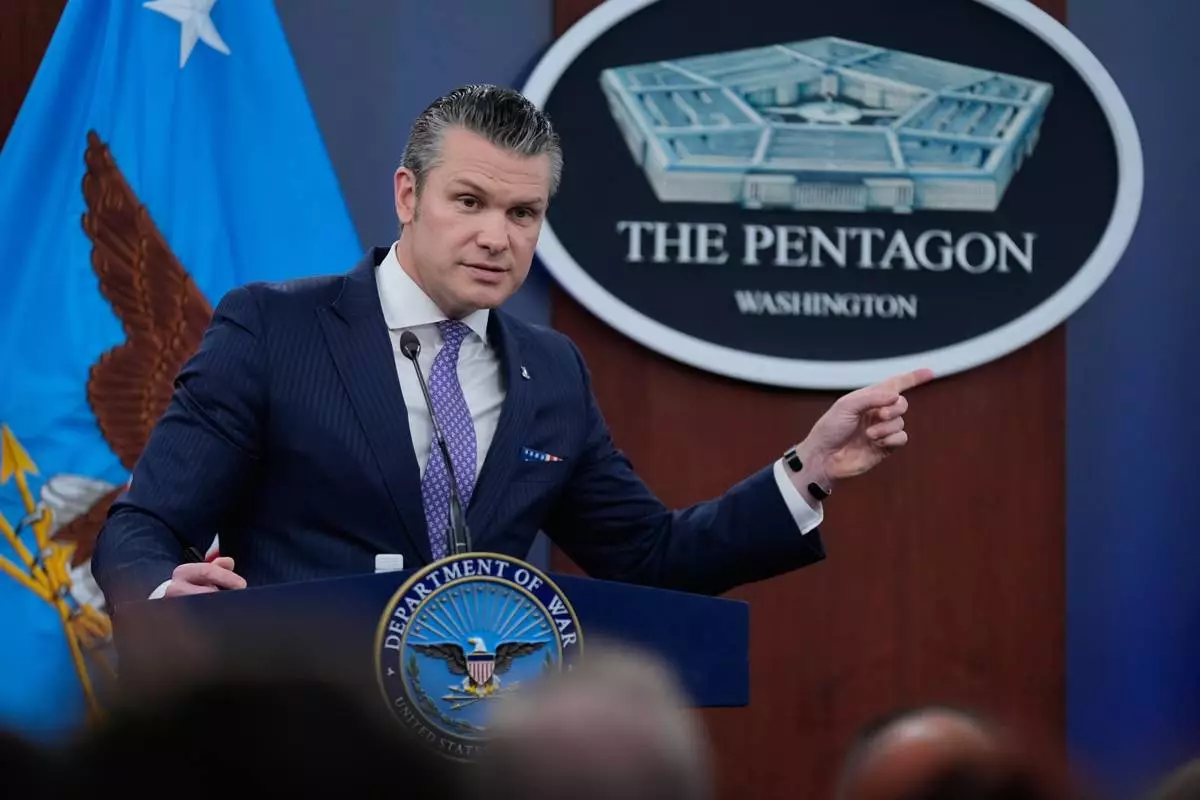
Defense Secretary Pete Hegseth speaks to members of the media during a press briefing at the Pentagon in Washington, Tuesday, March 31, 2026. (AP Photo/Manuel Balce Ceneta)