Deep in the rainforest on the Indonesian island of Sumatra, a group of female forest rangers patrol the Leuser Ecosystem, one of the most biodiverse places in the world, to stop illegal logging, protect biodiversity, and secure water supplies for their villages.
Betty, leader of the women ranger patrol team, recalled that a flash flood in 2006 motivated them to take care of the forest. Since then, she often patrols the forest with her husband, Sariyadi.
She said that the women in the team juggle multiple jobs and care for their families, but they still find time to patrol the forest.
"We are always so motivated and in high spirits, because even though we are old, we want to be an inspiration to young people. We want to show them 'we can do it, so why can't you'? This is for the future, for our children and grandchildren, not just us. If this forest is damaged, our future will be affected. The air, the water, the land, everything is connected. This is not just for us here, it's for all of you too," Betty said.
As co-leader of the team, Raliah said women's role in forest protection is vital.
"It is so important for women to guard the forest. There are illegal loggers, and forest encroachers around here. When those loggers meet other men, they fight, their egos are threatened. But when they come face to face with us, with mothers, their hearts automatically soften. That is the advantage of women guarding the forest," she said.
One of the most important tasks that they do is to document changes in the forest. These documents are then shared with local non-governmental organizations (NGOs), to help them do further conservation work.
Species such as elephants, rhinos, tigers, and orangutans are increasingly endangered, and they depend on the ecosystem to survive.
Sariyadi, the only man on this team, said that efforts to protect the forest should be stepped up.
"If we don't protect these animals, how will our children, our grandchildren, understand what is a rhinoceros, what is a tiger, what is an elephant, what is an orangutan? They will only know it in pictures. Wildlife must be protected for this reason, because they are almost extinct in the Leuser ecosystem area," he said.
These mothers are choosing to pass down a forest for their future generations. For them, protecting the forest is not just a duty, it's an act of love.

Female patrollers fight illegal logging, protect wildlife in rainforest
From cutting-edge technology exhibitions to retail stores thousands of kilometers away from Europe and Southeast Asia, China-made robot vacuum cleaners are increasingly becoming a popular choice among consumers worldwide.
At electronics retailers in Berlin, Germany, Chinese brands such as Roborock and Dreame occupy prominent positions in dedicated robot vacuum sections, offering a wide range of products priced between 200 and 2,000 euros.
Many local consumers said that when purchasing smart home appliances including robot vacuum cleaners, they tend to give priority to Chinese-made products.
"It's a good price and good quality. It's also the innovation. I have a feeling that the European brands are not innovating enough," said one customer.
"I think they're always on top of the other technologies. They are getting them out faster. A lot of us are switching to the Chinese technology," another consumer said.
Germany is one of the most important overseas markets for China's floor-cleaning robots.
According to data from market research firm GfK, from January to November 2025, more than six out of 10 robot vacuum cleaners sold in Western Europe were Chinese brands.
Industry data also point to a strong global momentum.
According to the International Data Corporation (IDC), global shipments of smart robot vacuum cleaners reached 17.424 million units in the first three quarters of 2025, representing a year-on-year increase of 18.7 percent.
Chinese brands including Roborock, Ecovacs, Dreame, Xiaomi and Narwal ranked among the world's top five in terms of shipment volume, with a combined share of nearly 70 percent of the global market.
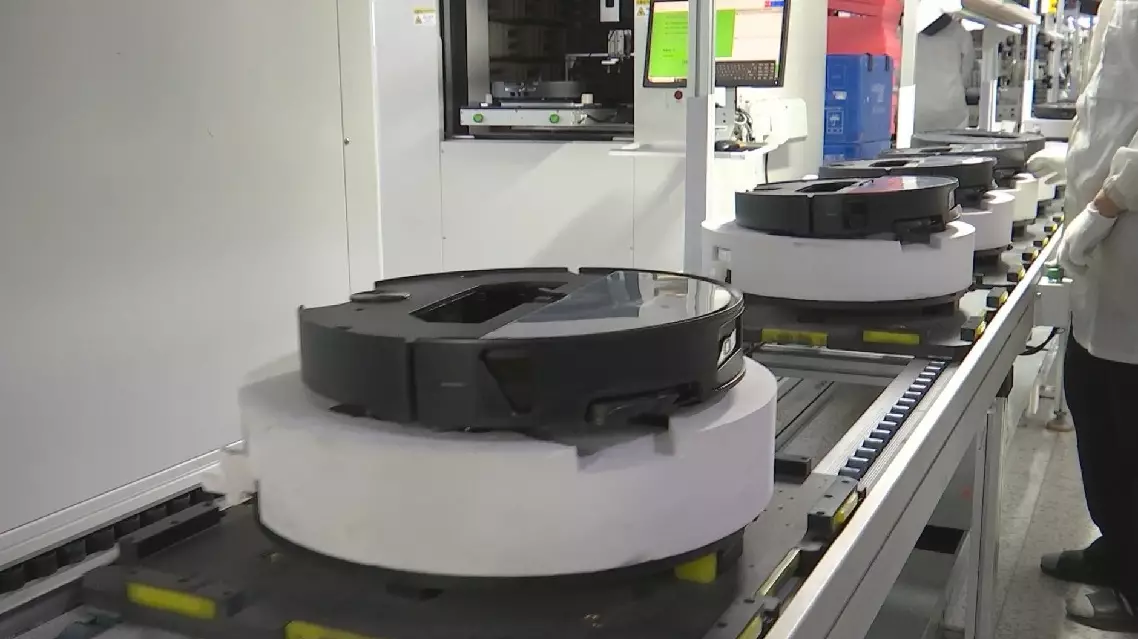
At a robot vacuum cleaner manufacturing plant in Huizhou, south China's Guangdong Province, workers were seen stepping up production of newly launched models that recently debuted at the Consumer Electronics Show in the United States, which concluded Friday in Las Vegas, Nevada.
The factory adjusted its production lines as early as December 2025 and stocked inventory in advance for overseas markets to ensure that new products could be delivered to global consumers at the earliest possible time.
"In 2025, Roborock's global shipments exceeded 7.2 million units. Since 2024, overseas revenue has accounted for more than 50 percent of our total revenue. Our products have now been sold to more than 170 countries and regions, serving more than 20 million households worldwide," said Quan Gang, president of Roborock.
At another robot vacuum cleaner manufacturing facility in Dongguan, Guangdong, rising overseas orders have prompted the company to upgrade its production lines with intelligent technologies to further boost capacity. The factory is currently operating at full load to meet a growing demand.
"For 2026, we have already obtained overseas orders worth at least 300 million to 400 million yuan (around 43 million to 57.3 million U.S. dollars). In addition, we've engaged in strategic cooperation with European home appliance group Cebos Group, and our total confirmed orders have exceeded 600 million yuan (around 86 million U.S. dollars)," said Zhang Junbin, founder and CEO of Narwal Robotics.
Chinese robot vacuum brands gain strong global traction