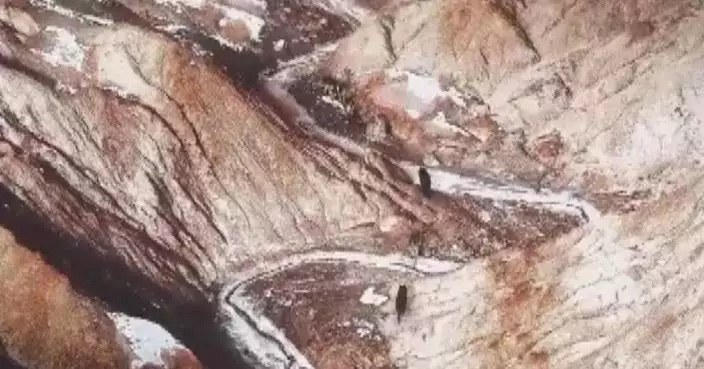
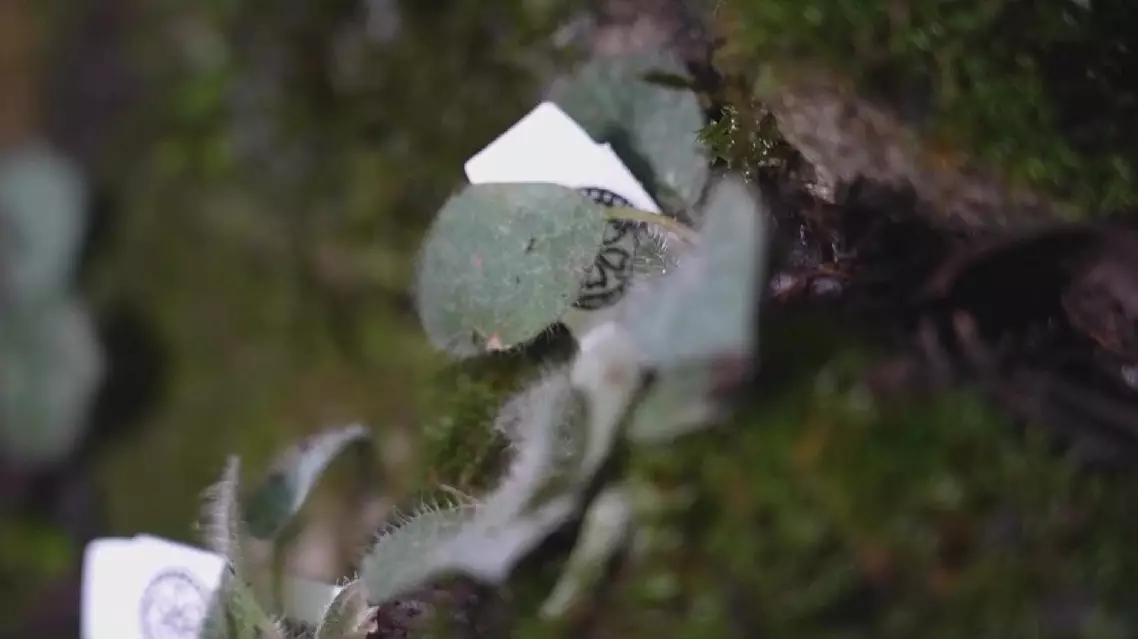
Chinese scientists have recently reintroduced the endangered herblet, Petrocosmea grandiflora, to its original habitat in a deep karst sinkhole in the city of Mengzi, southwest China's Yunnan Province, in a bid to restore and grow its fragile population.
The plant, which grows on limestone cliffs at altitudes around 2,100 meters, was first recorded in 1895 but had virtually vanished from public records for over a century. Due to its extreme rarity, the species was classified as "Critically Endangered" on the International Union for Conservation of Nature (IUCN) Red List.
In a routine field survey in September 2021, Chinese researchers from the Germplasm Bank of Wild Species rediscovered the plant. One month later, the researchers started to cultivate hundreds of Petrocosmea grandiflora seedlings in laboratory conditions through the tissue culture technique.
"Today, we brought more than 400 Petrocosmea grandiflora seedlings, and put them back to nature. The seedlings, after being cultivated through the tissue culture technique, spent one and a half years growing in a greenhouse in Kunming. Now, it is the rainy season, a perfect time to transplant them," said Cai Jie, deputy director of the Germplasm Bank of Wild Species.
The restoration site, known as "tiankeng" in Chinese, is a massive sinkhole over 100 meters wide and up to 100 meters deep. Its lush and damp cliffs are ideal for the Petrocosmea grandiflora, but its steep terrain posed significant challenges. Researchers used climbing harnesses and precision rigging to embed each seedling into the rock face, a task that took nearly two days.
"After the reintroduction, we will monitor their survival rates. We will monitor them throughout flowering and fruiting stages in about every half a year, because this is the first time we've attempted to reintroduce a cliff-dwelling species like this," said He Jun, a senior engineer at the Germplasm Bank of Wild Species.
Chinese scientists reintroduce endangered plant to native habitat in Yunnan
Chinese scientists reintroduce endangered plant to native habitat in Yunnan
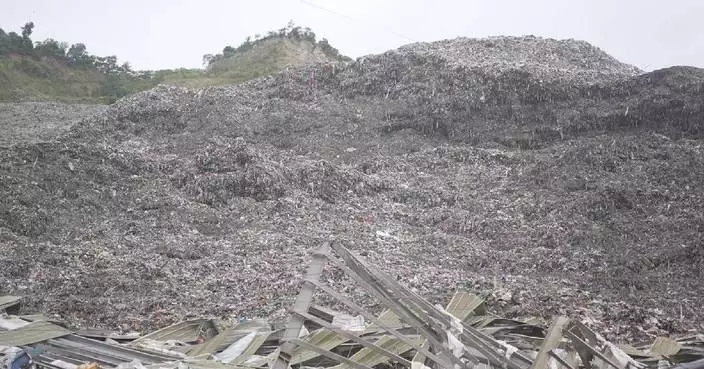
From cutting-edge technology exhibitions to retail stores thousands of kilometers away from Europe and Southeast Asia, China-made robot vacuum cleaners are increasingly becoming a popular choice among consumers worldwide.
At electronics retailers in Berlin, Germany, Chinese brands such as Roborock and Dreame occupy prominent positions in dedicated robot vacuum sections, offering a wide range of products priced between 200 and 2,000 euros.
Many local consumers said that when purchasing smart home appliances including robot vacuum cleaners, they tend to give priority to Chinese-made products.
"It's a good price and good quality. It's also the innovation. I have a feeling that the European brands are not innovating enough," said one customer.
"I think they're always on top of the other technologies. They are getting them out faster. A lot of us are switching to the Chinese technology," another consumer said.
Germany is one of the most important overseas markets for China's floor-cleaning robots.
According to data from market research firm GfK, from January to November 2025, more than six out of 10 robot vacuum cleaners sold in Western Europe were Chinese brands.
Industry data also point to a strong global momentum.
According to the International Data Corporation (IDC), global shipments of smart robot vacuum cleaners reached 17.424 million units in the first three quarters of 2025, representing a year-on-year increase of 18.7 percent.
Chinese brands including Roborock, Ecovacs, Dreame, Xiaomi and Narwal ranked among the world's top five in terms of shipment volume, with a combined share of nearly 70 percent of the global market.
At a robot vacuum cleaner manufacturing plant in Huizhou, south China's Guangdong Province, workers were seen stepping up production of newly launched models that recently debuted at the Consumer Electronics Show in the United States, which concluded Friday in Las Vegas, Nevada.
The factory adjusted its production lines as early as December 2025 and stocked inventory in advance for overseas markets to ensure that new products could be delivered to global consumers at the earliest possible time.
"In 2025, Roborock's global shipments exceeded 7.2 million units. Since 2024, overseas revenue has accounted for more than 50 percent of our total revenue. Our products have now been sold to more than 170 countries and regions, serving more than 20 million households worldwide," said Quan Gang, president of Roborock.
At another robot vacuum cleaner manufacturing facility in Dongguan, Guangdong, rising overseas orders have prompted the company to upgrade its production lines with intelligent technologies to further boost capacity. The factory is currently operating at full load to meet a growing demand.
"For 2026, we have already obtained overseas orders worth at least 300 million to 400 million yuan (around 43 million to 57.3 million U.S. dollars). In addition, we've engaged in strategic cooperation with European home appliance group Cebos Group, and our total confirmed orders have exceeded 600 million yuan (around 86 million U.S. dollars)," said Zhang Junbin, founder and CEO of Narwal Robotics.
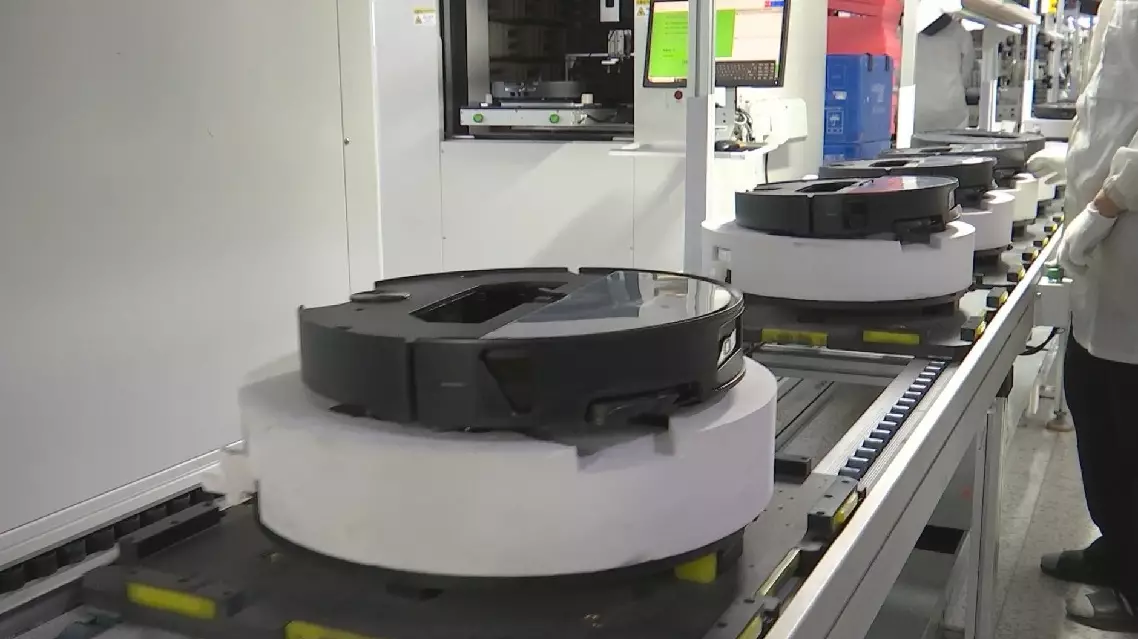
Chinese robot vacuum brands gain strong global traction