Three companies in northeast China's Jilin Province offer real examples of China's new industrial transformation strategy by pushing more small and medium-sized enterprises to become " little giants" that engage in manufacturing, specializing in a niche market, and boasting cutting-edge technologies.
The three companies - Haoyue Group, a beef farmer; Anrate, a human albumin producer; Changyou Food, a pancake maker -- share their common streak of persistence in their core competence, innovation, and embracing new technologies.
China has incubated 12,000 such "little giants" and plans to cultivate 10,000 such "little giants" during the 14th Five-Year Plan period (2021-2025).
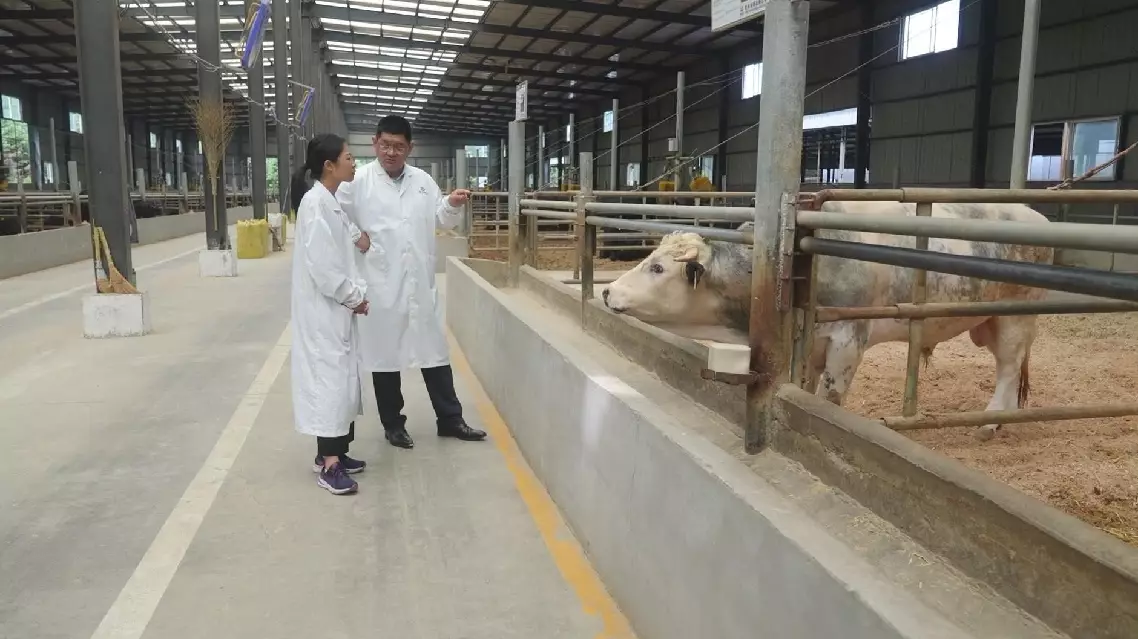
Inside Haoyue Group's cattle breeding facility in Changchun City, the clean barns, soothing classical music, and even massage machines create a scene more like a smart factory than a ranch. The company is famous for its flagship breed, Woking Wagyu.
"We spent more than 30 years developing Woking Wagyu, a high-end beef breed that rivals Japanese Wagyu. Today, each head of cattle generates over 20,000 U.S. dollars in value, making one cow worth more than a car," said Wang Weize, marketing director of Haoyue Group.
With its premium breeds and scientific farming, Haoyue beef is certified in 27 countries, positioning it among China's largest beef exporters.
In Tonghua City, another "little giant" is tackling biotech's hardest challenge: producing human albumin without human blood.
Traditionally derived from human plasma, albumin faces global shortages and safety risks. Anrate's breakthrough not only closes that gap but also pushes precision biotech into international markets.
"We use yeast expression systems to produce high-purity albumin. It's safer, scalable, and cost-effective. In 2024, we became the world's first company to receive market approval for recombinant albumin, starting with Russia," said Yang Tao, executive vice president of Anrate.
Meanwhile, in Dunhua City, innovation takes a tastier turn. Changyou Food is flipping the script on a beloved Chinese street snack, pancakes.
With pharmaceutical-grade production lines and strict fermentation protocols, these pancakes are being exported to 16 countries.
"After our brand became well-known, some wanted to use our trademark for desserts and pastries. But we said no. We're dedicated to making pancakes. I wanted to break the stereotype that pancakes are unsophisticated, and make a healthy food people actually feel proud to eat," said Chen Changyou, founder of Changyou Food.
According to a recent circular jointly issued by the Ministry of Finance and the Ministry of Industry and Information Technology, China will scale up support for "little giants" during 2024-2026, focusing on key industrial chains, strategic emerging industries, and other sectors.
Special funds will be used to encourage these firms to tackle technological challenges, develop new products, build up the supporting capacities of the industrial chain, and support local governments in nurturing "little giants".
Three "little giant" firms in Jilin exemplify China's industrial upgrade strategy
From cutting-edge technology exhibitions to retail stores thousands of kilometers away from Europe and Southeast Asia, China-made robot vacuum cleaners are increasingly becoming a popular choice among consumers worldwide.
At electronics retailers in Berlin, Germany, Chinese brands such as Roborock and Dreame occupy prominent positions in dedicated robot vacuum sections, offering a wide range of products priced between 200 and 2,000 euros.
Many local consumers said that when purchasing smart home appliances including robot vacuum cleaners, they tend to give priority to Chinese-made products.
"It's a good price and good quality. It's also the innovation. I have a feeling that the European brands are not innovating enough," said one customer.
"I think they're always on top of the other technologies. They are getting them out faster. A lot of us are switching to the Chinese technology," another consumer said.
Germany is one of the most important overseas markets for China's floor-cleaning robots.
According to data from market research firm GfK, from January to November 2025, more than six out of 10 robot vacuum cleaners sold in Western Europe were Chinese brands.
Industry data also point to a strong global momentum.
According to the International Data Corporation (IDC), global shipments of smart robot vacuum cleaners reached 17.424 million units in the first three quarters of 2025, representing a year-on-year increase of 18.7 percent.
Chinese brands including Roborock, Ecovacs, Dreame, Xiaomi and Narwal ranked among the world's top five in terms of shipment volume, with a combined share of nearly 70 percent of the global market.
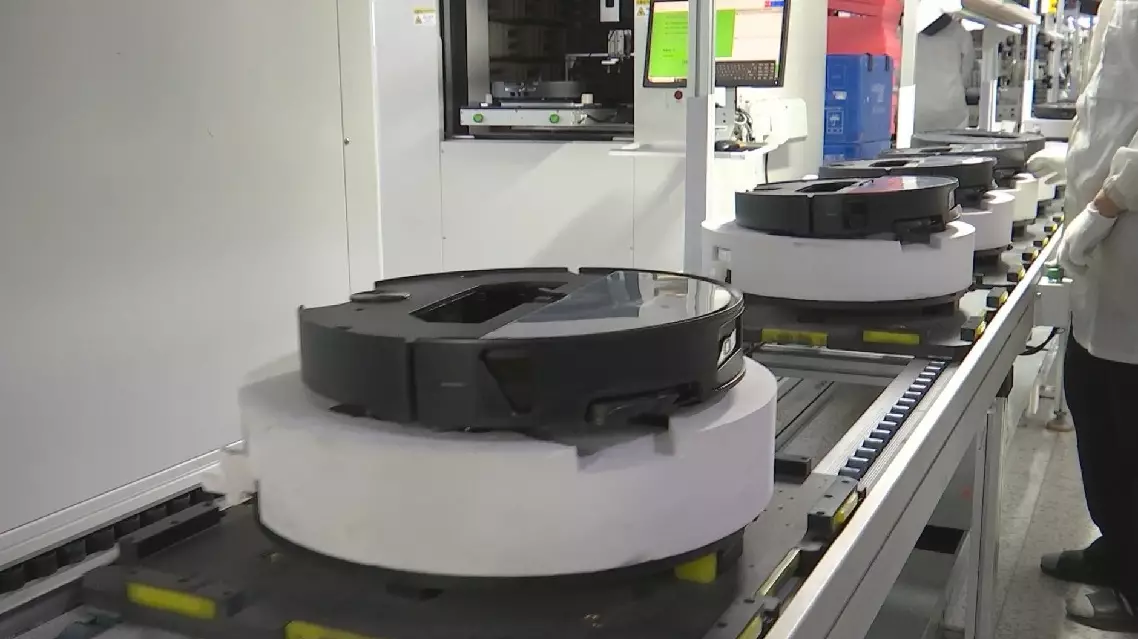
At a robot vacuum cleaner manufacturing plant in Huizhou, south China's Guangdong Province, workers were seen stepping up production of newly launched models that recently debuted at the Consumer Electronics Show in the United States, which concluded Friday in Las Vegas, Nevada.
The factory adjusted its production lines as early as December 2025 and stocked inventory in advance for overseas markets to ensure that new products could be delivered to global consumers at the earliest possible time.
"In 2025, Roborock's global shipments exceeded 7.2 million units. Since 2024, overseas revenue has accounted for more than 50 percent of our total revenue. Our products have now been sold to more than 170 countries and regions, serving more than 20 million households worldwide," said Quan Gang, president of Roborock.
At another robot vacuum cleaner manufacturing facility in Dongguan, Guangdong, rising overseas orders have prompted the company to upgrade its production lines with intelligent technologies to further boost capacity. The factory is currently operating at full load to meet a growing demand.
"For 2026, we have already obtained overseas orders worth at least 300 million to 400 million yuan (around 43 million to 57.3 million U.S. dollars). In addition, we've engaged in strategic cooperation with European home appliance group Cebos Group, and our total confirmed orders have exceeded 600 million yuan (around 86 million U.S. dollars)," said Zhang Junbin, founder and CEO of Narwal Robotics.
Chinese robot vacuum brands gain strong global traction