Traditional automakers in China are undergoing a rapid green transformation, embracing electric vehicles and intelligent technologies. In the central province of Hubei, these efforts have converged with global partnerships to create a world-class automotive ecosystem.
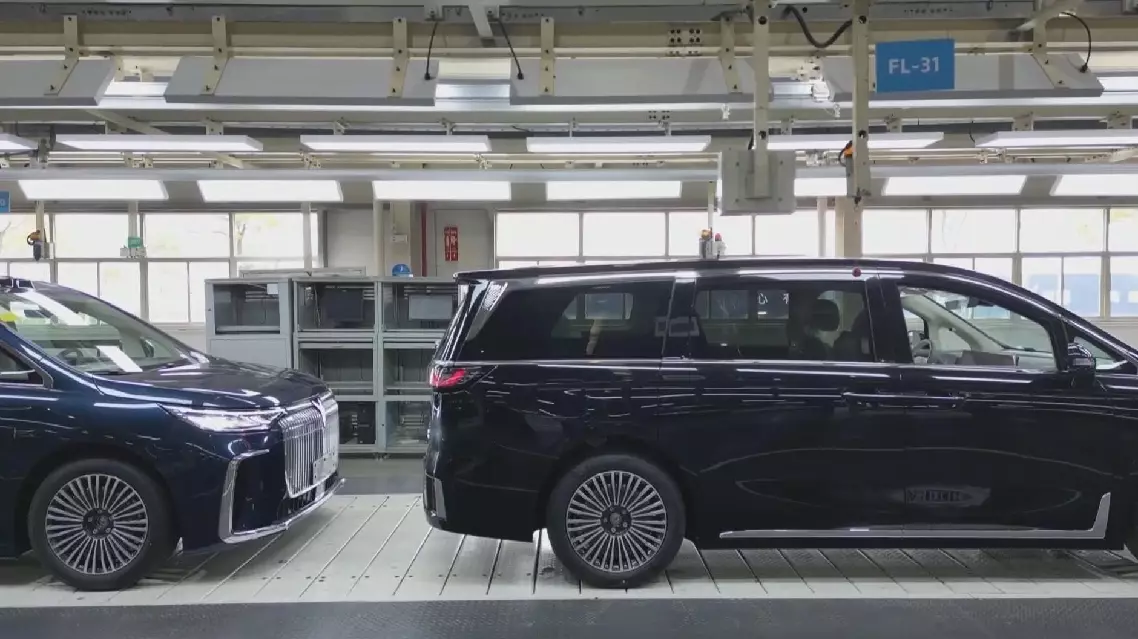
Dongfeng Motor Corporation, one of China's four state-owned major automobile groups with a legacy of over 50 years, is now keeping pace with the country's booming electric vehicle (EV) sector. At its headquarters in Wuhan, the capital city of Hubei, more than 900 industrial robots operate in a highly coordinated matrix, rolling one new vehicle off the production line every 118 seconds.
It took Dongfeng only 14 months to convert an old gas-powered vehicle production line into one for high-end EVs—just half the time and only 10 percent of the cost of building a new factory.
"It's very fast. In the past, it might take three to five years to develop a car. Now, we can launch a new model in just two years. The rapid roll-out of new vehicle models is made possible by strong support from the surrounding supply chain. While it previously focused solely on manufacturing, the supply chain in Wuhan has now shifted toward research and development. This allows us to collaborate across the entire process -- from product planning to manufacturing -- significantly shortening the development cycle," said Jiang Tao, chief operating officer, Dongfeng VOYAH Technology Co., Ltd.
Behind this speed is the region's complete auto industry ecosystem. Hubei hosts 25 automakers and over 2,400 parts suppliers, making it one of the provinces with the most complete auto industry chains in China.
This robust ecosystem is also attracting more and more foreign companies to establish a deeper presence in the region.
"Since 2021, we've welcomed 159 foreign firms with an investment of nearly two billion U.S. dollars, making this one of Wuhan's top foreign business hubs," said Liu Qinghua, deputy director of the Investment Promotion Bureau, Wuhan Economic and Technological Development Zone.
Cummins, a renowned U.S. provider of power equipment, has been embedded in the Chinese market for half a century. Once just an engine maker, the company now provides diversified power solutions across China’s auto industry. Its R and D hub in Wuhan now leads global product development.
"Previously, many of our products were first developed in the U.S. or U.K. and then adapted for China. Now, most of the core R and D happens right here, and then it is sold globally," said Shi Lei, general manager, Cummins East Asia R and D Center.
Many Chinese automakers are racing to master core technologies to strengthen their position in the industry.
Earlier this year, a test vehicle equipped with China’s first high-end, automotive-grade MCU chip, the DF30, successfully completed winter testing in northeastern China.
This high-performance chip, essential for powertrain control and chassis systems, has long been dominated by imports.
Jointly developed by Dongfeng and over 40 partners, the DF30 marks a major step toward breaking the foreign monopoly.
So far, five auto-grade chips have been successfully taped out. They will fill a domestic tech gap and slash costs.
"These chips boost supply chain resilience and give other automakers access to homegrown tech. More importantly, we've now built the full chip-to-car ecosystem," said Chen Zhongtian, deputy director of the Software Engineering Center, Dongfeng Motor Corporation R and D Institute.
As China's auto industry accelerates its shift from traditional fuel vehicles to new energy and smart technologies, these advancements in Hubei exemplify how collaboration, innovation, and a complete industrial ecosystem are driving the future of mobility -- not just for China, but for the global automotive landscape.
From local assembly to global innovation: China drives toward greener, smarter auto industry