The International Deep Space Exploration Association (IDSEA), an international academic organization dedicated to deep space exploration, was officially launched on Monday in Hefei, capital of east China's Anhui Province.
The move marks a key step in global collaboration to advance space technology and build a community with a shared future for humanity in outer space.
This association was jointly initiated by the Hefei-based Deep Space Exploration Laboratory, the Lunar Exploration and Space Program Center of the China National Space Administration, the Chinese Society of Astronautics, the Chinese Society of Space Research and the French initiative "Planetary Exploration, Horizon 2061." The founding of the IDSEA was also co-sponsored by 20 academicians from China and 31 international scientists.
Wu Weiren, chief designer of China's lunar exploration program, was elected as the association's first chairman.
Wu said the association's establishment is an important step for international exchange and cooperation in China's space program, allowing for more collaborative innovation within the global space community.
"We are trying to attract 500 international scientific research members and 100,000 individual scientist members within a decade, to make our association's active contribution to the joint exploration of the mysteries of the universe and the mission of advancing human civilization," said Wu.
Wu said the association will focus on lunar exploration, planetary exploration and asteroid defense among its different initiatives. It will study trends in international deep space exploration, host international academic events, train global talent in space science and technology, take part in making standards and rules concerning outer space, and advance the peaceful and sustainable use of outer space.
Many space exploration experts who contributed to the founding of the IDSEA said the association is expected to help connect member countries in an attempt to unleash their unique advantages while they seek to deepen multilateral cooperation.
"Many countries have specializations in one thing, like landers or rockets, but others can do better in instruments. It makes a lot of sense to collaborate with the rest of the world," said Simone Dell' Agnello, a researcher at Italy’s National Institute for Nuclear Physics and also a founding member of the IDSEA.
"With this association, we will be able to reach all the international partners and scientists in one platform," said Ahmet Hamdi Takan, a Turkish expert in deep space science and technology and also a founding member of the IDSEA.
Jiang Hui, secretary-general at the Asia-Pacific Space Cooperation Organization, said the IDSEA is set to deliver a diversified package of resources to help member countries develop skills and talents in the field of deep space exploration.
"So, we can work together, and to provide a very profound platform for them. We can provide them more diversified short training, education programs to help them with capacity building," said Jiang.
Despite being a relative latecomer to space exploration, China has rapidly emerged as a prominent player in this field while also demonstrating its commitment to cooperating with other nations.
In April 2025, China announced that seven institutions from six countries -- France, Germany, Japan, Pakistan, the United Kingdom and the United States -- had been authorized to borrow lunar samples collected by China's Chang'e-5 mission for scientific research purposes.
China has also invited global partners to participate in its Mars missions. The country plans to launch the Tianwen-3 Mars sample-return mission around 2028, with the primary scientific goal of searching for signs of life on Mars.
Retrieval of samples from Mars, the first mission of its kind in human history, is considered the most technically challenging space exploration task since NASA's Apollo program.
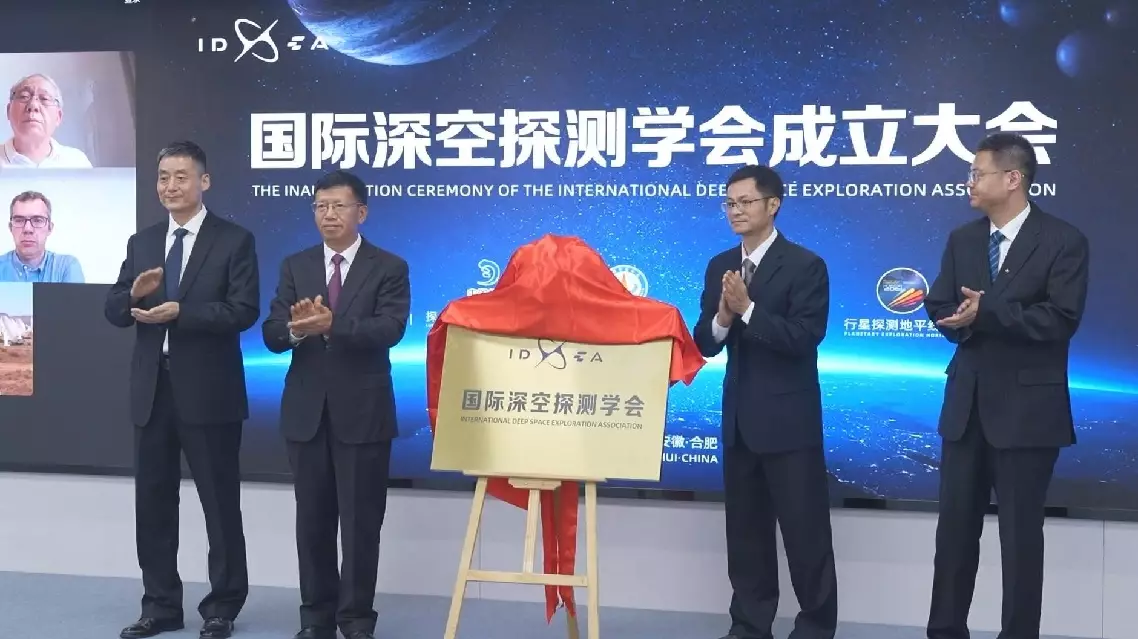
International Deep Space Exploration Association launched in China