A Japanese expert has emphasized the importance of face-to-face interactions in fostering understanding between Chinese and Japanese people.
Commenting on the promotion of people-to-people exchange between the two countries, especially via the Osaka Expo 2025, which just celebrated the China Pavilion Day, Koji Nozaki, deputy director of the Japan Foundation in Beijing, said since the foundation established its Beijing office in 1994, a variety of activities and programs have been held to promote exchanges between Chinese and Japanese students and deepen mutual understanding between the two countries.
Drawing on his experience in cross-cultural communication, Nozaki said combining online communication with in-person meetings is key to foster understanding and minimize misunderstanding.
"I believe two things are important. The first one is maintaining open lines of communication, and second is meeting face to face. Those are key to overcoming misunderstandings. When facilitating exchanges among young people, the Japan Foundation, we first encourage(s) online communication for several months before arranging a one-week visit to China where they can meet in person and spend time together. Over this longer period of time, online and face-to-face interaction help to understand each other," Nozaki said.
"Online tools such as WeChat have enabled us to stay connected, keep contact across borders, but in those chat tools, message mostly showed just a few lines. So sometimes it's not clear if your message has been understood the way of you intended it to be. So I believe face-to-face exchanges is quite important. It's great emotional experience when you talk online all the time and finally meet face to face together. It's a great feeling to finally meet a friend. So we the Japan Foundation Beijing, based in China, put emphasize [on] creating opportunity for face-to-face interaction in fostering exchanges where has connect," he said.

Japanese expert calls for 'face-to-face' communication with China to reduce misunderstanding
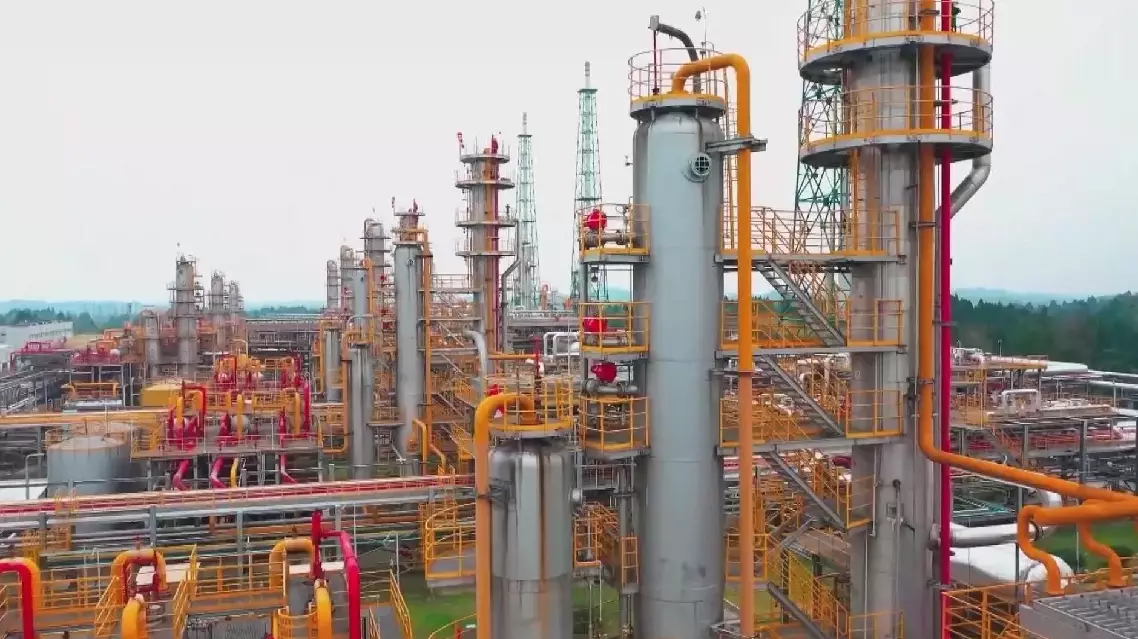
China's natural gas production is projected to reach 300 billion cubic meters by 2030, according to a development report released in Beijing.
The report, covering the development of China's oil and gas industry during the country's 14th Five-Year Plan period (2021–2025), said proven geological reserves rose by 7 billion tons of oil and 7 trillion cubic meters of gas, up 43 percent and 40 percent respectively from the previous five-year period. Oil and gas production hit record highs.
"The oil output is likely to reach between 215 and 216 million tons this year. Natural gas has seen major growth during the 14th Five-Year Plan period (2021–2025), with annual domestic output rising by nearly 13 billion cubic meters. In the 15th Five-Year Plan period (2026-2030), we expect annual increases of more than 10 billion cubic meters, reaching 300 billion cubic meters around 2030," said Wu Mouyuan, deputy director of the Economics and Technology Research Institute of China National Petroleum Corporation (CNPC).
The report forecast that China's energy structure will feature less coal, stable oil and gas, and rising non-fossil fuels over the next decade.
By 2060, fossil fuels are expected to account for 23 percent of the energy mix, hydropower and nuclear 19 percent, wind 25 percent, and solar 30 percent, the report said.
"In the next five years, through the integrated development of fossil energy and renewables, we will achieve a heathy, stable, and resilient energy system. Clean energy will continue to grow rapidly. More than 90 percent of renewable energy will be consumed via electricity, so the electrification at end-use sectors is a key direction of transformation in the future," said Wu.
With the rapid growth of artificial intelligence and new high-energy industries, China's power demand will exceed 20 trillion kilowatt hours by 2060, double the 2025 level. Electrification at end-use sectors is expected to reach 62 percent, rising by nearly one percentage point annually, the report projected.
China to see gas output hitting 300 bcm by 2030: report