Parts of China are battling a widespread heatwave that has pushed up temperatures to above 40 degree Celsius, particularly in northwest China's Xinjiang and southwest China's Chongqing, prompting authorities to issue high-temperature alerts, open public cooling shelters, pump water from reservoirs to protect drought-stricken farmland.
The National Meteorological Center renewed an orange alert for high temperatures on Saturday, warning that the Turpan Basin in Xinjiang and northeastern parts of Chongqing could see extreme heat.
In Urumqi, capital city of Xinjiang that has been scorched by temperatures of as high as 40 degree Celsius until Sunday, 110 rest stations were opened to the public on Friday, offering water, shade, and remote medical consultations to outdoor workers.
Kashgar and Aksu in southern parts of Xinjiang have issued multiple rounds of warnings for high temperatures, as temperatures exceed 35 degrees Celsius, even peak at 40 degrees Celsius in some areas.
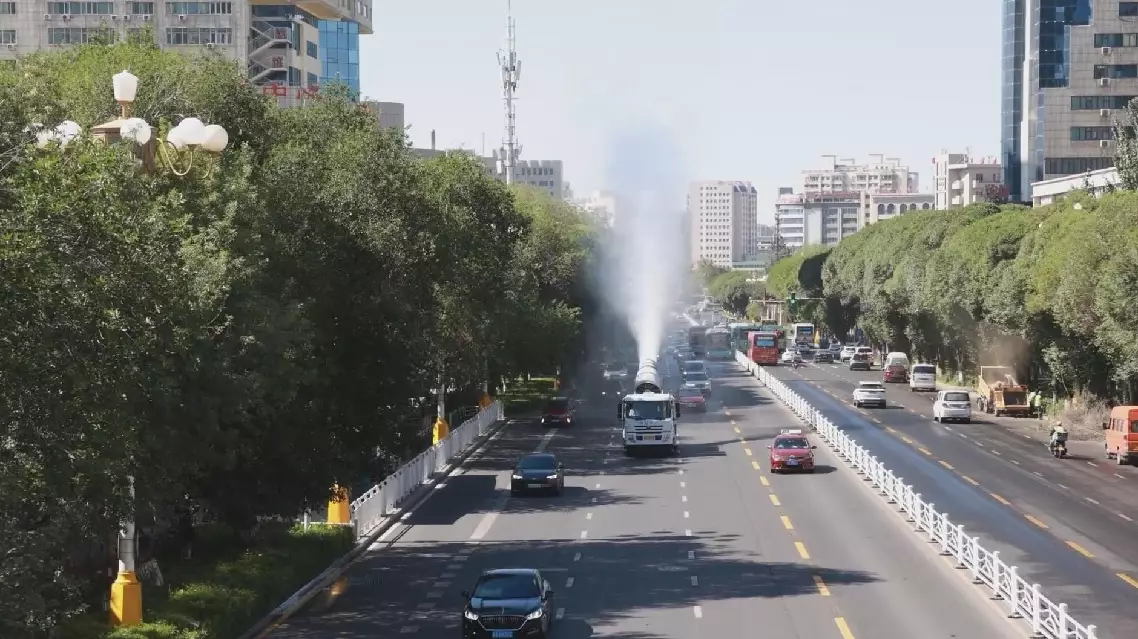
In face of the spell of heat, municipal workers in Bachu County, Kashgar, spray water on streets and irrigate roadside greenery to reduce heat everyday.
"We carry out three rounds of street spraying on 29 streets in the urban areas each day -- in the morning, at noon and in the evening. Every week, we wash guard bars, curbstones, bus stations, trees and shrubs. These efforts can effectively reduce dust, and also help bring down the temperature," said Kevisel Nurmaimaiti, a municipal worker.
In Aksu, outdoor workers can take a brief relief from the heat at the widely-distributed rest stations.
"We cannot only get free drinking water here, but can also have lunch here. It is a good place for a break. The rest stations for outdoor workers are widely distributed, and I can find one in a 15-minute of walk," said a sanitation worker.
In Liuzhou, a city in south China's Guangxi Zhuang Autonomous Region, two underground shelters have been opened to the public on Friday.
Hospitals in Chongqing have reported a rise in heatstroke cases, including "cold heatstroke" caused by abrupt temperature changes between air-conditioned spaces and outdoor heat. Doctors recommend setting indoor temperatures between 26 degrees Celsius 27 degrees Celsius and avoiding sudden exposure.
The heatwave has also impacted agriculture in Chongqing's Bishan District, where over 6,600 hectares of crops face drought stress.
Authorities have diverted water from 81 reservoirs and provided irrigation guidance to farmers. Power crews are working around the clock to ensure stable supply of electricity for irrigation.
"We've established a three-level coordination mechanism across the district, township and village levels. By actively working with power and water supply departments, we ensure round-the-clock supply of electricity for agricultural production and of water for irrigation. At the same time, we're guiding farmers to stagger their electricity use and irrigate during early mornings or evenings to avoid excessive water evaporation in midday and improve irrigation efficiency," said Zhang Jie, director of the grain, oil and soil fertility division at the Bishan District Modern Agricultural Development Promotion Center.
Parts of China battle scorching temperatures, as blistering heatwave hits