Skip to Content Facebook Feature Image

Survivors recount Tehran apartment building leveled by Israeli strike

China

China

China

Survivors recount Tehran apartment building leveled by Israeli strike

2025-07-21 21:53 Last Updated At:22:47

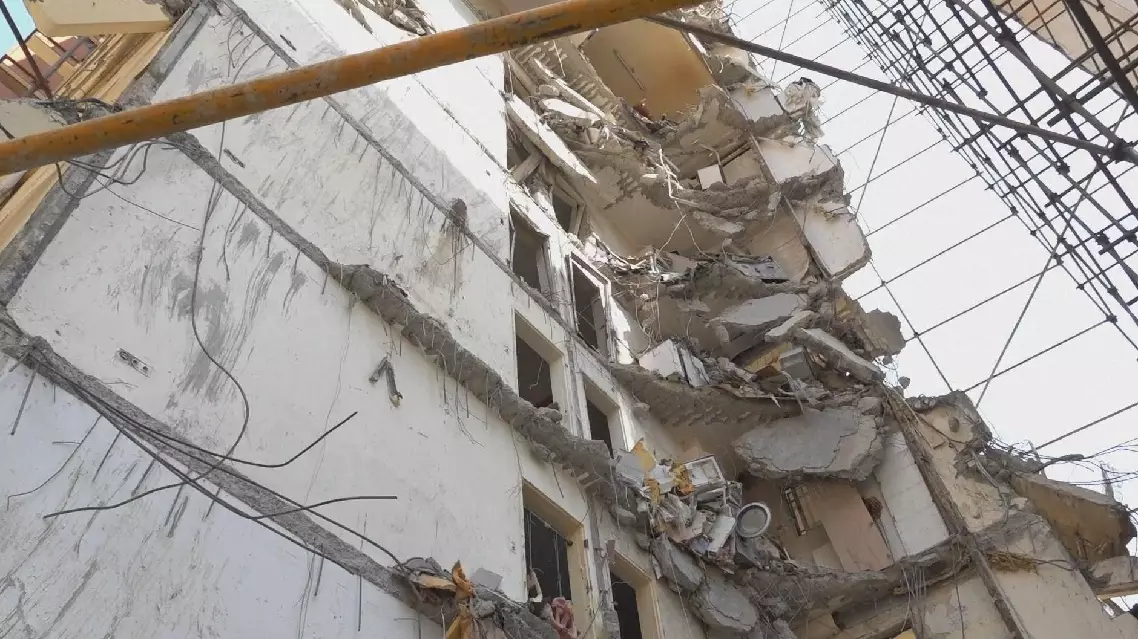
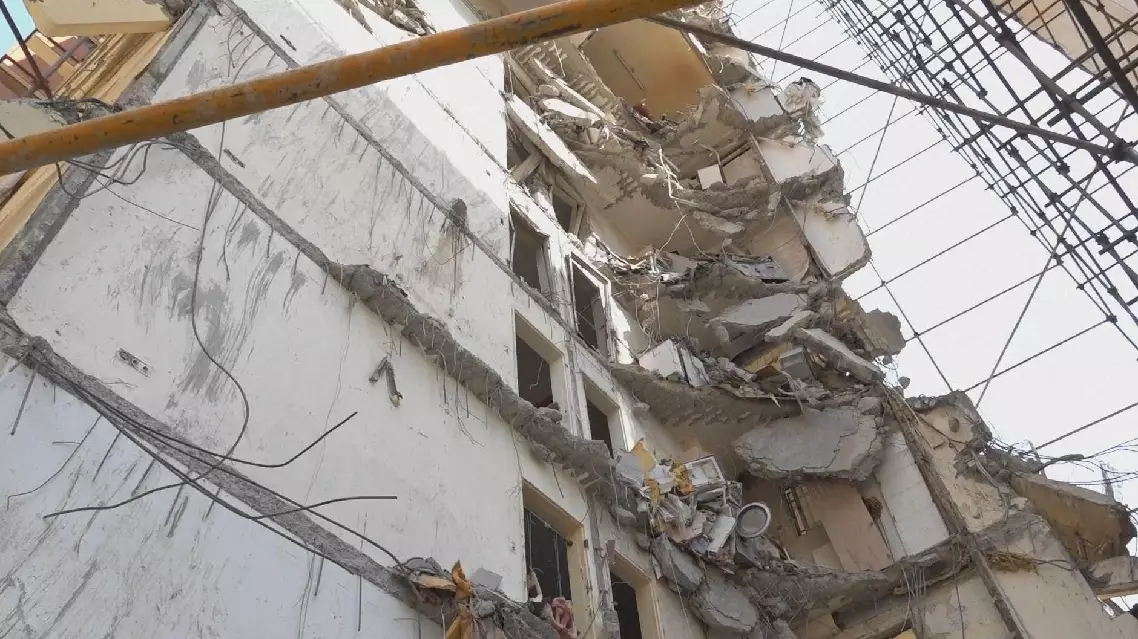
Survivors on Saturday recounted the devastation of a 14-story apartment building in northern Tehran, the capital of Iran, which was struck by an Israeli missile on June 13, the first day of renewed hostilities between Israel and Iran.

The attack turned the building into rubble in seconds, killed nearly 50 people, including women and children, and left the community devastated and heartbroken.

Amid the destruction, a family survived against the odds. The parents, sleeping in the westernmost unit, escaped. Their two children were trapped under debris, but a fallen mattress shielded them, sparing their lives.

The children's mother recalled the terrifying ordeal, her voice trembling.

"When we arrived, we couldn't see anything. Under the rubble was my son's mattress. My children were underneath. Yes, because we couldn't see them, we didn't know where to look for them. I kept calling out, 'Mohammad Masih' (my younger son's name), 'Mohammad Jawad' (my older son's name). Mohammad Jawad was very scared and didn't answer. Mohammad Masih said, 'Mom, I can see your feet.' Then my husband came over and removed some of the rubble. We stood by a door frame because we felt it was going to collapse," said the surviving woman.

Rescue worker Reza described the aftermath, fighting back emotion as he recalled what he saw.

"I witnessed heartbreaking scenes. Unfortunately, I saw some civilians' bodies burnt and torn apart. I saw children being retrieved from the rubble of the collapsed building with the help of firefighters and rescuers. Their bodies were charred. I can only imagine the tragic fate their families will face. I hope such actions stop worldwide and never occur to any civilians, especially in any war. Regardless of their intentions or reasons, civilians should be kept away from danger," said Reza.

For the children, the attack left a lasting mark.

"I was sleeping when suddenly I was thrown from my bed and hit the wall. When the missile struck my room, half a block fell and trapped me. At that moment, I jumped up and hit the wall. Then the mattress fell to the floor, and stones and other debris landed on it. Because of the mattress, the stones didn't crush me. My dad pulled me out, and we walked out of the building," 10-year-old Mohammad Jawad recalled.

Israel launched a series of major airstrikes on June 13 targeting nuclear and military sites across Iran, killing senior commanders, nuclear scientists, and civilians, and injuring many others, according to Iranian authorities. Iran retaliated with multiple waves of missile and drone attacks on Israeli territory.

A ceasefire between the two countries was reached on June 24, ending 12 days of fighting.

Official Iranian figures say that in the 12-day conflict, more than 1,200 residential units were attacked, with 400 completely destroyed, nearly 1,100 people killed, and 5,750 others injured.
Survivors recount Tehran apartment building leveled by Israeli strike
Survivors recount Tehran apartment building leveled by Israeli strike

Survivors recount Tehran apartment building leveled by Israeli strike

Survivors recount Tehran apartment building leveled by Israeli strike

Survivors recount Tehran apartment building leveled by Israeli strike

Survivors recount Tehran apartment building leveled by Israeli strike

Chicago policymakers have introduced measures to increase housing supply, in a move that local activists and construction industry stakeholders have hailed as key to easing affordability pressures on residents.

According to the city's 2025 annual report on homelessness, Chicago is facing its largest gap in affordable and available housing in a decade, with the annual Point-in-Time (PIT) Count estimating that 7,452 people were experiencing homelessness, either in shelters or unsheltered locations, on January 23, 2025.

Steven Vance, a social worker in Chicago, said policies that previously curbed the city's housing supply have pushed up rent costs amid demographic changes.

"Households are declining in size, and that means we need more homes, and I thought it was strange that we would artificially restrict how many homes could get built in Chicago. Right now in Chicago, we have one of the highest rent growths, compared year to year in the country, and so now is a pivotal time to allow more housing," he said.

To address the challenge, Chicago has introduced zoning and land-use reforms, including the Additional Dwelling Units (ADU) Ordinance, aimed at increasing residential density and expanding housing supply.

The ordinance effectively expands housing access across the city by allowing ADUs in attics, basements, and accessory buildings, easing the rent burden and creating more budget-friendly housing options.

"In December 2020, City Council adopted an ordinance that would legalize ADUs in five pilot areas. (With ADU,) rents will maybe not always come down, but they will not climb as quickly as they are now if we have more housing options," he said.

The construction sector in the city has welcomed the policy change, with builders jumping on the opportunity to create new structures. For many in the industry, boosting housing supply is not just about doing business, but about addressing the issue of affordability as Chicago residents themselves.

"The housing market in Chicago has been impacted by the ADU program, to me, in a really big way. It's enabled a lot more rental projects to be constructed. I want there to be more housing in Chicago. I think there is a need for that, and I think there's also a need for responsible development that maintains the character of the neighborhood. Affordable housing to me is a really important issue, and to me, the biggest denominator in affordable housing is the lack of supply. The best route to affordable housing is to have an influx of housing," said Nick Serra, a construction professional.

Chicago expands housing supply to ease affordability pressure

Chicago expands housing supply to ease affordability pressure

Recommended Articles