Skip to Content Facebook Feature Image

Democratic Gov. Tony Evers won't seek third term in battleground Wisconsin

News

Democratic Gov. Tony Evers won't seek third term in battleground Wisconsin
News

News

Democratic Gov. Tony Evers won't seek third term in battleground Wisconsin

2025-07-25 04:23 Last Updated At:04:30

MADISON, Wis. (AP) — Wisconsin Gov. Tony Evers announced Thursday that he won't seek a third term, setting off a scramble to replace the two-term Democrat in the battleground state’s first open race for governor in 16 years.

It will be Wisconsin’s highest profile race next year, as Democrats also angle to take control of the Legislature thanks to redrawn election maps that are friendlier to the party. They are also targeting two congressional districts, as Democrats nationwide try to retake the House.

The Legislature has been under Republican control since 2011, and some Democrats had hoped that Evers, 73, would run for a third term to give him a chance to potentially work with a Democratic-controlled Statehouse.

In a video announcing his decision, Evers said he was “damn proud” of working for 50 years in public service. But he said it was time to focus on his family.

“For five decades, my family has sacrificed to give me the gift of service,” Evers said. “They’re my world and I owe it to them to focus on doing all the things we enjoy and love doing together.”

The open race is sure to attract several Democratic and Republican candidates. Potential Democratic candidates include Attorney General Josh Kaul, Lt. Gov. Sara Rodriguez, former Lt. Gov. Mandela Barnes, state Sen. Kelda Roys, Secretary of State Sarah Godlewski, Milwaukee Mayor Cavalier Johnson and Milwaukee County Executive David Crowley.

Washington County Executive Josh Schoemann and suburban Milwaukee businessman Bill Berrien are running as Republicans. Others, including U.S. Rep. Tom Tiffany and state Senate President Mary Felzkowski, are considering it.

In a statement reacting to Evers’ decision, Berrien said the governor is “too scared to run” on a “record of failure.”

But on a Zoom call with reporters, he said Evers' decision not to run didn't change how he would approach his campaign “at all.”

“We have a vision and a mission of where we need to take Wisconsin,” Berrien said from his car in between campaign stops.

Schoemann also said Evers' exit wouldn't change his strategy.

“It’s a wide open race, no doubt," he said,

Tiffany said in a statement that Evers “leaves behind a legacy of decline” and that “it’s time we change course.” But he stopped short of saying whether he would run.

Kansas Gov. Laura Kelly, chair of the Democratic Governors Association, said whichever Republican wins the primary will be “too extreme for Wisconsin,” and she pledged to keep the office under Democratic control.

The last open race for governor was in 2010, when Democratic incumbent Jim Doyle, similar to Evers, opted not to seek a third term. Republican Scott Walker won that year and served two terms before Evers defeated him in 2018.

Walker appeared to tease a possible run, posting an image of a “Make Wisconsin Great Again” hat that noted President Donald Trump was both the 45th and 47th president. The post originally included a winking face emoji, indicating that he was joking, but Walker later deleted the emoji.

Walker did not reply to a text message seeking comment.

The only Wisconsin governor to be elected to a third four-year term was Republican Tommy Thompson, who served from 1987 to 2001. He resigned midway through his fourth term.

Evers won his first race by just over 1 percentage point in 2018. He won reelection by just over 3 points in 2022.

Before being elected governor, Evers worked for 10 years as state superintendent of education after a career as a teacher and school administrator.

Evers has drawn the ire of Trump’s administration, and his tenure has been marked by his often contentious relationship with the Legislature.

Before Evers even took office, Republicans convened a lame-duck session to pass a package of laws to weaken his power.

Evers angered Republicans during the COVID-19 pandemic in 2020 when he ordered schools and nonessential businesses to close, issued a statewide mask mandate and tried, unsuccessfully, to delay the state’s April presidential primary.

Republicans broke with tradition to reject 21 Evers appointees. They also blocked many of his proposals, including expanding Medicaid, legalizing marijuana and spending more on child care, K-12 schools and higher education.

Evers used his broad veto powers to stop Republicans from enacting a wide range of conservative priorities, including making voting requirements more strict, expanding gun rights, growing the private school voucher program and making abortions more difficult to obtain.

But Evers did work with Republicans to pass the most recent state budget, which included $1.5 billion in tax cuts prioritized by the GOP and more funding for both K-12 special education and the University of Wisconsin. Evers also worked with Republicans to keep the Brewers in Milwaukee and funnel more money to local governments.

Evers pushed for the redrawing of Wisconsin’s legislative boundary lines, which the state Supreme Court ordered after liberal justices gained a majority in 2023.

The maps drawn by Republicans, which had been in place for more than a decade, were widely regarded as among the most gerrymandered in the country. The new maps drawn by Evers are more favorable to Democrats and helped them pick up seats in last November’s election. Democrats are optimistic that they can win control of at least one legislative chamber next year.

Evers waited until after he signed the state budget before making his retirement announcement.

Evers positioned himself as a folksy governor who would sprinkle the occasional mild swear word into his comments and other Midwestern colloquialisms such as “holy mackerel” and “folks.” His mild-mannered demeanor stood in stark contrast to Trump and other political firebrands.

“I think he is the most quintessential Wisconsin politician I’ve ever seen,” said Democratic U.S. Rep. Mark Pocan, who has been in elected office since the 1990s.

After winning reelection in 2022, Evers noted that he is frequently described as boring, but said: “As it turns out, boring wins.”

This story was updated to correct the spelling of Sara Rodriguez’s first name, that Republicans fought with Evers over expanding Medicaid, not Medicare, and that Thompson took office in 1987, not 1986.
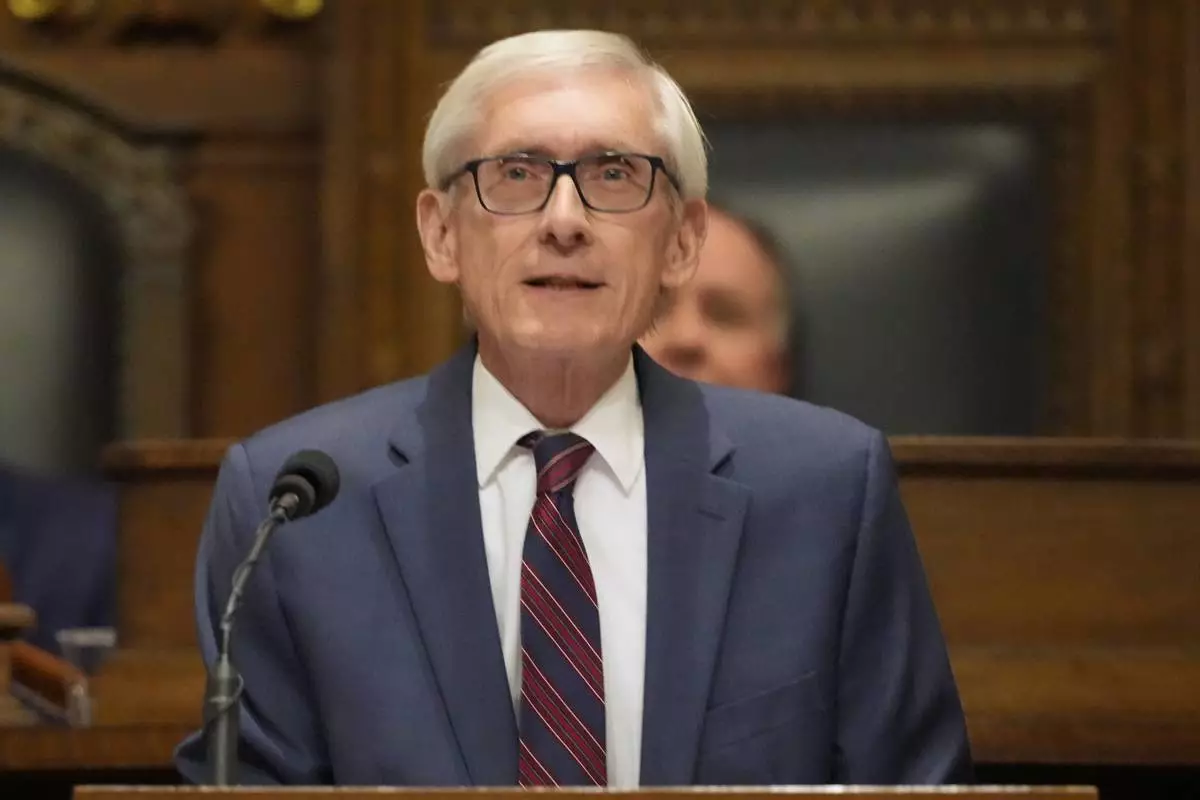
FILE - Wisconsin Gov. Tony Evers gives the annual State of the State address Wednesday, Jan. 22, 2025, at the state Capitol in Madison, Wis. (AP Photo/Morry Gash, File)
FILE - Wisconsin Gov. Tony Evers gives the annual State of the State address Wednesday, Jan. 22, 2025, at the state Capitol in Madison, Wis. (AP Photo/Morry Gash, File)
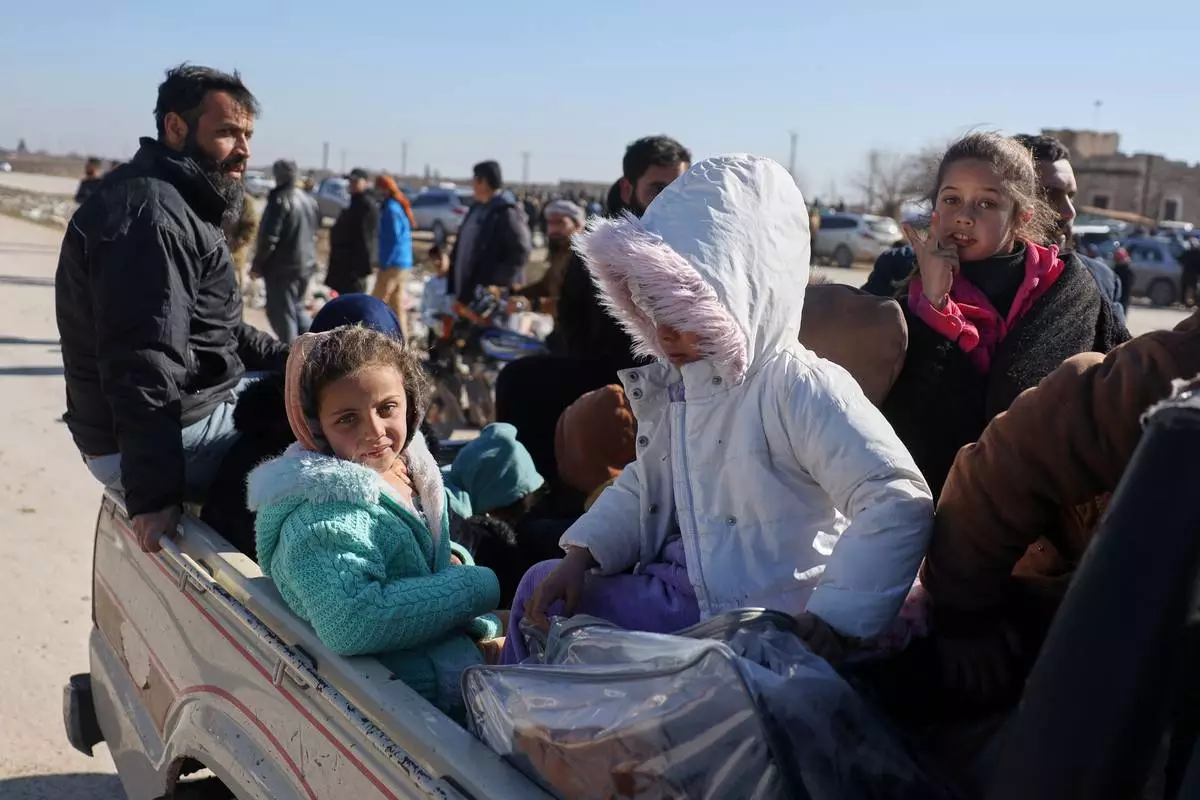
HAMIMA, Syria (AP) — A trickle of civilians left a contested area east of Aleppo on Thursday after a warning by the Syrian military to evacuate ahead of an anticipated government military offensive against Kurdish-led forces.

Government officials and some residents who managed to get out said the Kurdish-led Syrian Democratic Forces prevented people from leaving via the corridor designated by the military along the main road leading west from the town of Maskana through Deir Hafer to the town of Hamima.

The SDF denied the reports that they were blocking the evacuation.

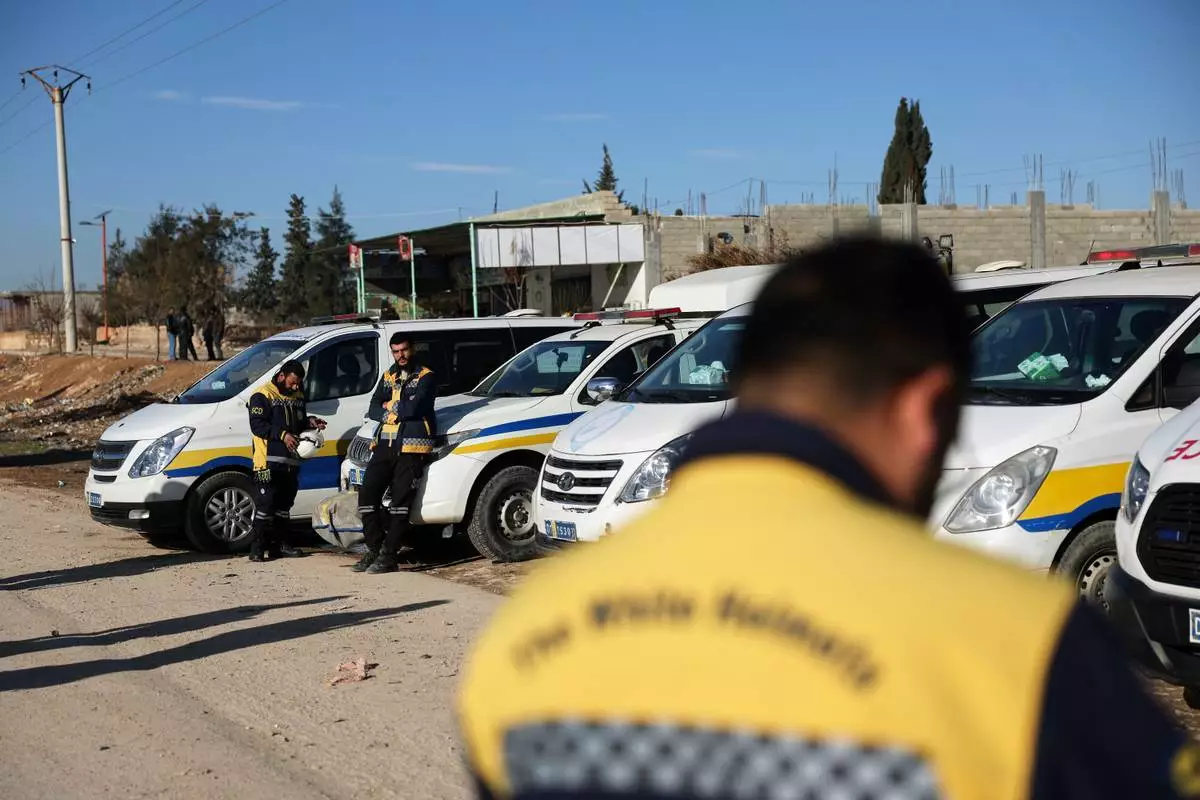
In Hamima, ambulances and government officials were gathered beginning early in the morning waiting to receive the evacuees and take them to shelters, but few arrived.

Farhat Khorto, a member of the executive office of Aleppo Governorate who was waiting there, claimed that there were "nearly two hundred civilian cars and hundreds of people who wanted to leave” the Deir Hafer area but that they were prevented by the SDF. He said the SDF was warning residents they could face “sniping operations or booby-trapped explosives” along that route.

Some families said they got out of the evacuation zone by taking back roads or going part of the distance on foot.

“We tried to leave this morning, but the SDF prevented us. So we left on foot … we walked about seven to eight kilometers until we hit the main road, and there the civil defense took us and things were good then,” said Saleh al-Othman, who said he fled Deir Hafer with more than 50 relatives.

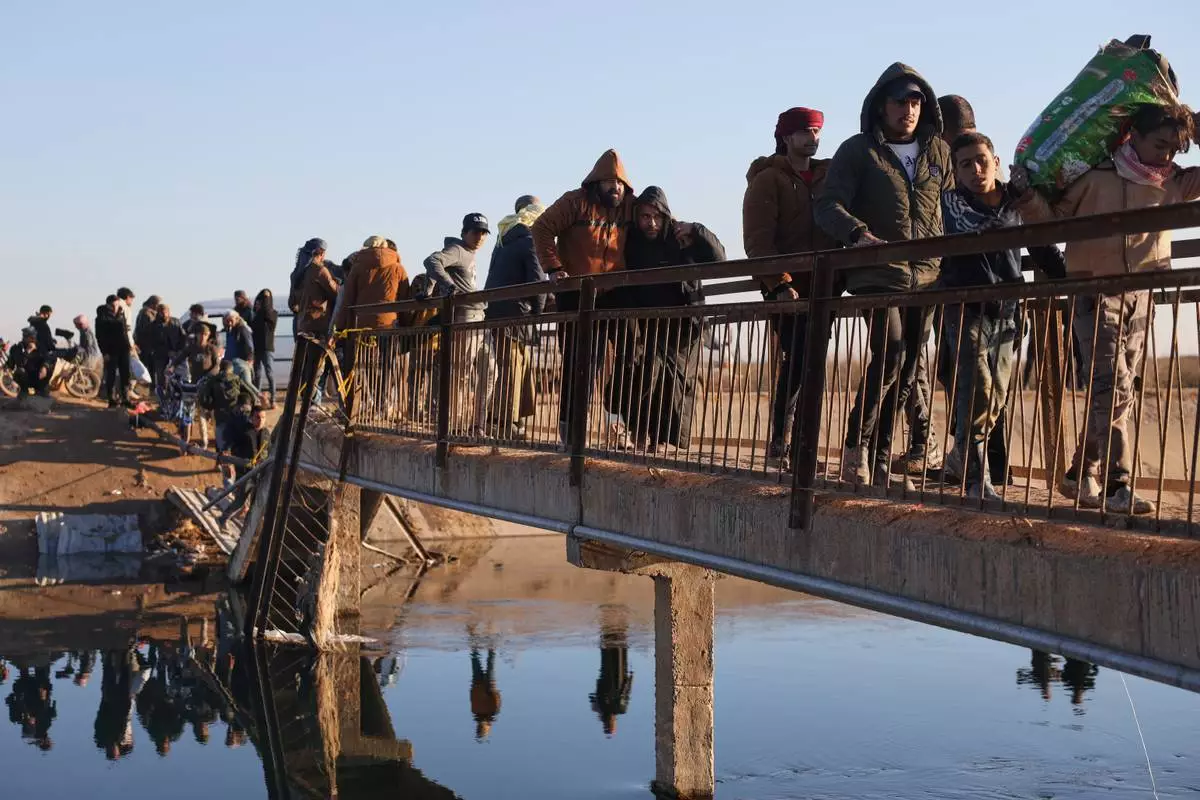
Yasser al-Hasno, also from Deir Hafer, said he and his family left via back roads because the main routes were closed and finally crossed a small river on foot to get out of the evacuation area.

Another Deir Hafer resident who crossed the river on foot, Ahmad al-Ali, said, “We only made it here by bribing people. They still have not allowed a single person to go through the main crossing."

Farhad Shami, a spokesman for the SDF, said the allegations that the group had prevented civilians from leaving were “baseless.” He suggested that government shelling was deterring residents from moving.

The SDF later issued a statement also denying that it had blocked civilians from fleeing. It said that “any displacement of civilians under threat of force by Damascus constitutes a war crime" and called on the international community to condemn it.

“Today, the people of Deir Hafer have demonstrated their unwavering commitment to their land and homes, and no party can deprive them of their right to remain there under military pressure,” it said.

The Syrian army’s announcement late Wednesday — which said civilians would be able to evacuate through the “humanitarian corridor” from 9 a.m. to 5 p.m. Thursday — appeared to signal plans for an offensive against the SDF in the area east of Aleppo. Already there have been limited exchanges of fire between the two sides.

Thursday evening, the military said it would extend the humanitarian corridor for another day.

The Syrian military called on the SDF and other armed groups to withdraw to the other side of the Euphrates River, to the east of the contested zone. The SDF controls large swaths of northeastern Syria east of the river.

The tensions in the Deir Hafer area come after several days of intense clashes last week in Aleppo city that ended with the evacuation of Kurdish fighters and government forces taking control of three contested neighborhoods.

The fighting broke out as negotiations have stalled between Damascus and the SDF over an agreement reached last March to integrate their forces and for the central government to take control of institutions including border crossings and oil fields in the northeast.

Some of the factions that make up the new Syrian army, which was formed after the fall of former President Bashar Assad in a rebel offensive in December 2024, were previously Turkey-backed insurgent groups that have a long history of clashing with Kurdish forces.

The SDF for years has been the main U.S. partner in Syria in fighting against the Islamic State group, but Turkey considers the SDF a terrorist organization because of its association with Kurdish separatist insurgents in Turkey.

Despite the long-running U.S. support for the SDF, the Trump administration has also developed close ties with the government of interim Syrian President Ahmad al-Sharaa and has so far avoided publicly taking sides in the clashes in Aleppo.

Ilham Ahmed, head of foreign relations for the SDF-affiliated Kurdish-led administration in northeast Syria, at a press conference Thursday said SDF officials were in contact with the United States and Turkey and had presented several initiatives for de-escalation. She said that claims by Damascus that the SDF had failed to implement the March agreement were false.

——

Associated Press journalist Hogir Al Abdo in Qamishli, Syria, contributed.

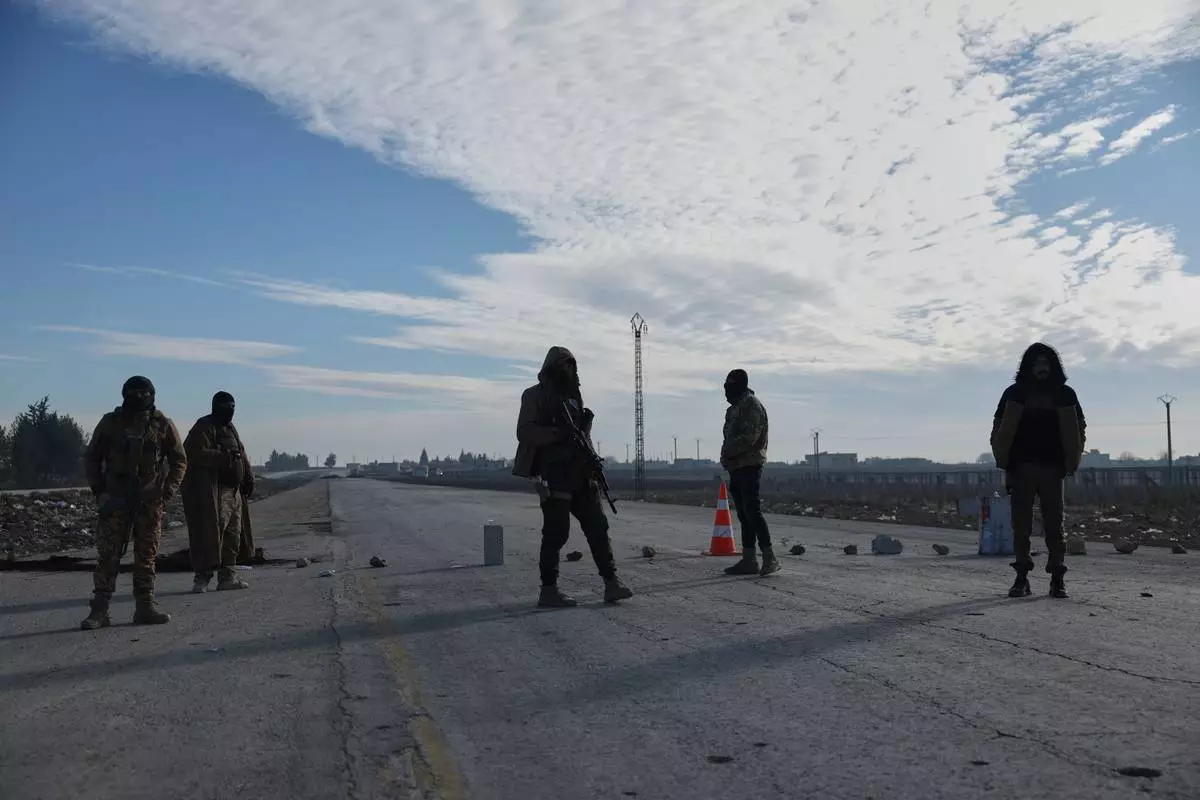
Members of the Syrian military police stand at a humanitarian crossing declared by the Syrian army in the village of Hamima, in the eastern Aleppo countryside, near the front line with the Kurdish-led Syrian Democratic Forces in Deir Hafer, Syria, Thursday, Jan. 15, 2026. (AP Photo/Ghaith Alsayed)

Members of the Syrian military police stand at a humanitarian crossing declared by the Syrian army in the village of Hamima, in the eastern Aleppo countryside, near the front line with the Kurdish-led Syrian Democratic Forces in Deir Hafer, Syria, Thursday, Jan. 15, 2026. (AP Photo/Ghaith Alsayed)

Members of the Syrian Civil Defense, stand next to their vehicles at a humanitarian crossing declared by the Syrian army in the village of Hamima, in the eastern Aleppo countryside, near the front line with the Kurdish-led Syrian Democratic Forces in Deir Hafer, Syria, Thursday, Jan. 15, 2026. (AP Photo/Ghaith Alsayed)

Members of the Syrian Civil Defense, stand next to their vehicles at a humanitarian crossing declared by the Syrian army in the village of Hamima, in the eastern Aleppo countryside, near the front line with the Kurdish-led Syrian Democratic Forces in Deir Hafer, Syria, Thursday, Jan. 15, 2026. (AP Photo/Ghaith Alsayed)

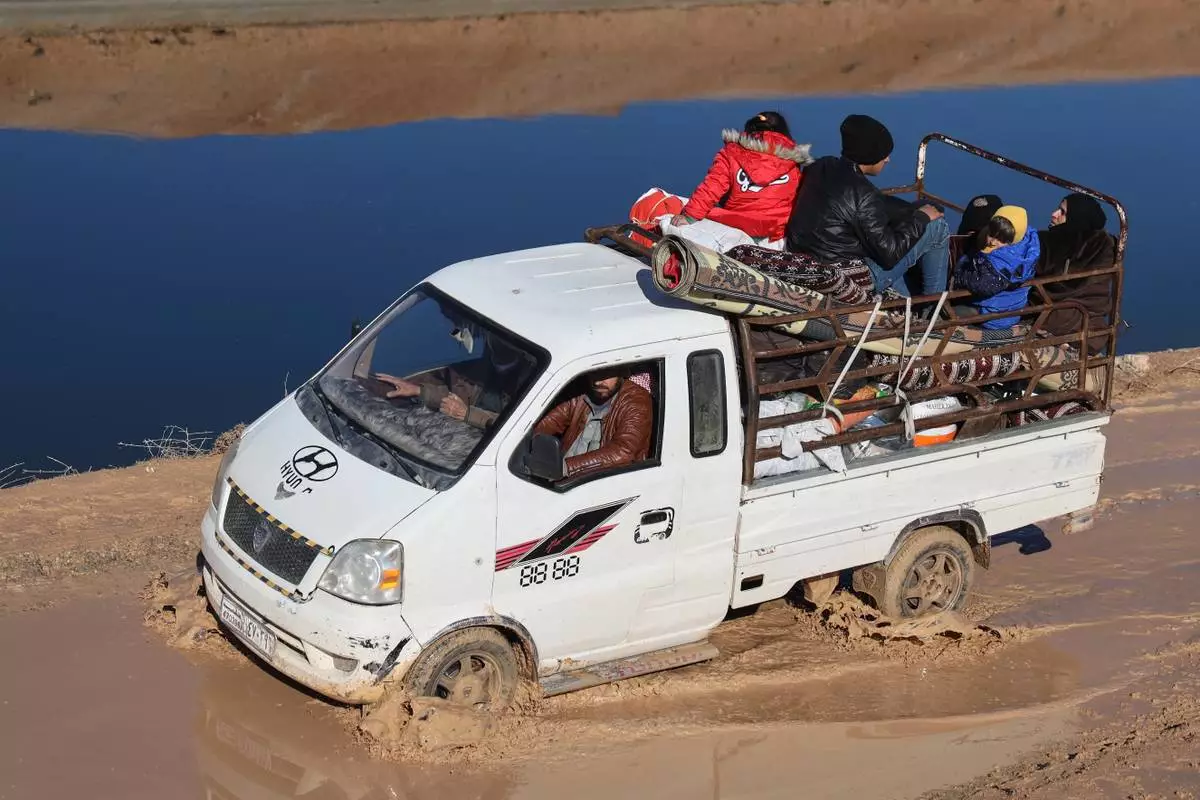
A displaced Syrian family rides in the back of a truck near a humanitarian crossing declared by the Syrian army next to a river in the village of Rasm Al-Abboud, in the eastern Aleppo countryside, near the front line with the Kurdish-led Syrian Democratic Forces in Deir Hafer, Syria, Thursday, Jan. 15, 2026. (AP Photo/Omar Albam)

A displaced Syrian family rides in the back of a truck near a humanitarian crossing declared by the Syrian army next to a river in the village of Rasm Al-Abboud, in the eastern Aleppo countryside, near the front line with the Kurdish-led Syrian Democratic Forces in Deir Hafer, Syria, Thursday, Jan. 15, 2026. (AP Photo/Omar Albam)

Displaced Syrian children and women ride in the back of a truck near a humanitarian crossing declared by the Syrian army in the village of Hamima, in the eastern Aleppo countryside, near the front line with the Kurdish-led Syrian Democratic Forces in Deir Hafer, Syria, Thursday, Jan. 15, 2026. (AP Photo/Omar Albam)

Displaced Syrian children and women ride in the back of a truck near a humanitarian crossing declared by the Syrian army in the village of Hamima, in the eastern Aleppo countryside, near the front line with the Kurdish-led Syrian Democratic Forces in Deir Hafer, Syria, Thursday, Jan. 15, 2026. (AP Photo/Omar Albam)

Displaced Syrians at a river crossing near the village of Jarirat al Imam, in the eastern Aleppo countryside, near the front line with the Kurdish-led Syrian Democratic Forces in Deir Hafer, Syria, Thursday, Jan. 15, 2026. (AP Photo/Omar Albam)

Displaced Syrians at a river crossing near the village of Jarirat al Imam, in the eastern Aleppo countryside, near the front line with the Kurdish-led Syrian Democratic Forces in Deir Hafer, Syria, Thursday, Jan. 15, 2026. (AP Photo/Omar Albam)

Recommended Articles