China made new progress in deep-sea exploration and marine resource development technology in the first half of this year, according to the Ministry of Natural Resources.
In June, China unveiled a deep-sea testing site in Hainan Province, which features an integrated service platform encompassing research and development, testing verification, industrial incubation and certification evaluation.
In the same month, the second phase of the country's flagship gas field in the South China Sea went into full operation, marking the completion of the country's largest offshore natural gas development to date.
The progress brings the gas field, named Shenhai Yihao or Deep Sea No. 1, to its designed production capacity of 4.5 billion cubic meters annually, the largest offshore oil and gas producer in China.
Earlier in March, China's Sea Guru II, a manta ray-inspired robot, completed a landmark 2,000-meter deep-sea trial in the South China Sea.
Collaborating with the deep-sea submersible Jiaolong in the exploration, the 3-meter-long, 1.5-meter-tall robot performed complex movements and operations near the seafloor in less than two hours.
Officials of the Ministry of Natural Resources said more efforts will be made to support the country's marine sci-tech innovation and sustainable development.
"We will deepen scientific and technological innovation, optimize industrial layout, stimulate market vitality, and promote new breakthroughs in the marine economy through effective improvement in quality and rational growth in quantity so as to provide solid support for building a strong maritime country," said Meng Qinglei, deputy director of the Marine Strategic Planning and Economics Department of the Ministry of Natural Resources.
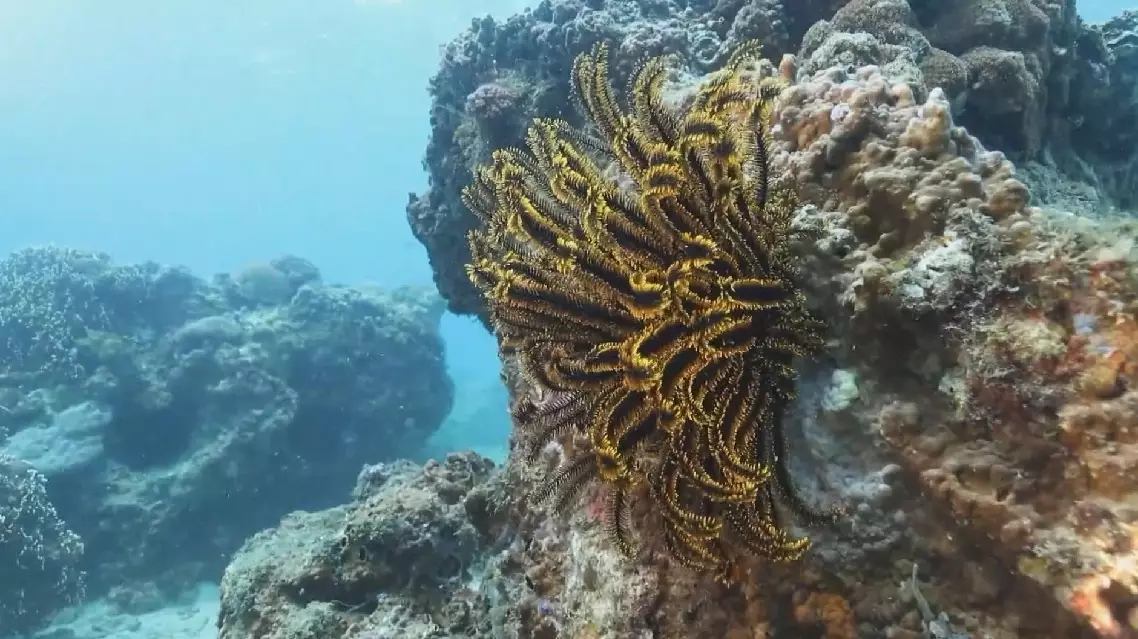
China makes new progress in deep-sea exploration
The Mianyang base of the China Conservation and Research Center for the Giant Panda held a soft opening on Sunday to assess its capacity to serve 6,000 daily visitors, ahead of its scheduled official inauguration next Monday.
The new giant panda base, which has been built after three years of construction, is seated at an ecological park in Mianyang City covering an area of about 120 hectares.
The base boasts 54 sets of giant panda enclosures and is up to strict giant panda breeding standards.
According to the base, the soft opening thoroughly evaluated the ticketing system, visitor routes, venue capacity, service facilities, and emergency response protocols.
The base is now ready to open to the public, and all the giant pandas are in good condition, said its staff.
"The Mianyang base now houses 20 giant pandas of all ages, and they have adapted well. At first, some were nervous and had a reduced appetite after their arrival. However, they are improving and are as active as ever," said Huang Zhi, head of the management and operation group for the preparatory working group at the base.
Each outdoor facility for the giant pandas features a specially designed climbing structure. Constructed from reinforced concrete with a log-like design, it prioritizes safety, durability, and stability. Real logs are placed on top, creating a natural environment for the pandas.
"We do not just build the structures. We have created a livable ecosystem. Strength and durability of the architectures are not our only goals. We want to build a functional ecological space that actively promotes the natural behaviors of giant pandas. To achieve this, our team has planted 900 trees in the park and developed a 5,400-square-meter rocky landscape with realistic shapes and textures," said Feng Liang, project manager of the base.
Feng added that the base has also built colony houses for red pandas, snub-nosed monkeys, sika deer and takins.
China's new giant panda base holds soft opening ahead of inauguration