UNITED NATIONS (AP) — After decades of inaction and frozen negotiations, the issue of an independent Palestinian state living in peace with Israel returned to the spotlight at a high-level U.N. conference — and France and Saudi Arabia, which spearheaded the effort, are determined to keep up the momentum.
But hurdles for a two-state solution that would see Israel living side-by-side with an independent Palestine are very high.
War in Gaza — a crucial part of a hoped-for Palestinian state — drags on with escalating violence in the West Bank, the other main component. And Israel’s Prime Minister Benjamin Netanyahu and his right-wing government vehemently oppose an independent Palestinian state, which the Israeli leader says would be a reward for terrorism after Hamas’ Oct. 7, 2023, attacks against his country.
Nonetheless, after eight decades of conflict between Israel and Palestinians, pressure is growing for a two-state solution, as last week’s high-level U.N. conference co-chaired by France and Saudi Arabia demonstrated — even if it was boycotted by Israel and its close ally, the United States.
The French U.N. ambassador, Jerome Bonnafont, conceded in an Associated Press interview that without a Gaza ceasefire and massive humanitarian aid for over 2 million Palestinians sliding toward famine, “it will be extremely difficult to move forward to define a new way of administering Gaza as part of Palestine” – and he said these are priority issues.
But the conference demonstrated that a majority of the U.N.’s 193 member nations are “convinced that there is a possibility of a political solution," he said, and that is "what its follow-up will continue to promote.”
About 160 of the U.N.’s 193 member nations participated, 125 spoke in support of a two-state solution (forcing the meeting into an unexpected third day), and between 40 and 50 were represented by a government minister.
An independent state of Palestine is recognized by over 145 countries, and the meeting sparked new pledges of recognition by three of the seven members of the powerful Group of Seven — France, United Kingdom and Canada — as well as Malta. A statement by seven others, including Australia, New Zealand, Finland and Portugal, expressed “positive consideration” of following suit.
French Foreign Minister Jean-Noel Barrot and Saudi Foreign Minister Prince Faisal bin Farham are determined not to let the spotlight fade. They are planning “an event” during the annual gathering of world leaders at the General Assembly, which starts Sept. 23, when the new pledges are expected to be officially announced.
The conference was notable for being co-chaired by an Arab and Western nation, and for setting up eight working groups with diverse chairs to make proposals on key issues for a two state solution — security for Israel and an independent Palestine, political reforms, legal problems, humanitarian assistance, economic development and Gaza reconstruction, to name some.
The result was a seven-page “New York Declaration.” The French and Saudi foreign ministers sent the declaration, with a lengthy annex of recommendations from the working groups, to all 193 U.N. members and asked them to endorse it by early September, before the world leaders’ gathering. The declaration, which also was endorsed by the European Union and Arab League, urges Israel to commit to a Palestinian state, and urges further recognitions as “an essential and indispensable component of the achievement of the two-state solution.”
For the first time, the Arab League’s 22 member nations condemned “the attacks committed by Hamas against civilians” in southern Israel on Oct. 7, and agree that “Hamas must end its rule in Gaza and hand over its weapons to the Palestinian Authority.”
It sets out a plan to then move to an independent, demilitarized Palestine, including deployment of a U.N. Security Council-mandated “temporary international stabilization mission” supported by the Palestinian Authority. It would protect civilians, help build support for a Palestinian state and its security forces, and provide “security guarantees for Palestine and Israel.”
Richard Gowan, the International Crisis Group’s U.N. director, gave French President Emmanuel Macron credit “for raising the level of ambition for the conference,” and helping make it “more symbolically significant than many diplomats expected.”
The meeting gave weighty states including France, Britain and Canada the opportunity “to signal their discontent with Israeli policy,” he said, and it gave Palestinians seeking a peaceful road to statehood “some political ammunition."
Turkish Foreign Minister Hakan Fidan, who hosted a Hamas delegation in Istanbul last week to discuss Gaza’s humanitarian crisis and stalled ceasefire talks, noted growing global support for the Palestinians and a Palestinian state — and Israel’s increasing isolation.
Bonnafont, the French ambassador, had messages for Israel’s opponents and Israelis seeking more territory.
“We say to those who are hostile to Israel, the way to peace is certainly not to deny the right of existence to Israel. This is the way to perpetual war,” Bonnafont said. “And the real way to defend the Palestinians is to give them a state, and the only way to give them a state is a two-state solution — and we have demonstrated concretely that this solution exists and is feasible.”
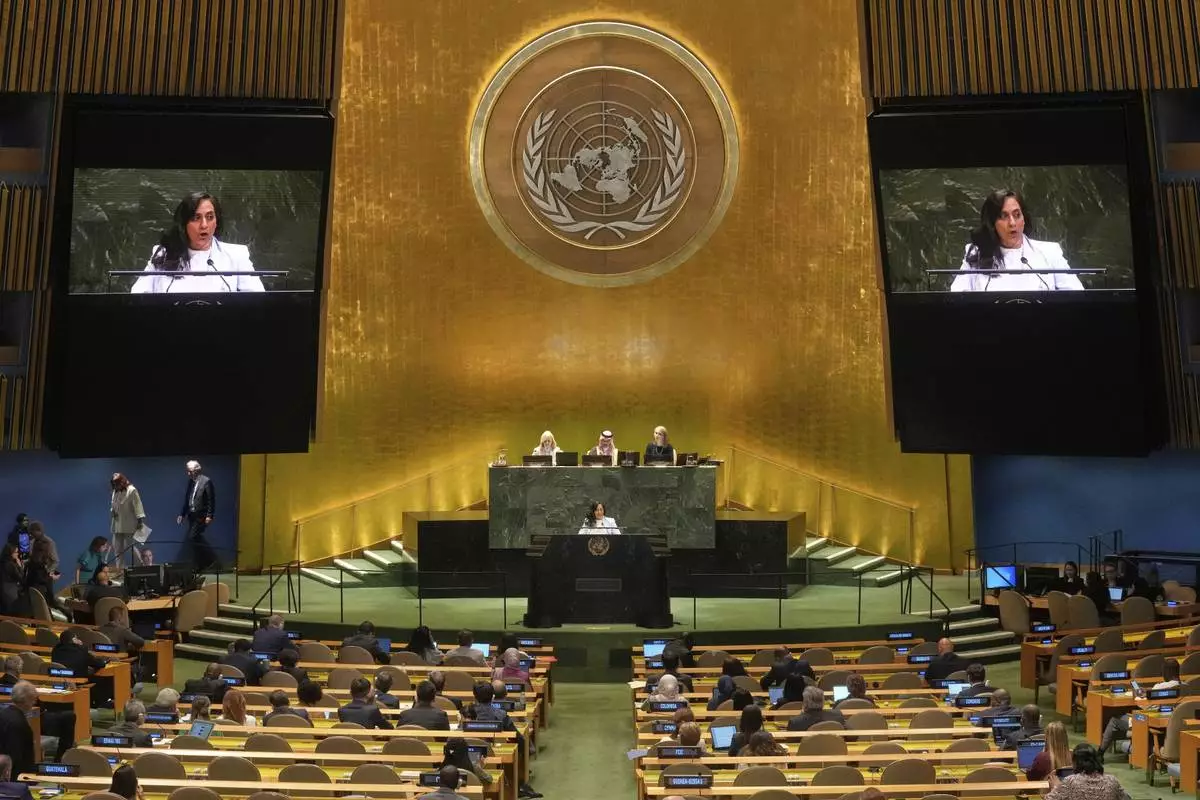
Canada Foreign Minister Anita Anand addresses the United Nations General Assembly, Monday, July 28, 2025. (AP Photo/Richard Drew)

Palestinian Prime Minister Mohammed Mustafa is seen on a interpreter monitor as he speaks during a high-level International Conference for the Peaceful Settlement of the Question of Palestine and the Implementation of the Two-State solution at United Nations Headquarters, Monday, July 28, 2025. (AP Photo/Adam Gray)
HAMIMA, Syria (AP) — A trickle of civilians left a contested area east of Aleppo on Thursday after a warning by the Syrian military to evacuate ahead of an anticipated government military offensive against Kurdish-led forces.
Government officials and some residents who managed to get out said the Kurdish-led Syrian Democratic Forces prevented people from leaving via the corridor designated by the military along the main road leading west from the town of Maskana through Deir Hafer to the town of Hamima.
The SDF denied the reports that they were blocking the evacuation.
In Hamima, ambulances and government officials were gathered beginning early in the morning waiting to receive the evacuees and take them to shelters, but few arrived.
Farhat Khorto, a member of the executive office of Aleppo Governorate who was waiting there, claimed that there were "nearly two hundred civilian cars and hundreds of people who wanted to leave” the Deir Hafer area but that they were prevented by the SDF. He said the SDF was warning residents they could face “sniping operations or booby-trapped explosives” along that route.
Some families said they got out of the evacuation zone by taking back roads or going part of the distance on foot.
“We tried to leave this morning, but the SDF prevented us. So we left on foot … we walked about seven to eight kilometers until we hit the main road, and there the civil defense took us and things were good then,” said Saleh al-Othman, who said he fled Deir Hafer with more than 50 relatives.
Yasser al-Hasno, also from Deir Hafer, said he and his family left via back roads because the main routes were closed and finally crossed a small river on foot to get out of the evacuation area.
Another Deir Hafer resident who crossed the river on foot, Ahmad al-Ali, said, “We only made it here by bribing people. They still have not allowed a single person to go through the main crossing."
Farhad Shami, a spokesman for the SDF, said the allegations that the group had prevented civilians from leaving were “baseless.” He suggested that government shelling was deterring residents from moving.
The SDF later issued a statement also denying that it had blocked civilians from fleeing. It said that “any displacement of civilians under threat of force by Damascus constitutes a war crime" and called on the international community to condemn it.
“Today, the people of Deir Hafer have demonstrated their unwavering commitment to their land and homes, and no party can deprive them of their right to remain there under military pressure,” it said.
The Syrian army’s announcement late Wednesday — which said civilians would be able to evacuate through the “humanitarian corridor” from 9 a.m. to 5 p.m. Thursday — appeared to signal plans for an offensive against the SDF in the area east of Aleppo. Already there have been limited exchanges of fire between the two sides.
Thursday evening, the military said it would extend the humanitarian corridor for another day.
The Syrian military called on the SDF and other armed groups to withdraw to the other side of the Euphrates River, to the east of the contested zone. The SDF controls large swaths of northeastern Syria east of the river.
The tensions in the Deir Hafer area come after several days of intense clashes last week in Aleppo city that ended with the evacuation of Kurdish fighters and government forces taking control of three contested neighborhoods.
The fighting broke out as negotiations have stalled between Damascus and the SDF over an agreement reached last March to integrate their forces and for the central government to take control of institutions including border crossings and oil fields in the northeast.
Some of the factions that make up the new Syrian army, which was formed after the fall of former President Bashar Assad in a rebel offensive in December 2024, were previously Turkey-backed insurgent groups that have a long history of clashing with Kurdish forces.
The SDF for years has been the main U.S. partner in Syria in fighting against the Islamic State group, but Turkey considers the SDF a terrorist organization because of its association with Kurdish separatist insurgents in Turkey.
Despite the long-running U.S. support for the SDF, the Trump administration has also developed close ties with the government of interim Syrian President Ahmad al-Sharaa and has so far avoided publicly taking sides in the clashes in Aleppo.
Ilham Ahmed, head of foreign relations for the SDF-affiliated Kurdish-led administration in northeast Syria, at a press conference Thursday said SDF officials were in contact with the United States and Turkey and had presented several initiatives for de-escalation. She said that claims by Damascus that the SDF had failed to implement the March agreement were false.
——
Associated Press journalist Hogir Al Abdo in Qamishli, Syria, contributed.
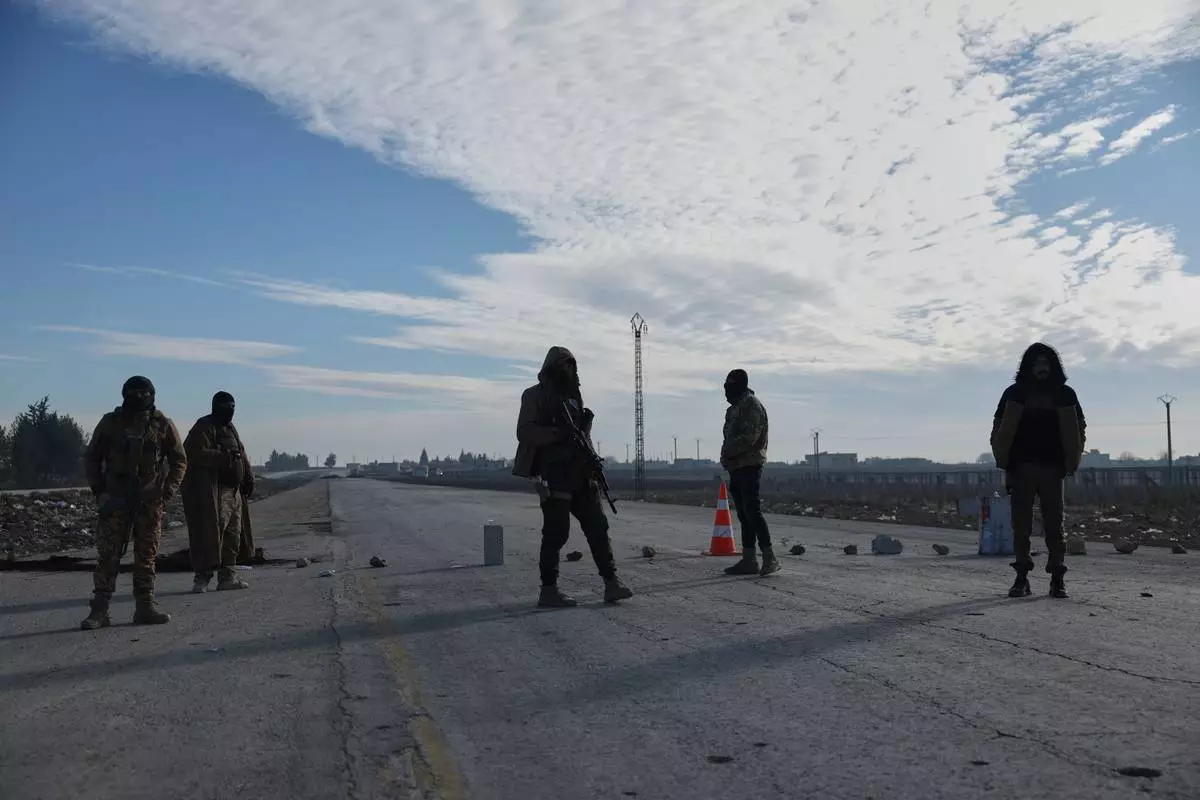
Members of the Syrian military police stand at a humanitarian crossing declared by the Syrian army in the village of Hamima, in the eastern Aleppo countryside, near the front line with the Kurdish-led Syrian Democratic Forces in Deir Hafer, Syria, Thursday, Jan. 15, 2026. (AP Photo/Ghaith Alsayed)
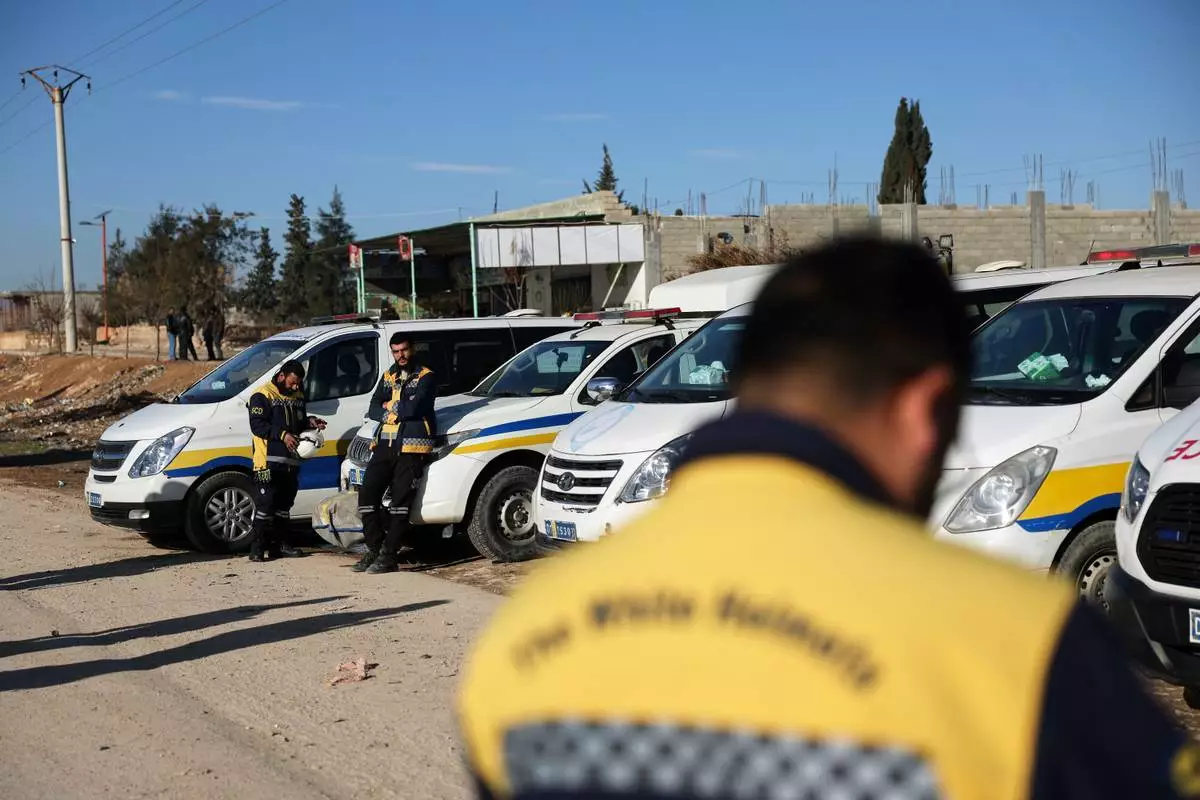
Members of the Syrian Civil Defense, stand next to their vehicles at a humanitarian crossing declared by the Syrian army in the village of Hamima, in the eastern Aleppo countryside, near the front line with the Kurdish-led Syrian Democratic Forces in Deir Hafer, Syria, Thursday, Jan. 15, 2026. (AP Photo/Ghaith Alsayed)

A displaced Syrian family rides in the back of a truck near a humanitarian crossing declared by the Syrian army next to a river in the village of Rasm Al-Abboud, in the eastern Aleppo countryside, near the front line with the Kurdish-led Syrian Democratic Forces in Deir Hafer, Syria, Thursday, Jan. 15, 2026. (AP Photo/Omar Albam)
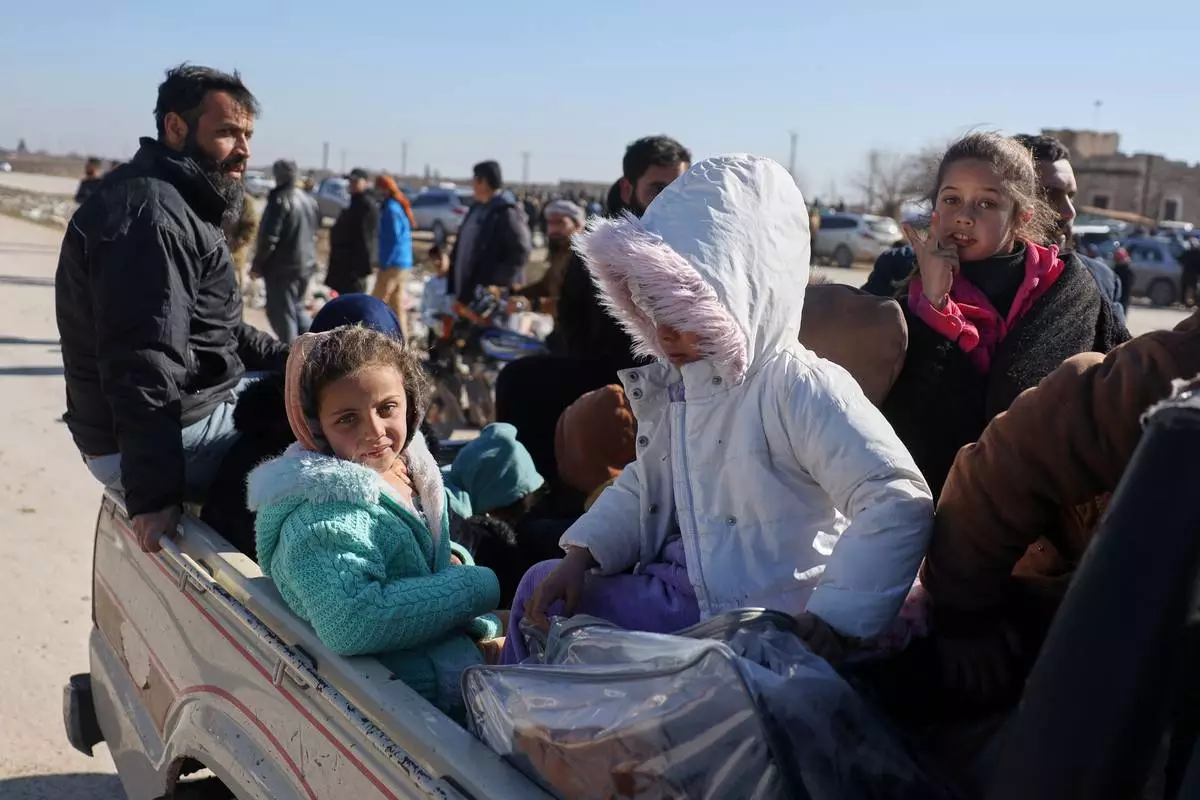
Displaced Syrian children and women ride in the back of a truck near a humanitarian crossing declared by the Syrian army in the village of Hamima, in the eastern Aleppo countryside, near the front line with the Kurdish-led Syrian Democratic Forces in Deir Hafer, Syria, Thursday, Jan. 15, 2026. (AP Photo/Omar Albam)
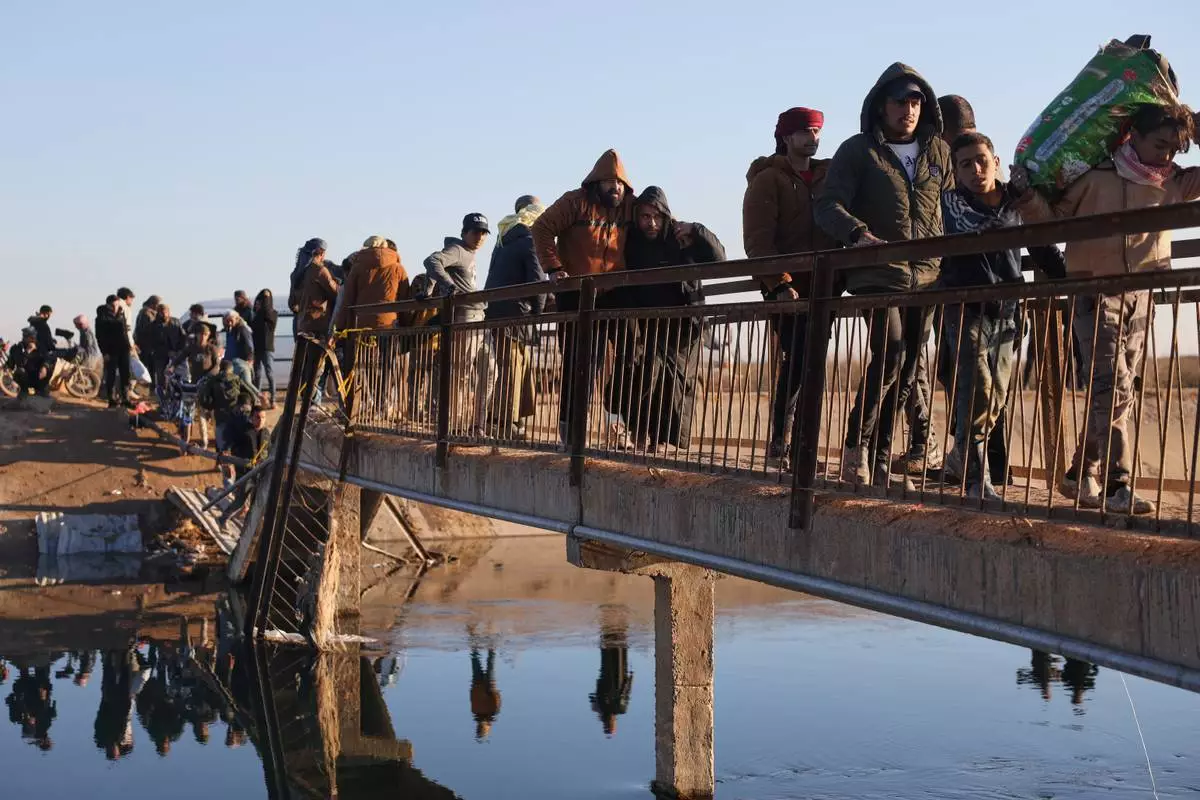
Displaced Syrians at a river crossing near the village of Jarirat al Imam, in the eastern Aleppo countryside, near the front line with the Kurdish-led Syrian Democratic Forces in Deir Hafer, Syria, Thursday, Jan. 15, 2026. (AP Photo/Omar Albam)