China’s first large-scale renewable energy transmission initiative,the Ningxia-Hunan ±800 kV UHVDC project, launched operations on Wednesday, marking a milestone for sustainable infrastructure in desert and barren regions.
It is designed to transmit over 36 billion kilowatt-hours of electricity annually from northwest China's Ningxia Hui Autonomous Region to central China's Hunan Province.
Stretching 1,616 kilometers across five regions—Ningxia, Gansu, Shaanxi, Chongqing, and Hubei, the transmission line terminates in Hunan.
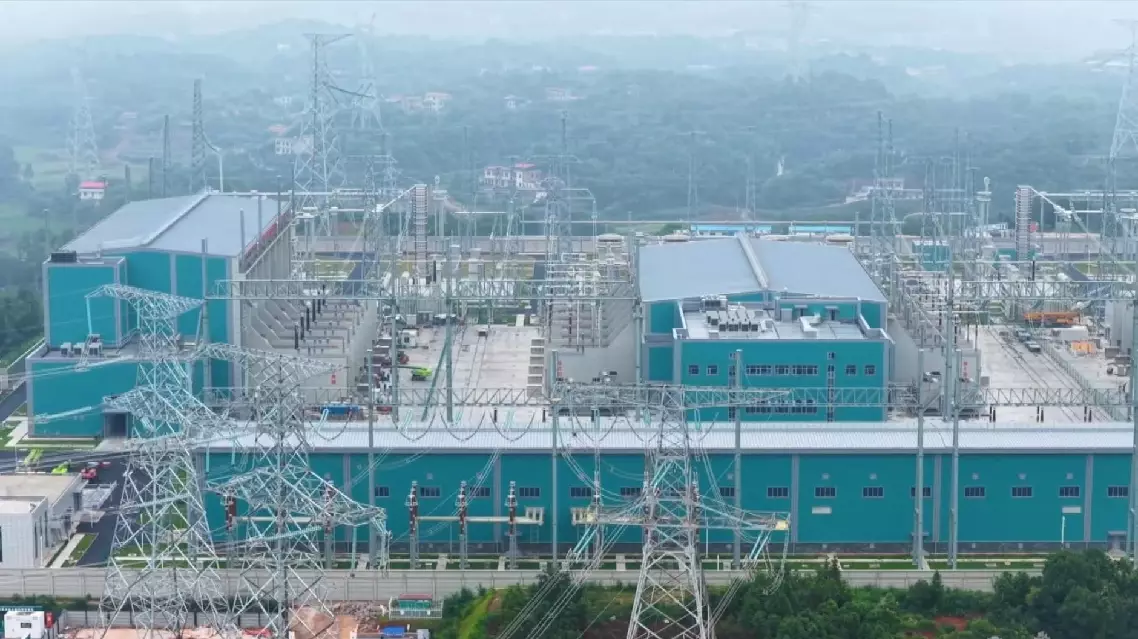
The project includes the construction of new converter stations in Ningxia's Zhongning County, and Hunan's Hengyang City. It boasts a transmission capacity of eight million kilowatts and represents a total investment of 28.1 billion yuan (around 3.91 billion U.S. dollars).
More than half of the electricity delivered will be generated from renewable sources, providing a robust and sustainable power supply that strongly supports Hunan's economic and social development.
"The project was planned and constructed with renewable energy as the absolute main source of outbound power. Renewable installations account for over 70 percent of its capacity. It will strongly support the large-scale development of renewable bases in desert and barren areas, optimize cross-regional energy allocation, help build a new-type power system, and promote coordinated development between central and western regions," said Wang Jin, an engineer from the State Grid UHV Engineering Department.
All equipment used in the project was manufactured domestically. Core components include 14 massive converter transformers—seven ±800 kV and seven ±600 kV units—installed at the Hengyang converter station.
These represent China's first independently designed and manufactured high-end converter transformers for UHVDC projects. Each unit stands 14.8 meters tall, equivalent to a four- to five-story building, and weighs 570 tons. These giants ensure a continuous and reliable power supply to Hunan.
"We conducted comprehensive technical improvements across more than 20 aspects, including manufacturing precision, installation standards, and environmental adaptability. For example, using digital simulation verification technology, we tested over 1,000 scenarios. These ±800 kV ultra-high-voltage converter transformers integrate cutting-edge achievements in materials science, high-voltage technology, electromagnetic field theory, and mechanical engineering. This is not only a technological breakthrough but a masterpiece of power industry innovation," said Chong Yanmin, chairman of TBEA Co.
New UHV power link boosts China's clean energy transmission