Chinese scientists revealed their first comprehensive plan for the near-Earth asteroid defense system at a space exploration conference held on Friday, calling for global partners to work together to protect the safety of this planet.
The Third International Deep Space Exploration Conference was held in Hefei, the provincial capital of Anhui in east China, from Thursday to Friday. Focusing on asteroid exploration, defense and resource utilization, the conference attracted more than 400 guests from over 40 countries and regions.
Chief designer of China's lunar exploration program Wu Weiren said at the conference that within the framework of the United Nations Committee on the Peaceful Uses of Outer Space (COPUOS), Chinese scientists have proposed a strategic concept for asteroid defense development.
The concept covers aspects of monitoring and early warning, in-orbit handling, and systematic response, with the goal of building a comprehensive near-Earth asteroid detection and defense system.
It includes an integrated, space-ground collaborative monitoring and early warning system capable of precise alerts and routine operation, said Wu, also director and chief scientist of the Hefei-based Deep Space Exploration Lab, the conference's organizer.
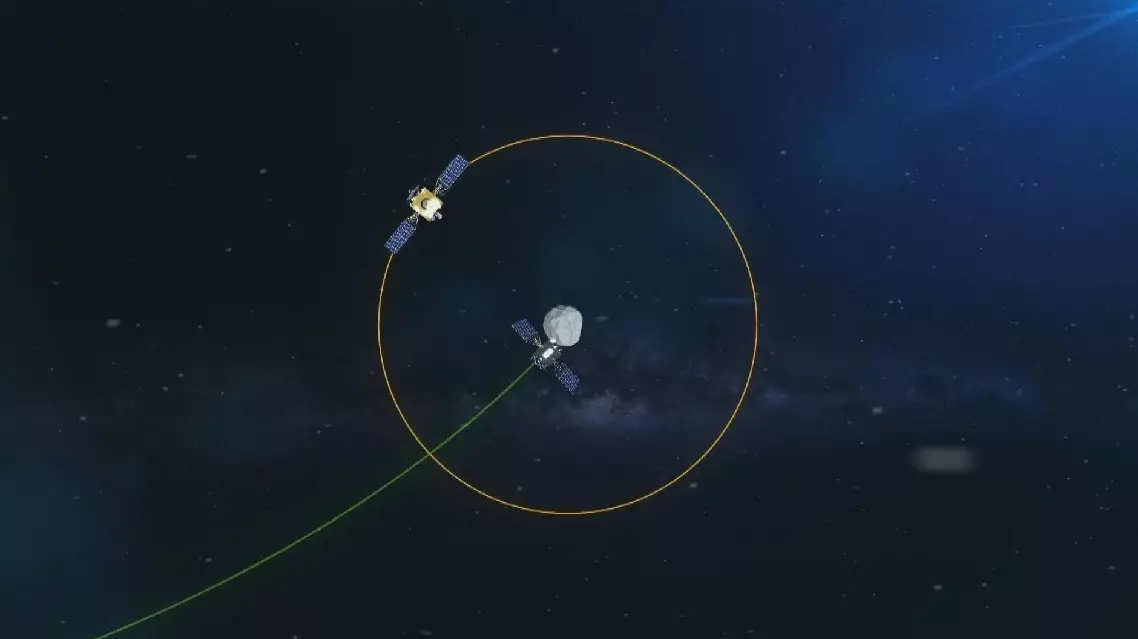
Wu said the mission will follow a "fly-along–impact–fly-along" model, involving both an observer and an impactor spacecraft.
The observer will arrive first to conduct close-up surveys of the target asteroid, collecting detailed physical parameters. The impactor will then strike the asteroid at high speed, while both spacecraft, together with ground- and space-based assets, record the event using advanced imaging technologies to precisely assess the results, he said.
"We are going to launch a kinetic impactor to meet a small celestial body coming towards us at a distance of about 10 million kilometers. The convergence is expected to generate tremendous kinetic energy to change the orbit of this small celestial body. And the strike will prevent it from hitting the Earth again for at least several decades or even 100 years," Wu said. Near-Earth asteroids are among the most potentially hazardous objects in the solar system. It is widely understood in the scientific community that around 66 million years ago, an asteroid approximately 10 km in diameter struck the Earth, leading to the extinction of about 75 percent of global species, including dinosaurs.
China unveils blueprint for asteroid defense mission