MADISON, Wis. (AP) — The top-elected official in Milwaukee County, who rose out of poverty in one of the state's poorest neighborhoods, launched a bid for Wisconsin governor on Tuesday, saying his background and experience in office make him uniquely prepared for the job.
Milwaukee County Executive David Crowley joins the battleground state's Lt. Gov. Sara Rodriguez as the two highest profile Democratic candidates in the 2026 race to replace Gov. Tony Evers, who is retiring after two terms. The race is open with no incumbent running for the first time since 2010.
Crowley, 39, is vying to become the state's first Black governor, while Rodriguez would be the first woman elected to the post. There are two announced Republicans, with several others in both parties considering getting in.
The primary is 11 months away in August.
Crowley told The Associated Press in an interview Monday that he wants to be a “governor for all of us,” focusing on lowering costs for families, affordable health care and housing and fully funding public schools.
“I understand the experiences of what many families are going through,” Crowley said. “It’s really about showing up for people and that’s what people want.”
Crowley grew up in the 53206 ZIP code, which a 2013 University of Wisconsin-Milwaukee study found was the most incarcerated ZIP code in the country, with a majority of men who lived there having spent time behind bars. The area is also known for high rates of poverty, a high concentration of vacant lots and poor health care.
Crowley leans into his background in his launch video, highlighting how his family was once homeless in Milwaukee but he rose to become a community organizer and was elected to the state Assembly in 2016 at age 30. He served until the middle of 2020, when he was elected as executive of Milwaukee County, the state’s largest county. He was the first Black person to hold that job and also the youngest at age 33.
Three years ago, Crowley started pursuing a college degree at the University of Wisconsin-Milwaukee and graduated in December, all while serving as county executive.
“My upbringing has really given me the guiding principles of how I govern," Crowley said. "That's why I stress being the governor for all of us. I know what its like to struggle. I know what it’s like to be poor.”
Rodriguez tried to contrast herself with Crowley in a statement reacting to his candidacy, saying that she brings “a proven record of delivering results across all 72 counties.” Rodriguez, unlike Crowley, has won a statewide election. She won the 2022 primary for lieutenant governor.
Both Crowley and Rodriguez have also targeted President Donald Trump early in the governor’s race. In his launch video, Crowley said that Trump’s “chaos and cruelty means that the Wisconsin that we cherish will perish unless we unite and fight back.”
Rodriguez called Trump a “maniac” in her launch video.
Democrats are hoping to hold on to the governor's office as they also eye flipping majority control of the state Legislature, which Republicans have held since 2011.
Crowley is one of several younger Democratic candidates looking at replacing Evers, who is 73.
Rodriguez is 50, and another likely candidate, state Sen. Kelda Roys, is 46. Former Lt. Gov. Mandela Barnes, who is also mulling a bid, is 38. Attorney General Josh Kaul, 44, is also considering a run.
On the Republican side, Washington County Executive Josh Schoemann, 43, and suburban Milwaukee businessman Bill Berrien, 56, are the only announced candidates.
Berrien derided Crowley as “another career politician” while Schoemann said “Milwaukee County’s dysfunction is the greatest advertisement” for the suburban Milwaukee county where he is the top elected official.
Other Republicans, including U.S. Rep. Tom Tiffany and state Senate President Mary Felzkowski, are considering running.
Tiffany has indicated that he will announce his decision later this month. Felzkowski said last week that she would not run if Tiffany gets into the race and she was undecided about a bid if he declined.

FILE - Milwaukee County Executive David Crowley addresses a crowd on a campaign stop for Wisconsin Supreme Court candidate Susan Crawford Saturday, March 29, 2025, in Milwaukee. (AP Photo/Andy Manis, file)
HAMIMA, Syria (AP) — A trickle of civilians left a contested area east of Aleppo on Thursday after a warning by the Syrian military to evacuate ahead of an anticipated government military offensive against Kurdish-led forces.
Government officials and some residents who managed to get out said the Kurdish-led Syrian Democratic Forces prevented people from leaving via the corridor designated by the military along the main road leading west from the town of Maskana through Deir Hafer to the town of Hamima.
The SDF denied the reports that they were blocking the evacuation.
In Hamima, ambulances and government officials were gathered beginning early in the morning waiting to receive the evacuees and take them to shelters, but few arrived.
Farhat Khorto, a member of the executive office of Aleppo Governorate who was waiting there, claimed that there were "nearly two hundred civilian cars and hundreds of people who wanted to leave” the Deir Hafer area but that they were prevented by the SDF. He said the SDF was warning residents they could face “sniping operations or booby-trapped explosives” along that route.
Some families said they got out of the evacuation zone by taking back roads or going part of the distance on foot.
“We tried to leave this morning, but the SDF prevented us. So we left on foot … we walked about seven to eight kilometers until we hit the main road, and there the civil defense took us and things were good then,” said Saleh al-Othman, who said he fled Deir Hafer with more than 50 relatives.
Yasser al-Hasno, also from Deir Hafer, said he and his family left via back roads because the main routes were closed and finally crossed a small river on foot to get out of the evacuation area.
Another Deir Hafer resident who crossed the river on foot, Ahmad al-Ali, said, “We only made it here by bribing people. They still have not allowed a single person to go through the main crossing."
Farhad Shami, a spokesman for the SDF, said the allegations that the group had prevented civilians from leaving were “baseless.” He suggested that government shelling was deterring residents from moving.
The SDF later issued a statement also denying that it had blocked civilians from fleeing. It said that “any displacement of civilians under threat of force by Damascus constitutes a war crime" and called on the international community to condemn it.
“Today, the people of Deir Hafer have demonstrated their unwavering commitment to their land and homes, and no party can deprive them of their right to remain there under military pressure,” it said.
The Syrian army’s announcement late Wednesday — which said civilians would be able to evacuate through the “humanitarian corridor” from 9 a.m. to 5 p.m. Thursday — appeared to signal plans for an offensive against the SDF in the area east of Aleppo. Already there have been limited exchanges of fire between the two sides.
Thursday evening, the military said it would extend the humanitarian corridor for another day.
The Syrian military called on the SDF and other armed groups to withdraw to the other side of the Euphrates River, to the east of the contested zone. The SDF controls large swaths of northeastern Syria east of the river.
The tensions in the Deir Hafer area come after several days of intense clashes last week in Aleppo city that ended with the evacuation of Kurdish fighters and government forces taking control of three contested neighborhoods.
The fighting broke out as negotiations have stalled between Damascus and the SDF over an agreement reached last March to integrate their forces and for the central government to take control of institutions including border crossings and oil fields in the northeast.
Some of the factions that make up the new Syrian army, which was formed after the fall of former President Bashar Assad in a rebel offensive in December 2024, were previously Turkey-backed insurgent groups that have a long history of clashing with Kurdish forces.
The SDF for years has been the main U.S. partner in Syria in fighting against the Islamic State group, but Turkey considers the SDF a terrorist organization because of its association with Kurdish separatist insurgents in Turkey.
Despite the long-running U.S. support for the SDF, the Trump administration has also developed close ties with the government of interim Syrian President Ahmad al-Sharaa and has so far avoided publicly taking sides in the clashes in Aleppo.
Ilham Ahmed, head of foreign relations for the SDF-affiliated Kurdish-led administration in northeast Syria, at a press conference Thursday said SDF officials were in contact with the United States and Turkey and had presented several initiatives for de-escalation. She said that claims by Damascus that the SDF had failed to implement the March agreement were false.
——
Associated Press journalist Hogir Al Abdo in Qamishli, Syria, contributed.
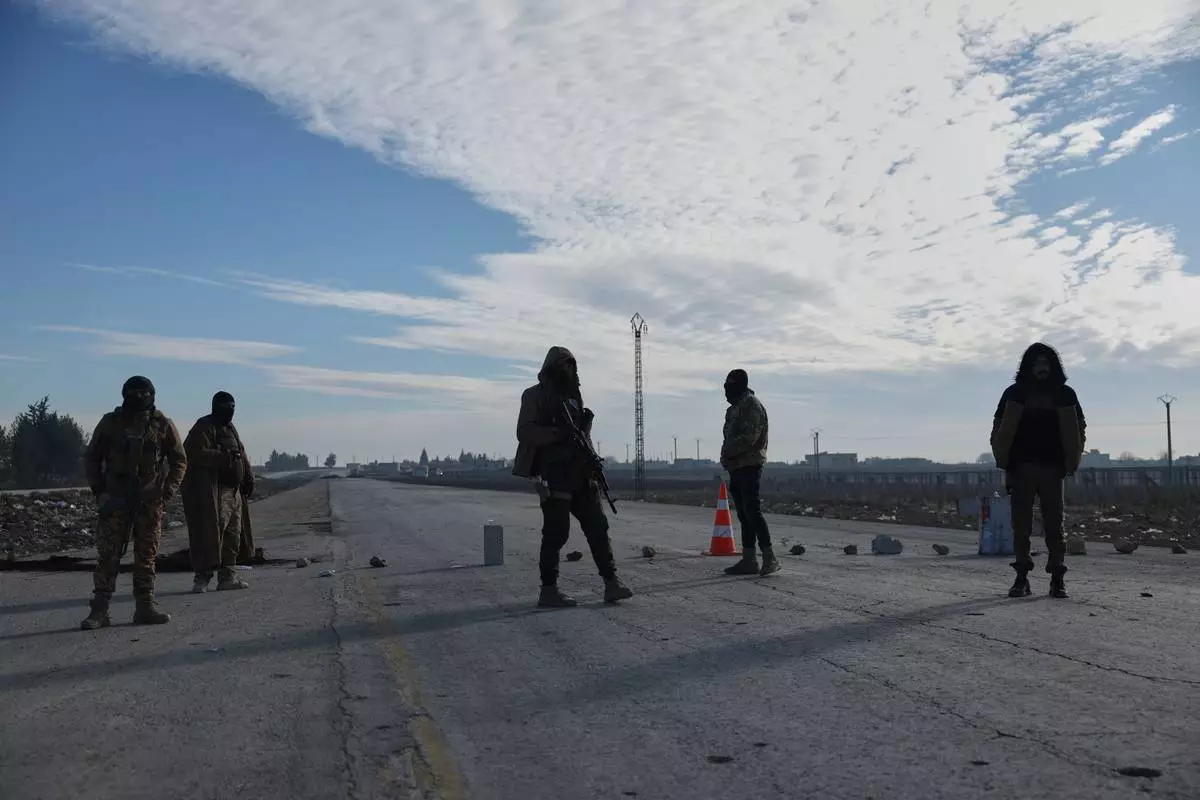
Members of the Syrian military police stand at a humanitarian crossing declared by the Syrian army in the village of Hamima, in the eastern Aleppo countryside, near the front line with the Kurdish-led Syrian Democratic Forces in Deir Hafer, Syria, Thursday, Jan. 15, 2026. (AP Photo/Ghaith Alsayed)
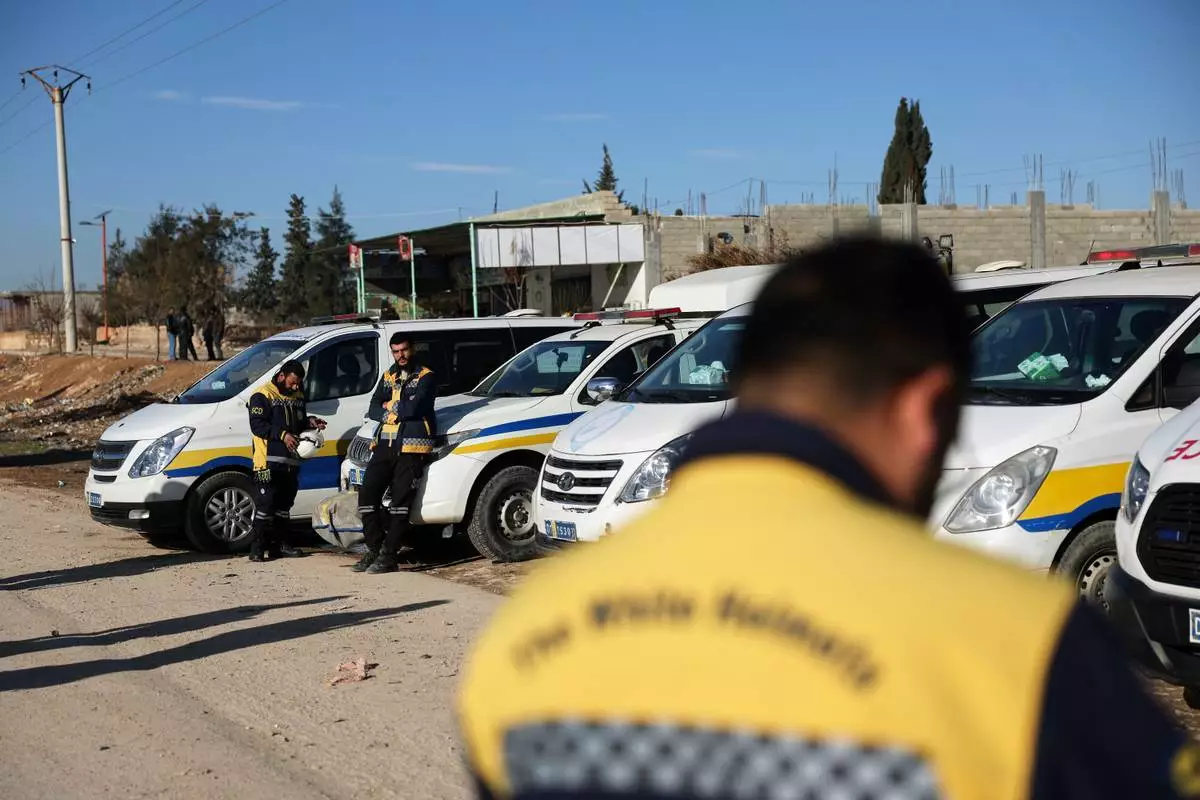
Members of the Syrian Civil Defense, stand next to their vehicles at a humanitarian crossing declared by the Syrian army in the village of Hamima, in the eastern Aleppo countryside, near the front line with the Kurdish-led Syrian Democratic Forces in Deir Hafer, Syria, Thursday, Jan. 15, 2026. (AP Photo/Ghaith Alsayed)

A displaced Syrian family rides in the back of a truck near a humanitarian crossing declared by the Syrian army next to a river in the village of Rasm Al-Abboud, in the eastern Aleppo countryside, near the front line with the Kurdish-led Syrian Democratic Forces in Deir Hafer, Syria, Thursday, Jan. 15, 2026. (AP Photo/Omar Albam)
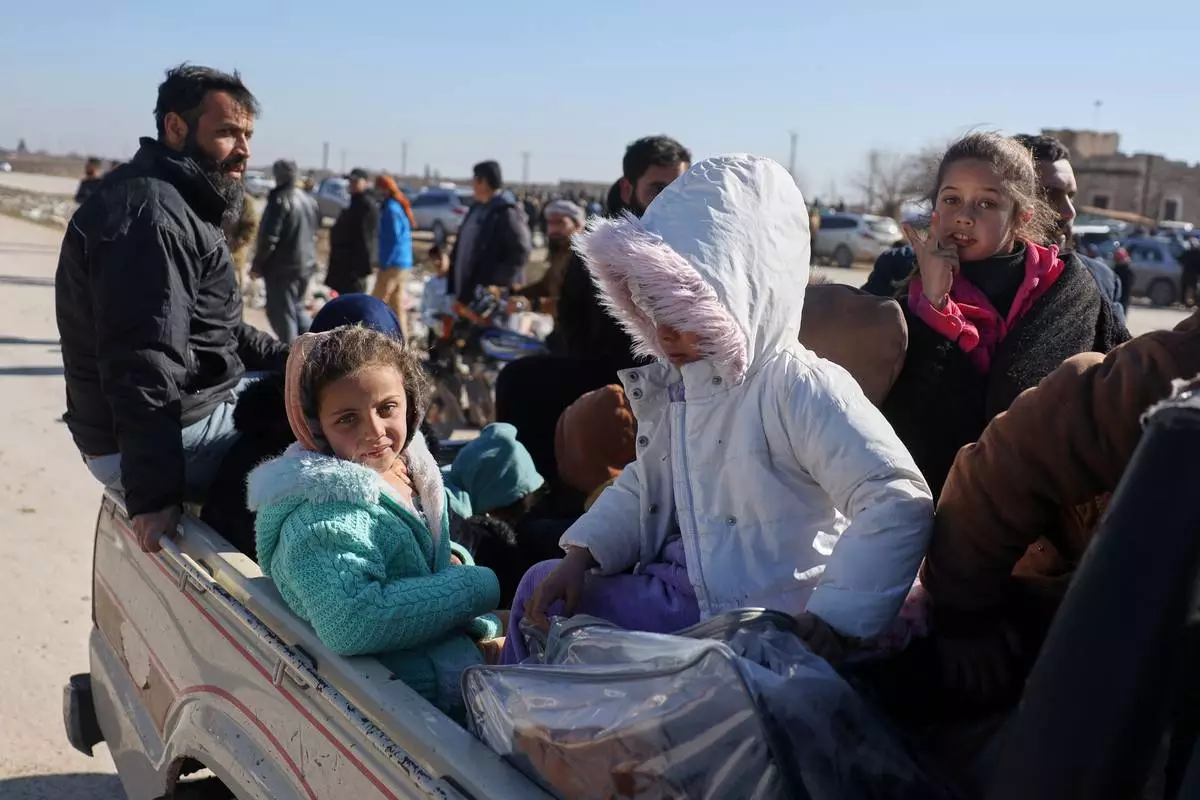
Displaced Syrian children and women ride in the back of a truck near a humanitarian crossing declared by the Syrian army in the village of Hamima, in the eastern Aleppo countryside, near the front line with the Kurdish-led Syrian Democratic Forces in Deir Hafer, Syria, Thursday, Jan. 15, 2026. (AP Photo/Omar Albam)
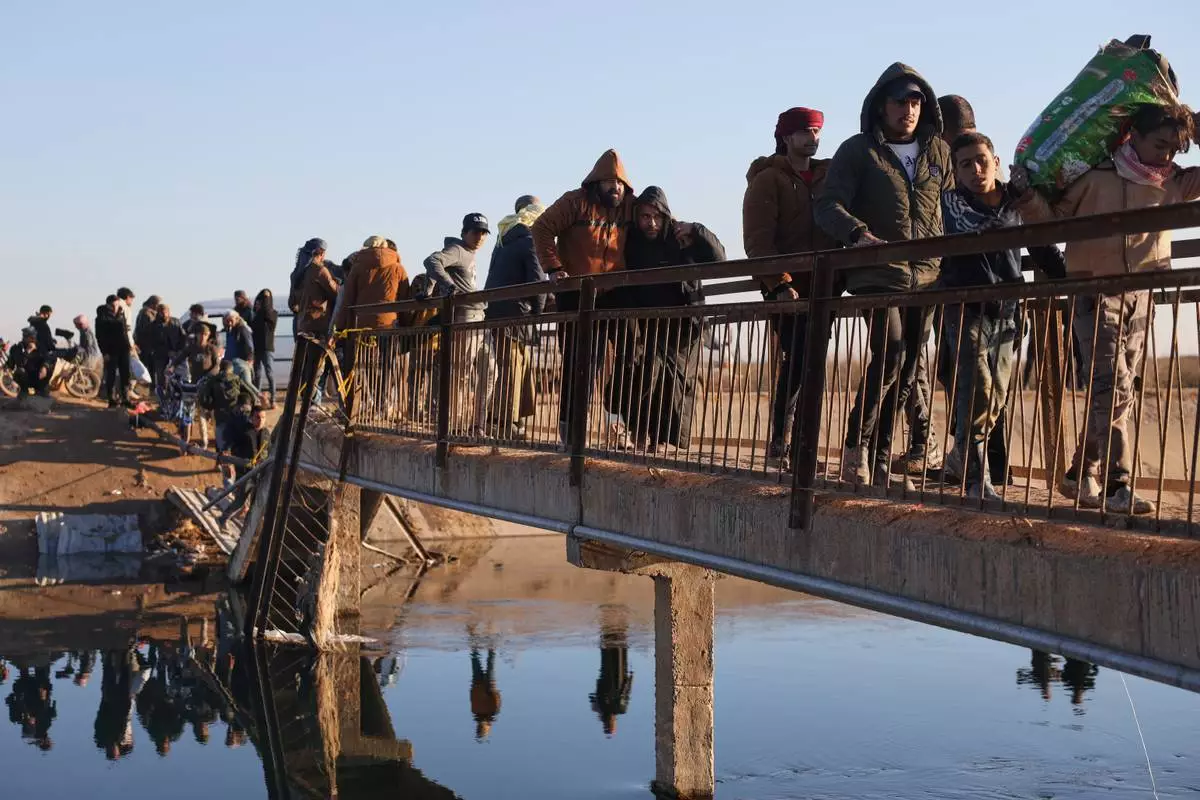
Displaced Syrians at a river crossing near the village of Jarirat al Imam, in the eastern Aleppo countryside, near the front line with the Kurdish-led Syrian Democratic Forces in Deir Hafer, Syria, Thursday, Jan. 15, 2026. (AP Photo/Omar Albam)