Politics has always been a brutal arena, from ancient times to today.
On September 10, Utah Valley University became the scene of a shocking turn when 31-year-old Charlie Kirk—a leading MAGA influencer known for his razor-sharp rhetoric and his role in Trump’s “crush the left, defeat the woke” mission—was fatally shot during a campus speaking tour. As founder of Turning Point USA, Kirk ran multiple social platforms with over a million followers each, traveling colleges to pull young Americans back from the liberal left.
A Lecture Turns Deadly
It was 12:10 p.m. on September 10 when a single shot cracked through the plaza outside the Sorensen Student Center at the University of Utah. The debate, packed with around 3,000 attendees, saw Kirk seated beneath a white tent branded “Prove Me Wrong” as he debated with the audience.
Mid-debate, a voice asked, “How many transgender Americans have been tied to mass shootings in the past decade?” Kirk replied, “Too many.” Applause roared. Then came, “And how many mass shootings overall in the U.S. in that same period?” Kirk shot back, “Does that include gang violence?” No sooner had he spoken than the rifle’s crack shattered the exchange. Kirk collapsed as blood poured from his neck, dousing his white “Freedom” T-shirt in scarlet, and the crowd scattered in panic.
The Old Mauser’s Fatal Echo
The shooter fired from about 150 yards away, using a bolt-action Mauser .30-06 rifle positioned at the Losee Center across campus. That single round proved fatal. Mauser rifles date back to 1874, crafted by the German manufacturer Mauser. Despite their age, these rifles are common in the U.S. hunting market—and at $500 to $800, they remain surprisingly affordable.
Tom Chittum, former ATF (Bureau of Alcohol,Tobacco, firearms and Explosives) deputy assistant director, pointed out that at 150 yards, gravity and wind are barely a factor—hitting a target at that range is within reach for anyone. He notes that non-combat trainees can pass a 350-yard shooting test after just a few days of training, making this shot well within an amateur marksman’s capability.
Yet the most telling detail is that the shooter ditched the rifle on site—an amateur’s careless slip or a pro’s deliberate ploy to leave behind false DNA and fake leads. Running off with a long gun in a crowd isn’t exactly rocket science, so abandoning it either points to inexperience or a calculated move to muddy the waters.
A Bullet with a Message
Whether this was the act of a lone political zealot or a hired gun, the message was unmistakable: the bullet itself was etched with “transgender and anti-fascist ideology.” Striking just after Kirk weighed in on gun rights, the assassin left no doubt—they were standing up for transgender rights and railing against fascism, directly challenging MAGA.
When Trump’s Hope Was Gunned Down
Charlie Kirk wasn’t just another voice on the right—he was MAGA’s front-line recruiter for young voters. Since 2012, his group Turning Point USA has pledged to “discover, educate, train and organize students” under banners of freedom, free markets, and limited government. Over 13 years, TPUSA has ballooned into America’s biggest conservative youth movement, boasting 850 campus chapters. Kirk’s eloquence and genuine faith in his cause set him apart from the plastic politicos like Defense Secretary Herges or DHS head Nome, who, let’s face it, lack real critical thinking.
When Trump was campaigning, Kirk was in Trump’s corner—mobilizing tens of thousands of young swing-state voters and even releasing a “professor watchlist” to name-and-shame academics pushing left-wing agendas. Ironically, this Utah talk marked the kickoff of Turning Point’s “America Rises Again” tour—and Kirk didn’t make it past the opener.
The Deep State Strikes Back
This attack wasn’t a spur-of-the-moment outburst—it was choreographed. Charlie Kirk, the shining hope of Trump’s next-gen conservative wave, was the target. In today’s hyper-radicalized U.S. politics, killings of public figures have graduated from amateur hacks like last December’s CEO assassin to full-blown professional hits. And brace yourself: even if they pin down a suspect, odds are they’re a sacrificial pawn—nobody really buys Lee Harvey Oswald as JFK’s solo gunman.
Make no mistake: America’s deep state has already circled the wagons, hellbent on crushing the Trump side that dared to move their cheese.
Lo Wing-hung
Bastille Commentary
** 博客文章文責自負,不代表本公司立場 **
A person’s luck or misfortune is always a matter of perspective—without something to measure against, there’s no sense of grievance. That’s the story of Jimmy Lai’s fate.
The trial of Jimmy Lai has just wrapped up its closing arguments, and now everyone’s waiting for the judge’s verdict. At the very same time, I stumbled onto a story from America—one that really puts into perspective just how remarkably lucky Jimmy Lai is to be facing justice in Hong Kong.
America’s Instant Judgement: Sink Now, Ask Later
Let’s start with a chilling episode: On September 2, Trump stood at the White House to announce that the American military had attacked and sunk a drug-carrying boat from Venezuela, killing all 11 people on board. Trump’s words were clear: that was a “drug-carrying boat” and there was “A lot of drugs in that boat”. Later he added on his Truth Social platform: “Let this be a warning to anyone contemplating bringing drugs into the United States. BEWARE!”
Just one declaration from the President of the United States—labeling a Venezuelan boat as filled with drugs—and the US military launched a missile, destroying the boat and killing every soul onboard. If you go by the textbook version of Western democracy, suspected criminals should be arrested, brought before a judge, and have the evidence weighed against them. Guilt beyond a reasonable doubt, right? But here, a single presidential order turned into a death sentence—no trial, no evidence, just annihilation at sea.
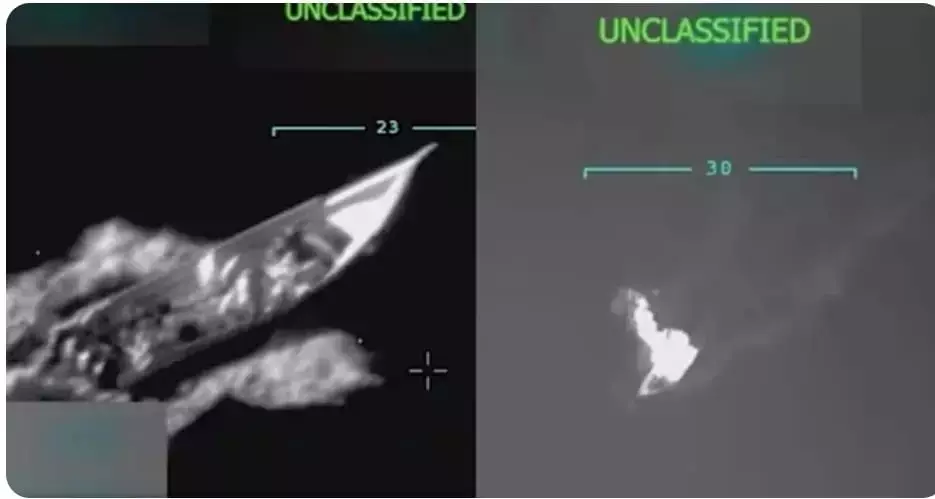
Trump posts video confirming he ordered the sinking of a “drug-carrying boat” of “positively identified Tren de Aragua Narcoterrorists”.
Even in the US, trafficking drugs almost never ends with the death penalty. Federal laws, like the Comprehensive Crime Control Act, restrict the death penalty to the most extreme crimes—typically those where drugs and murder intertwine. Since death penalty reinstatement in 1988, only one person was executed for a drug-connected murder in 2020. There’s never been a modern case of someone executed just for trafficking.
The Eighth Amendment to the US Constitution bans “cruel and unusual punishment.” The Supreme Court also held, in Kennedy v. Louisiana, that giving the death penalty for crimes like simple drug trafficking is unconstitutional. In reality: even if a boat packed with drugs was more than enough for a conviction, executing the suspects without trial would be off the table. So, what gave Trump the right to skip the courts and go straight to killing 11, supposedly just on “intelligence”?
Applying “Trump Logic”: It Could Have Been Worse
Imagine this: By Trump’s logic, if there were an “American Jimmy Lai” who he saw as a severe threat to national security, he could’ve simply duped this guy onto a smuggling boat and obliterated it—no trial, just sunk it at sea with a missile. That’s really terrifying.
Compare that to how authorities handled things here: when 12 fugitives—connected to Lai’s case—tried to flee by speedboat, they were briefly sentenced on the mainland before being handed back to Hong Kong for trial. Now that’s how a system built on law and civilization is supposed to look.
Jail in Hong Kong vs. “Crocodile Devil’s Island”
Jimmy Lai’s son, Sebastien, and the so-called “international legal team” representing him, have been quick to claim Lai is suffering from poor health, harsh treatment, and solitary confinement—that enduring 40°C heat without AC amounts to torture. But the reality isn’t quite so dramatic—especially if you compare it to America’s way of handling detainees.
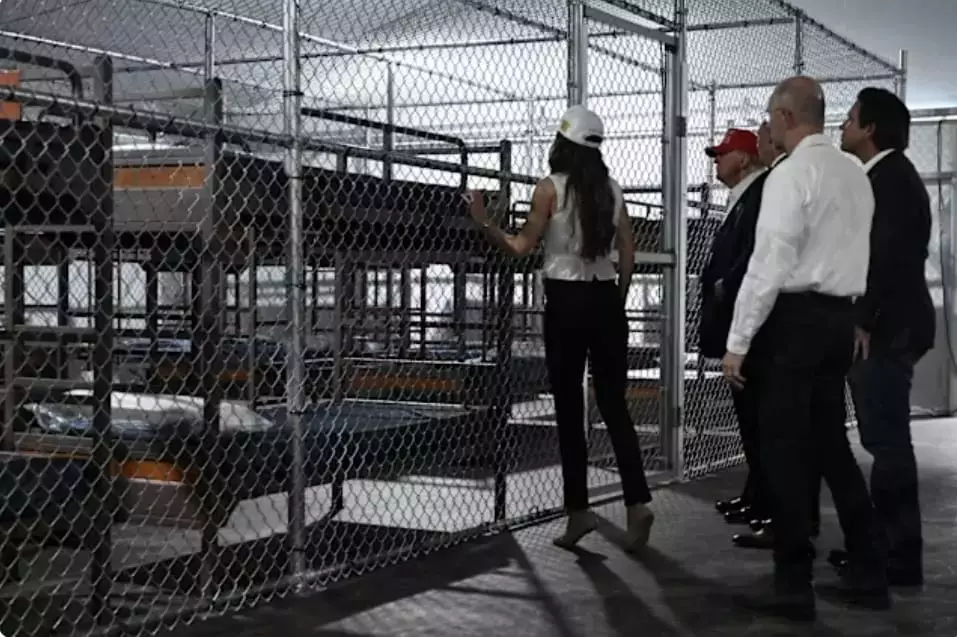
Trump (2nd left) and Homeland Security Secretary Kristi Noem (1st left) tour “Alligator Alcatraz”, inspecting the iron cages where “illegal immigrants” are detained.
The US built a massive detention facility outside Miami, nicknamed “Alligator Alcatraz” because of its alligator-infested swamps. With 5,000 beds, Trump made sure the world knew it was a place to fear. He and Homeland Security Secretary Kristi Noem even did a publicity tour—showing off endless metal bunks inside vast iron cages, purposely designed to humiliate. They paraded through this intimidating compound, emphasizing the cruel environment.
Americans packed detainees—suspected illegal immigrants—into cages, row after row of beds, all to send a public message. Jimmy Lai, by contrast, actually asked for solitary confinement for his own safety—and Hong Kong’s correctional authorities agreed. His family then spun this into claims of “abuse.” Now, if Lai were a Trump critic in America and got thrown in prison, just imagine the “special treatment”: an extra-large super-cage packed with the worst kinds of criminals—murderers, drug lords, and rapists—all crammed together. Would that be “gentle treatment”?
Selective Outrage and Convenient Silence
Sebastien Lai and his overseas supporters have been lobbying so-called human rights organizations, demanding Lai’s release. But as they protest so loudly for him, where was the outrage for those 11 Venezuelans killed on that boat—executed without any legal process? Are these organizations fine with extrajudicial killings, or are they just so afraid of Trump that they roll over and play lapdog when he’s involved?
Bottom line: Jimmy Lai is lucky—standing trial in Hong Kong within a transparent legal system, he’s already far better off than many people elsewhere in the world.
Lo Wing-hung