The Hong Kong government amended its National Security Law implementation rules, making it a criminal offense to refuse providing police with electronic device passwords for accessing data in national security cases.
Such 'unlock orders' are standard practice across Western democracies. Yet the US Consulate General in Hong Kong and Macau seized on this March 16, issuing a travel alert claiming the amendments grant authorities sweeping powers to confiscate personal devices—and assuring US citizens they can contact the consulate if detained.
The Office of the Commissioner of the Ministry of Foreign Affairs in Hong Kong responded swiftly. Special Commissioner Cui Jianchun set up a meeting with US Consul General Julie Eadeh the very next day, lodging formal objections and demanding the US cease interfering in Hong Kong and Chinese internal affairs.
The timing was pointed: the US imposes far stricter device-access rules on travelers entering the US, yet lectures Hong Kong on civil liberties—a textbook case of double standards.
US Double Standards on Device Access
The US Consulate General's travel warning about Hong Kong rings hollow. It reminds me of a case on June 11, 2025 when a Norwegian tourist Mikkelson landed at Newark Liberty International Airport in New Jersey, only to be harassed by US border officers. They grilled him about drug trafficking, terrorism, and far-right extremism—without cause. When he refused to unlock his phone, they threatened him with a $5,000 fine and five years in prison.

A Norwegian tourist told his story that he was deported by the US after his phone contained a meme of Vance.
Mikkelson had no choice. US border officers found a meme on his phone: Vice President Vance's head photoshopped into a bald egg. That image was enough. They deported him back to Norway the same day.
The contrast is stark. Hong Kong police must obtain a court warrant based on reasonable suspicion before demanding phone access in national security cases. US border personnel demand it arbitrarily. Hong Kong's maximum penalty is one year imprisonment; Mikkelson faced threats of five years. The US enforces stricter laws itself, yet issues travel warnings about Hong Kong's comparable requirements. The hypocrisy is hard to miss.
US Interests in Global Destabilization
The United States has a stake in the game. It kindles color revolutions worldwide, topples governments across multiple nations, and deploys military force to meddle in other countries' internal affairs. So it bristles at national security laws—they threaten its ability to destabilize rivals and reshape global politics on its terms.
Fang Haoming, a 26-year-old Iraqi journalist, captured the paradox perfectly in an interview before this year's National Committee of the CPPCC. "This is not a peaceful era," he said. "We simply live in a peaceful country. I hope through my reporting, more people around the world can understand how China has achieved peace."
His story bears this out. Born in Baghdad in 2000, Fang's childhood was ravaged by war. When he was three, in 2003, the United States launched its invasion of Iraq on the claim that the country possessed weapons of mass destruction—a charge it never substantiated. At the UN, US officials presented a small vial of unidentified white powder as evidence. Then the US attacked anyway, overthrowing the anti-US Iraq president Saddam Hussein.
The conflict shattered Fang's family. His childhood memories are filled with air raid shelters and explosions. When war made Iraq uninhabitable, the family fled to Syria as refugees. The displacement devastated their circumstances. His mother, once a PhD holder and English professor, could only work as a restaurant waitress, teaching English at night to supplement the family income.
In 2011, when Fang was 11, he experienced warfare for the second time. Syria erupted into civil war—another US-backed attempt to overthrow a sitting president Bashar al-Assad. Fang’s father made a decisive choice: the family would flee to China and seek stability. After arriving, they settled in Yinchuan, Ningxia. At 11 years old, Fang finally entered a classroom for formal education. That stability, he would later reflect, was extraordinarily precious.
Rebuilding Life in Peaceful China
Fang Haoming completed his primary and secondary education in Yinchuan, Ningxia, then entered Beifang Minzu University in 2017 to study Chinese language and international trade. His original name was Ameen, but he later adopted the surname Fang from his university's name and took the given name Haoming. After graduation, he joined China-Arab Satellite Television as a reporter based in Beijing. Moving to China transformed his life entirely.
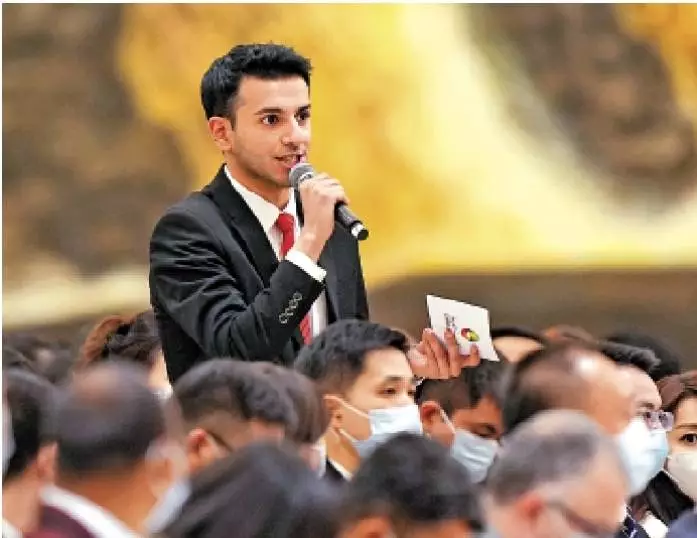
Fang Haoming, who grew up in Yinchuan, Ningxia, China.
Fang Haoming's story reveals how the wars and turmoil launched by the United States have destroyed families. It also shows how China maintains national security and stability, enabling people to rebuild their lives.
This story underscores why safeguarding national security really matters. Those who oppose these laws are precisely those seeking to undermine our country's security and stability.
Lo Wing-hung
Bastille Commentary
** 博客文章文責自負,不代表本公司立場 **
Disaster strikes quietly. When catastrophe unfolds, people rarely grasp its magnitude until it's too late—unaware they're witnessing something unseen for decades.
October 1973. Saudi Arabia and Arab members of OPEC announced an oil embargo against nations supporting Israel in the Yom Kippur War. The blow was swift and severe. My family ran a small leather trading business. My mother called it terrifying—in the year that followed, our shop completed just one transaction and nearly closed for good. That memory stays with me.
Today, the United States and Israel's assault on Iran has ignited a crisis matching 1973. The Strait of Hormuz is no longer navigable. Vast quantities of Middle Eastern oil cannot flow out. Oil prices spike globally. Southeast Asian nations with only 20 days of reserves already face shortages—long queues snake around petrol stations. Our country holds 200 days of strategic reserves, so prices have risen but supplies hold for now. The full horror of this disaster hasn't yet landed.
South Pars Bombed, Gas Flows Cut
Another sector facing a major crisis is natural gas. A significant energy event has quietly unfolded: Iran has completely halted its natural gas exports to Turkey, signaling that Iran's South Pars gas field — the world's largest natural gas field — has had its gas processing capacity essentially paralyzed following Israeli bombardment.
On March 18, the Israeli Air Force launched a missile strike on Iran's South Pars gas field and the Assaluyeh gas processing center, severely damaging two facilities with a combined processing capacity of 100 million cubic meters daily, affecting 20% of Iran's total natural gas processing capacity.
Since 90% of Iran's electricity comes from natural gas power generation, the remaining gas production capacity at South Pars must be prioritized to meet the electricity needs of Iran's 90 million domestic residents, leaving the country with no capacity for exports and forcing it to cut off natural gas supplies to Turkey.
Turkey imports 9.6 billion cubic meters of natural gas from Iran annually, accounting for 14% of its gas consumption. Turkish Energy Minister Alparslan Bayraktar said the country has increased pipeline imports from Russia and Azerbaijan, and is purchasing liquefied natural gas on the spot market. But global energy markets responded swiftly, with European spot natural gas prices rising 15% within days of the Iranian gas field attack.
Iran retaliated by striking Ras Laffan Industrial City, Qatar's energy hub, damaging 17% of Qatar's liquefied natural gas export production facilities, with repairs estimated to take 3 to 5 years. Thus, even if the Strait of Hormuz reopens to shipping and liquefied natural gas can again be exported from Gulf states, both Qatar and Iran's natural gas output have suffered severe damage, reducing global supply and driving up prices.
IEA Warns of Unprecedented Energy Shock
Natural gas isn't just an energy source. Ammonia, a natural gas byproduct, fuels fertilizer production. Helium, extracted alongside it, powers chip manufacturing. When natural gas flows stop, fertilizer and semiconductor plants grind to a halt. Hospital helium supplies dry up. The ripple effects cascade across every industry.
On March 23, Fatih Birol, Executive Director of the International Energy Agency, warned that “At least forty… energy assets in the region are severely or very severely damaged across nine countries.”
Birol's assessment cuts deeper than the 1973 and 1979 oil crises—and sharper than the natural gas shock from Russia's invasion of Ukraine. In both 1973 and 1979, the world lost roughly 5 million barrels daily, triggering global economic upheaval.
Today, daily losses hit 11 million barrels. (Though global oil consumption has doubled since 1973, the proportional impact remains comparable.) The math is stark: current losses exceed both crises combined.
Natural gas tells an even grimmer story. After Russia invaded Ukraine, Europe lost roughly 75 billion cubic meters of gas supply. And the current crisis has wiped out 140 billion cubic meters—nearly double.
Birol frames it plainly: the impact equals two oil crises plus one natural gas crisis hitting simultaneously. Reopening the Strait of Hormuz is the only key to breaking the deadlock.
Fragile Signals Point Toward Diplomacy
The situation is beginning to show some positive signs. Reports suggest the United States is negotiating with Iran through Pakistan as an intermediary.
A recent development offers a glimmer of hope. On the evening of March 23, a container ship called the SELEN departed the UAE bound for Karachi, Pakistan, attempting to pass through the Strait of Hormuz without Iranian permission. As it transited the strait, Iran ordered it to turn back. Managed by Exceed Oceanic Trading LLC in Dubai, the SELEN faced a choice—but Iran chose restraint. Rather than strike it down with a missile, Iran simply advised the vessel to return. A measured response, signaling a de-escalatory posture.
Adding to this cautious optimism, China Ocean Shipping announced Wednesday it is resuming new booking services for routes from the Far East to the Middle East, including Saudi Arabia, the UAE, and Qatar. The move suggests China has negotiated arrangements with Iran on how Chinese vessels can safely transit the Strait of Hormuz.
The window for diplomacy remains open—barely. The United States and Iran must sit down for talks before the global energy crisis fully detonates. The world needs them to press pause on disaster now.
Lo Wing-hung