Skip to Content Facebook Feature Image

“The Art of Donald": I myself don’t know—how could the enemy know?

Blog

“The Art of Donald": I myself don’t know—how could the enemy know?
Blog

Blog

“The Art of Donald": I myself don’t know—how could the enemy know?

2026-04-03 09:52 Last Updated At:09:52

US President Trump's baffling maneuvers have trapped himself in a chaotic command dilemma in the war against Iran.

Online commentary jokes that Donald Trump follows "The Art of Donald", or say, “The Art of Don’t Know”—" If even I know not my next move, how then could the enemy? "—implying that Trump blindly charges ahead, and naturally the enemy can’t decipher his strategy because he has none at all.


Before launching the conflict with Iran, Trump relied heavily on the United States’ military supremacy—aircraft carriers, stealth fighters, Tomahawk missiles, and the THAAD defense system. He assumed a heavy bombardment campaign would either topple the Iranian regime or force it to surrender.

This single-script scenario repeated everywhere like a formula. When Iran’s actual response deviated from the script, Trump, the director, found himself at a loss and resorted to "The Art of Donald."

First, the bluffing

Just over a week ago, Trump concluded the war was unwinnable and called for peace talks with Iran. On March 30, he posted on his self-founded social media platform Truth Social, claiming serious negotiations with a "new, more rational regime" in Iran had made significant progress.

Yet, Trump simultaneously threatened that if talks failed, the US would utterly destroy all of Iran’s power plants, oil wells, and the oil export hub Kharg Island.

The United States keeps sending more Marine Corps troops to the Middle East as a clear show of force, trying to pressure Iran into talks. The goal is to quickly reach a ceasefire and force acceptance of the so-called "15-point ceasefire plan" pushed by the US, effectively demanding total surrender.

But, if deploying troops were so straightforward, Trump would have already sent forces on the ground. His repeated talk of troop deployments is more bluff than action—he is determined to avoid another Afghanistan-style quagmire. Iran has seen right through these empty threats.


Second, the blown cover 

If Russia’s protracted three-year assault on Ukraine has gradually exposed its limits, the United States blew its cover in just three weeks—both diplomatically and militarily. Trump claimed for over a week that talks with Iran were underway, but Tehran has flatly denied it. On March 31, Iranian Foreign Ministry spokesman Baghaei posted on the X platform, rejecting claims of negotiations. He said, "In the past 31 days, we have had no negotiations with the United States. The US has only transmitted a series of proposals to Iran via intermediaries including Pakistan." Baghaei emphasized that Iran hasn't forgotten past failed talks with the US


Trump has essentially been negotiating with thin air. If forced to choose between the US and Iranian accounts, I’d believe Iran. Genuine talks have not happened. The US has merely relayed peace proposals through third parties, with no real bargaining underway.

The US has also revealed military vulnerabilities. After Iran hit the supposedly invincible F-35 stealth fighter jet, on March 27 Iran attacked the US Prince Sultan Air Base in Saudi Arabia, damaging multiple American aircrafts. A $300 million E-3 Sentry Airborne Early

Warning and Control aircraft was struck by an Iranian missile on the runway as it prepared for takeoff, breaking in two—a first for the E-3 in wartime. This incident reveals serious flaws in the US missile defense system, thus allowing Iran’s destruction of such a vital early-warning aircraft.


Earlier, the US aircraft carrier USS Gerald R. Ford had cited a laundry room fire before withdrawing from the Red Sea combat zone. But on March 17, Trump told the audience at a Saudi investment forum in Miami that the Ford was attacked. He said Iranian missiles struck the carrier from 17 different angles, putting the situation on board in grave danger. Trump's unexpected disclosure casts doubt on the official explanation that a laundry fire prompted the Ford’s exit from the Middle East, suggesting it was in fact hit and caught fire.

The US military’s cover is quickly blown in the US-Iran conflict.

Thirdly, Risks and Opportunities 

Trump’s so-called “Art of Donald” lacks a follow-up plan, leaving a deadlock that stalls any deal with Iran. US officials told The Wall Street Journal, in a report published on March 30, that Trump informed aides he would be willing to halt military operations against Iran even if the Strait of Hormuz remains largely closed. Instead, pressure would shift to diplomatic channels to restore free trade flow. Essentially, Trump plans to unilaterally halt hostilities if negotiations with Iran collapse.

With oil prices surging, the whole world must share the burden—Hong Kong included. Yet amid the chaos, Hong Kong finds some opportunities. On March 31, the Ministry of Foreign Affairs confirmed that three Chinese vessels passed through the Strait of Hormuz, including the Hong Kong-registered container ships CSCL Arctic Ocean and CSCL Indian Ocean, which had been stranded in the Persian Gulf for over a month.

Since late February, this is the first time that China’s large ships have transited the Strait, restoring confidence in the global supply chain. Coordinated by the Chinese government, Hong Kong’s container ships remain among the few commercial vessels able to navigate Hormuz. Amid Middle East turmoil, Hong Kong stands out as an alternative stable choice—and it must seize these opportunities.

Lo Wing-hung


Bastille Commentary

** The blog article is the sole responsibility of the author and does not represent the position of our company. **

The Hong Kong government amended its National Security Law implementation rules, making it a criminal offense to refuse providing police with electronic device passwords for accessing data in national security cases.

Such 'unlock orders' are standard practice across Western democracies. Yet the US Consulate General in Hong Kong and Macau seized on this March 16, issuing a travel alert claiming the amendments grant authorities sweeping powers to confiscate personal devices—and assuring US citizens they can contact the consulate if detained.

The Office of the Commissioner of the Ministry of Foreign Affairs in Hong Kong responded swiftly. Special Commissioner Cui Jianchun set up a meeting with US Consul General Julie Eadeh the very next day, lodging formal objections and demanding the US cease interfering in Hong Kong and Chinese internal affairs.

The timing was pointed: the US imposes far stricter device-access rules on  travelers entering the US, yet lectures Hong Kong on civil liberties—a textbook case of double standards.

US Double Standards on Device Access

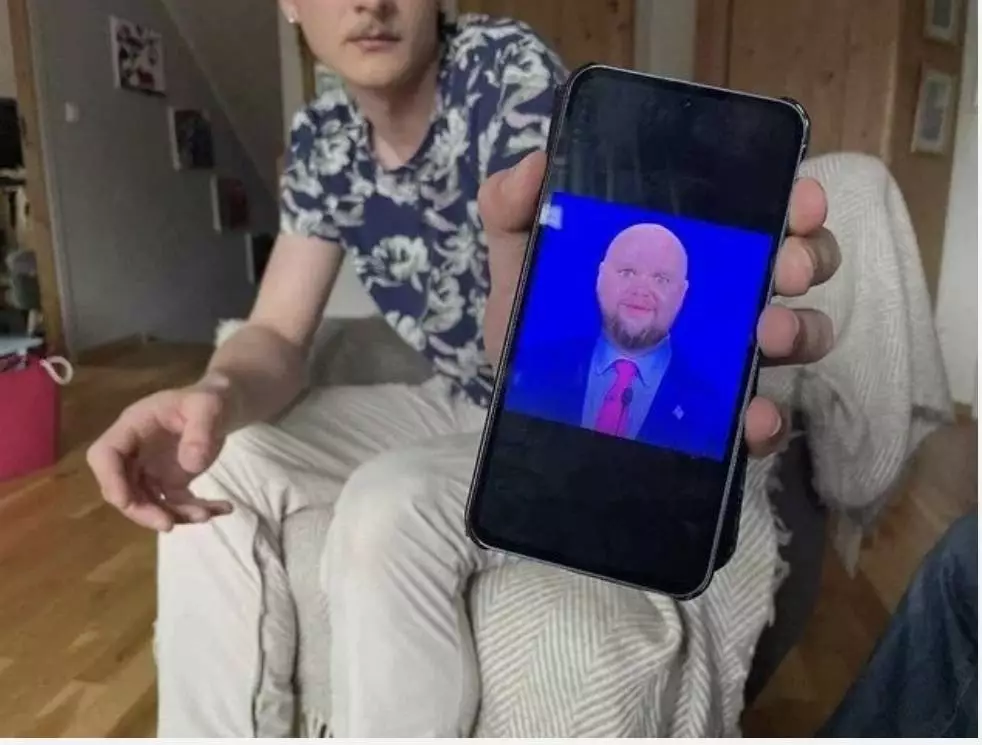
The US Consulate General's travel warning about Hong Kong rings hollow. It reminds me of a case on June 11, 2025 when a Norwegian tourist Mikkelson landed at Newark Liberty International Airport in New Jersey, only to be harassed by US border officers. They grilled him about drug trafficking, terrorism, and far-right extremism—without cause. When he refused to unlock his phone, they threatened him with a $5,000 fine and five years in prison.

A Norwegian tourist told his story that he was deported by the US after his phone contained a meme of Vance.

A Norwegian tourist told his story that he was deported by the US after his phone contained a meme of Vance.

Mikkelson had no choice. US border officers found a meme on his phone: Vice President Vance's head photoshopped into a bald egg. That image was enough. They deported him back to Norway the same day.

The contrast is stark. Hong Kong police must obtain a court warrant based on reasonable suspicion before demanding phone access in national security cases. US border personnel demand it arbitrarily. Hong Kong's maximum penalty is one year imprisonment; Mikkelson faced threats of five years. The US enforces stricter laws itself, yet issues travel warnings about Hong Kong's comparable requirements. The hypocrisy is hard to miss.

US Interests in Global Destabilization

The United States has a stake in the game. It kindles color revolutions worldwide, topples governments across multiple nations, and deploys military force to meddle in other countries' internal affairs. So it bristles at national security laws—they threaten its ability to destabilize rivals and reshape global politics on its terms.

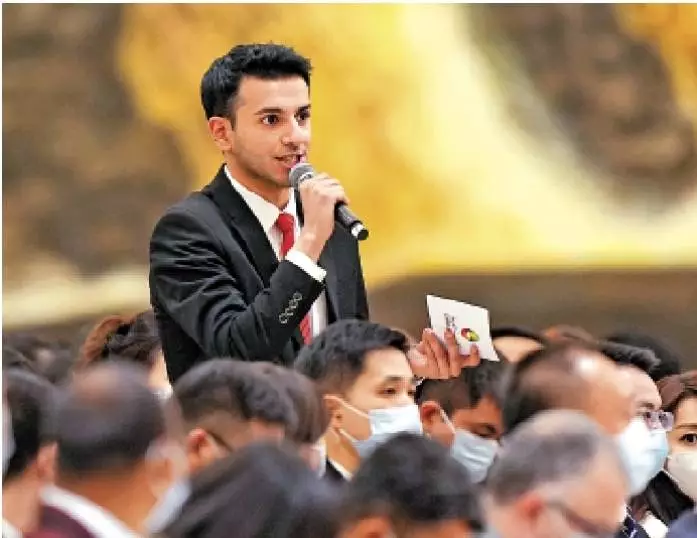
Fang Haoming, a 26-year-old Iraqi journalist, captured the paradox perfectly in an interview before this year's National Committee of the CPPCC. "This is not a peaceful era," he said. "We simply live in a peaceful country. I hope through my reporting, more people around the world can understand how China has achieved peace."

His story bears this out. Born in Baghdad in 2000, Fang's childhood was ravaged by war. When he was three, in 2003, the United States launched its invasion of Iraq on the claim that the country possessed weapons of mass destruction—a charge it never substantiated. At the UN, US officials presented a small vial of unidentified white powder as evidence. Then the US attacked anyway, overthrowing the anti-US Iraq president Saddam Hussein.

The conflict shattered Fang's family. His childhood memories are filled with air raid shelters and explosions. When war made Iraq uninhabitable, the family fled to Syria as refugees. The displacement devastated their circumstances. His mother, once a PhD holder and English professor, could only work as a restaurant waitress, teaching English at night to supplement the family income.

In 2011, when Fang was 11, he experienced warfare for the second time. Syria erupted into civil war—another US-backed attempt to overthrow a sitting president Bashar al-Assad. Fang’s father made a decisive choice: the family would flee to China and seek stability. After arriving, they settled in Yinchuan, Ningxia. At 11 years old, Fang finally entered a classroom for formal education. That stability, he would later reflect, was extraordinarily precious.

Rebuilding Life in Peaceful China

Fang Haoming completed his primary and secondary education in Yinchuan, Ningxia, then entered Beifang Minzu University in 2017 to study Chinese language and international trade. His original name was Ameen, but he later adopted the surname Fang from his university's name and took the given name Haoming. After graduation, he joined China-Arab Satellite Television as a reporter based in Beijing. Moving to China transformed his life entirely.

Fang Haoming, who grew up in Yinchuan, Ningxia, China.

Fang Haoming, who grew up in Yinchuan, Ningxia, China.

Fang Haoming's story reveals how the wars and turmoil launched by the United States have destroyed families. It also shows how China maintains national security and stability, enabling people to rebuild their lives.

This story underscores why safeguarding national security really matters. Those who oppose these laws are precisely those seeking to undermine our country's security and stability.

Lo Wing-hung

Recommended Articles