In the harsh, stony expanse of the Gobi Desert in Wushi County in northwest China's Xinjiang Uygur Autonomous Region, Wang Guoliang has achieved what many deemed impossible: He planted seabuckthorn and made it thrive.
Over the past five years, Wang, a native of Aksu Prefecture where Wushi County is located, has transformed a barren wasteland into a flourishing seabuckthorn forest.
Today, what began as an audacious experiment has expanded across Xinjiang -- from the towering Pamir Plateau to the arid deserts near the Kunlun Mountains -- and even beyond China's borders, with exports of seabuckthorn products reaching Pakistan and soon, Southeast Asia.
Wang's journey was anything but conventional. Originally trained in computer network and engineering, he first encountered the seabuckthorn industry in 2019. By 2020, he had pivoted entirely to the large-scale cultivation of the plant.
"I started working with seabuckthorn in 2019. Since 2020, I have been developing it on a large scale. I originally studied computer science, specializing in networks and engineering. The first time when I planted seabuckthorn, it didn't survive. At that time, I didn't know much about this plant. I thought that as long as I watered it after planting, it would be fine. We conducted a special failure analysis, and found that we needed to learn and practice. At the same time, we had to be more careful. So, when we were planting, we improved some of our methods," said Wang.
By pre-watering the soil, carefully planting the seedlings, gently covering their roots, and watering them again, Wang and his team have achieved a seabuckthorn survival rate of at least 95 percent.
This remarkable success enhanced Wang's confidence in the long-term viability and growth of the seabuckthorn industry across Xinjiang.
"In 2021, we established a Xinjiang seabuckthorn nursery base. We supply seabuckthorn seedlings for all of southern Xinjiang. In the past two years, the highest place we grew the plant is Tashkurgan County on the Pamir Plateau at an altitude of 3,700 meters. The farthest place we grew the plant is at the foot of the Kunlun Mountains in Qiemo County. We've supplied our seabuckthorn seedlings even to Zhangye City in Gansu Province," said Wang.
Wang noted that seabuckthorn's deep, sprawling root system makes it a natural barrier against wind and soil erosion -- a vital tool in ecological restoration.
"Above ground, it (seabuckthorn) is like an umbrella. Underground, it's like a web. The root system of seabuckthorn is very developed. So it plays a huge role in windbreak and sand fixation, especially in moisture retention and soil conservation. Our frontline workers are all local residents. They may not fully understand what we mean by ecology. But they understand one thing: As long as they can grow these trees well, Wushi County will have more clear skies, with sandstorms reduced and our environment improved," said Wang.
Wang's vision goes beyond ecology. He aims to unlock both environmental and economic values from seabuckthorn cultivation.
"We need both ecological benefits and economic value. How do we manage these 11,333 hectares of seabuckthorn? How do we cultivate them into an economic forest, harvest the fruits, and process them into products? Through this cycle, we can address current employment issues. Meanwhile, we can reinvest the profits and value from these products back into the land," said Wang.
Already, seabuckthorn products processed in Tashkurgan County have reached Pakistan. Wang's next goal? Global reach.
"We have exported our products to Pakistan from our processing plant in Tashkurgan County. So, next year, we want to work even harder. First, we need to ensure the quality of our products. Second, we want to export our seabuckthorn products to Southeast Asia through Ningbo and Tianjin ports," said Wang.
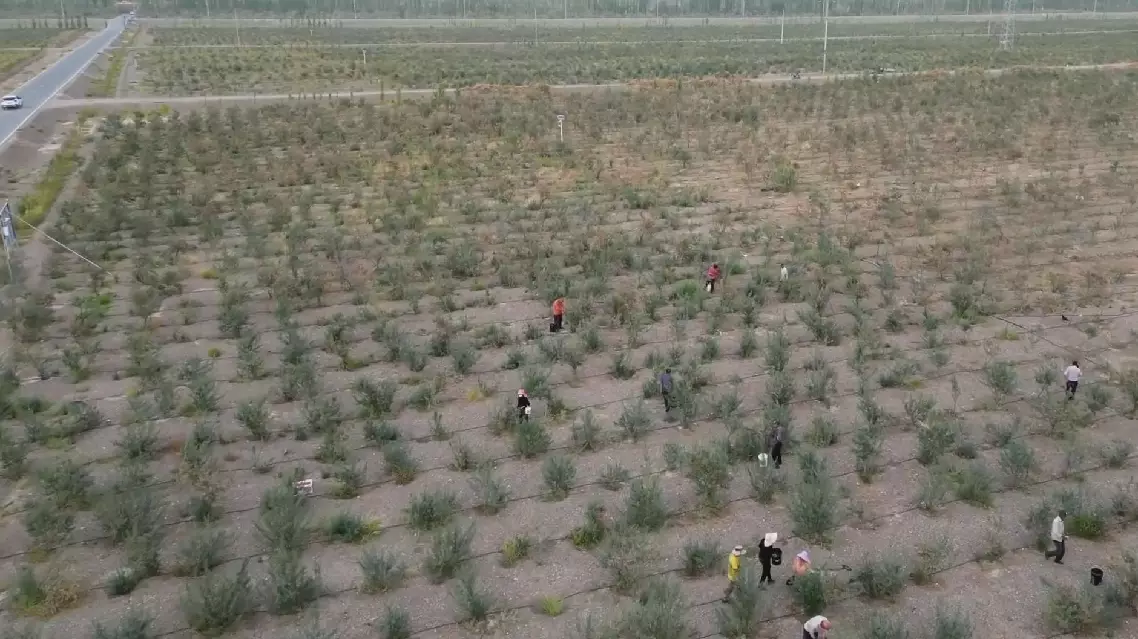
One man's seabuckthorn dream turns Xinjiang's barren Gobi into green miracle