Northwest China's Xinjiang Uygur Autonomous Region, endowed with abundant solar and wind resources, is rapidly becoming one of the nation's primary clean energy engines, delivering social, environmental, and economic benefits and driving China towards its dual carbon goals.
China has committed to peaking carbon emissions by 2030 and achieving carbon neutrality by 2060. In light of these goals, Xinjiang's resources position it as a clean energy hub and critical transmission corridor.
In 2024, Xinjiang’s new energy generation jumped by 30.7 percent to 116.16 billion kilowatt-hours, making up over 80 percent of the region’s total power growth, according to the State Grid Xinjiang Electric Power.
Photovoltaic power generation rose by 65.7 percent year on year to 40.77 billion kWh, while wind power generation reached 75.39 billion kWh, up 17.3 percent compared to the previous year, the company has reported.
In Xinjiang's Wushi County, which lies deep in the Taklamakan Desert and logs about 314 days of sunshine per year, a 493-hectare solar project is capable of satisfying the energy demand of about 430,000 people for one year.
Project members said it helps protect the environment and promote employment.
"Compared to traditional methods, this approach has two key benefits. First, the panel infrastructure stabilizes the soil and prevents erosion. Second, water runoff from the panels irrigates the ground below, supporting sustainable plant growth," said Zhou Bo, head of Wushi Photovoltaic Power Station under China Huaneng Group.
"I started working here two years ago, right after I graduated. The pay is quite good for the area, and I've already been able to buy an apartment in Aksu and a car. Now, I'm getting ready to get married," said Yusan Wuermaiti, an operations and maintenance technician at the station.
Storage facilities allow the solar power to remain usable to 300,000 homes every day, even at night or during cloudy or rainy weather conditions.
Local officials said the project has boosted local economic development and is likely to inspire other regions to follow suit.
"This project creates a great ripple effect. On one hand, we're attracting the companies that actually make the solar panels and equipment to set up factories right here. Then, on the other hand, having a growing, reliable supply of clean energy makes the entire region more attractive for other businesses to come and invest. This model has been a huge boost for Wushi County's economy, and it has the potential to work in other places, too. Of course, it's not a simple copy-and-paste. You have to adapt it to the local economy and the level of government support available," said Gao Wenyi, director of the price certification center under the Wushi County Development and Reform Commission.
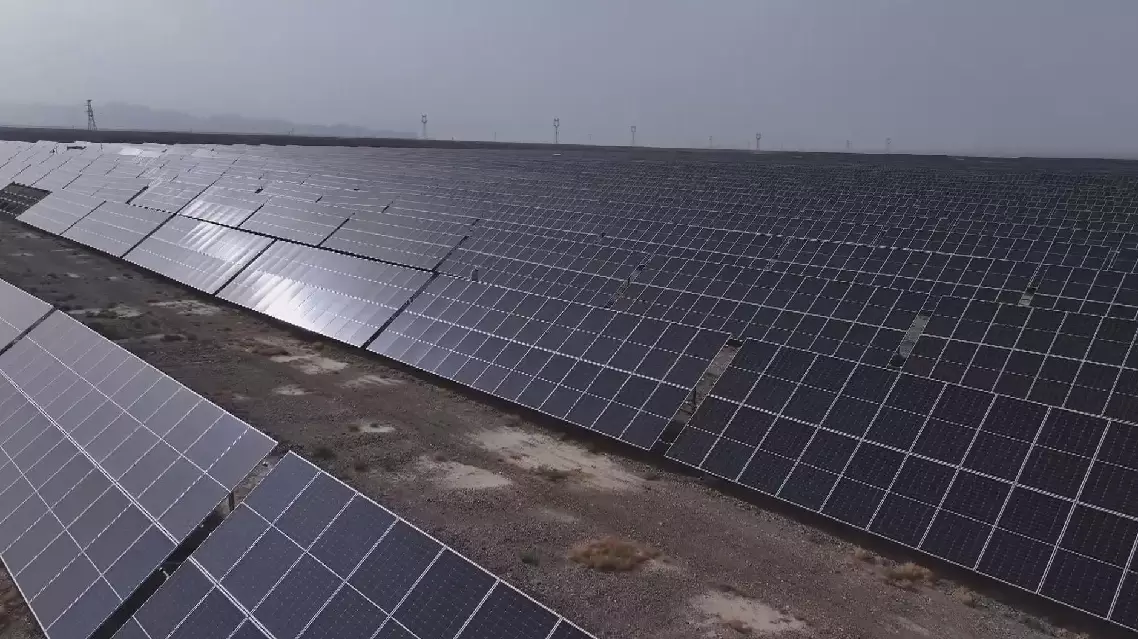
China's Xinjiang turns desert into powerhouse for green energy