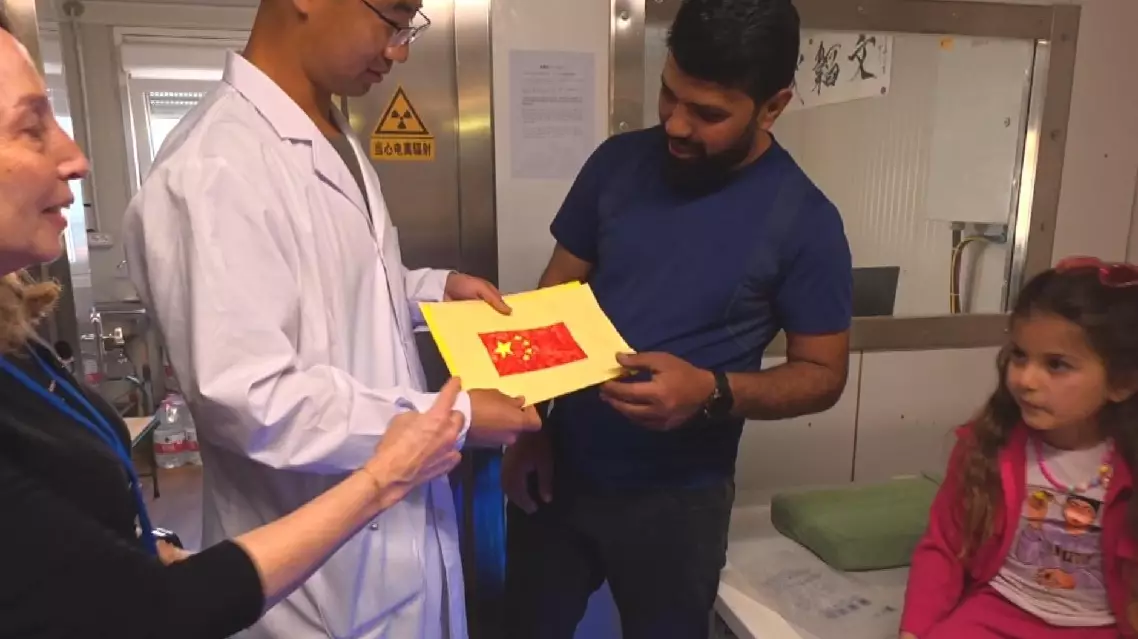
A young Syrian refugee living in Lebanon has drawn the Chinese national flag to show her heartfelt gratitude to the Chinese peacekeeping doctor who healed her broken leg and brought her comfort with exceptional skill and meticulous care.
This is a story featured in the China Global Television Network's (CGTN) special documentary series "Blue Helmets, No Borders", which premiered Tuesday, spotlighting the humanitarian work of Chinese peacekeepers deployed overseas.
Little Elin suffered a leg fracture after a bicycle accident. She was rushed to a hospital run by the medical contingent of the 23rd Chinese peacekeeping force to the United Nations Interim Force in Lebanon (UNIFIL), where Dr. Xin Peng took charge of her case.
"Based on the X-ray results, we determined that her fracture could be treated in a conservative way, because surgery could affect her growth. So we tried manual reduction to spare her the pain of surgery, and it proved to be quite effective," said Xin.
For Elin, whose childhood had been shattered by explosions, trauma, and the loss of loved ones, the hospital became a sanctuary.
"The little girl experienced blast injuries and the loss of family members and friends during her childhood. But in our hospital, she feels peace and care. I believe this will have a positive impact on her childhood, and has helped her to trust us more," said Xin.
From the moment she entered the hospital, Elin felt safe, calm, and even joyful -- free from the fear that so often marred her young life.
Touched by the warmth, kindness, and professionalism of her caregivers, Elin picked up crayons and paper to draw a picture of the Chinese national flag and another picture that represents her feeling when she came to the clinic.
"The entire Chinese medical team works together to provide healthcare support to the local people, which has brought them hope, peace and health. For me, this is the most memorable part [of our mission]," said Xin.
Since 2006, China has maintained a peacekeeping force in southern Lebanon as part of UNIFIL, tasked with missions such as mine-sweeping, project construction, medical rescue and humanitarian assistance.
Young Syrian refugee thanks Chinese peacekeeping doctor with hand-drawn flag
Iran and the United States remained locked in disagreement over control of the Strait of Hormuz during talks in Islamabad, the Pakistani capital, on Saturday, with the Islamic Republic flatly rejecting an American proposal for "joint management" of the strategic waterway.
Two sources familiar with the negotiations said Iranian negotiators insisted on retaining full control of the Strait, including the right to levy transit fees on vessels passing through the key maritime chokepoint.
The issue has emerged as a major sticking point in the negotiations between the two sides, which began on Saturday.
Tensions over the Strait have escalated in recent days.
On Saturday, the U.S. Central Command (CENTCOM) announced that two American guided-missile destroyers, the USS Frank E. Peterson and USS Michael Murphy, transited the Strait and commenced mine-sweeping operations in the Strait of Hormuz.
CENTCOM described the operation as part of an effort to clear mines allegedly laid by Iran's Islamic Revolutionary Guards Corps and to establish a new safety corridor for commercial shipping.
Brad Cooper, commander of CENTCOM, said the new corridor would be opened to the maritime industry soon to facilitate the free flow of commerce. He stressed that the Strait, a vital international waterway, is crucial for regional and global economies.
Additional U.S. forces, including underwater drones, will join the clearance effort in the coming days.
Iran, however, has categorically denied the U.S. account.
On Saturday, a spokesperson for Iran's Khatam al-Anbiya Central Headquarters rejected the American claim that its warships had approached or entered the Strait. The spokesperson reaffirmed that Iran maintains full control over transit through the waterway.
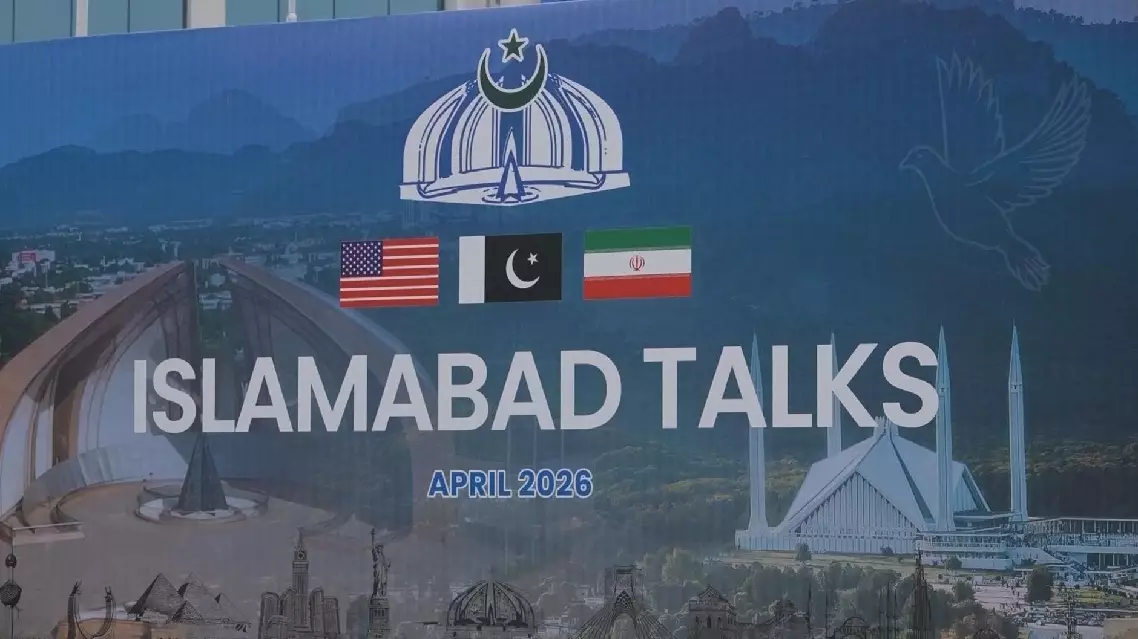
The conflicting statements came as delegations from Iran and the United States are currently in Islamabad for talks on easing tensions in the Middle East after a ceasefire was achieved between the two countries early Wednesday.
Following a meeting between senior officials, Iranian and U.S. expert and technical teams had reached the stage of exchanging texts to develop a joint framework for further talks.
However, the third round of U.S.-Iran negotiations concluded with "serious disagreements," the semi-official Tasnim news agency reported Sunday. According to Tasnim, the Strait of Hormuz and several other issues remain sources of "serious disagreement" in the negotiations held in Pakistan.
Iran's government said on social media that despite the disagreements, negotiations will continue.
The Iranian delegation at the talks includes Mohammad Bagher Ghalibaf, speaker of the Iranian Parliament; Iranian Foreign Minister Seyed Abbas Araghchi; and Ali Bagheri, a member of Iran's Supreme National Security Council.
The U.S. side is represented by Vice President J.D. Vance, President's Middle East Envoy Steve Witkoff, and Special Peace Envoy Jared Kushner.
Iranian officials have previously signaled that any outcome must preserve the country's military achievements and safeguard the rights of its people, underscoring the high stakes of the discussions over the strategic waterway.
Iran, U.S. at odds over control of Strait of Hormuz as Tehran rejects joint management