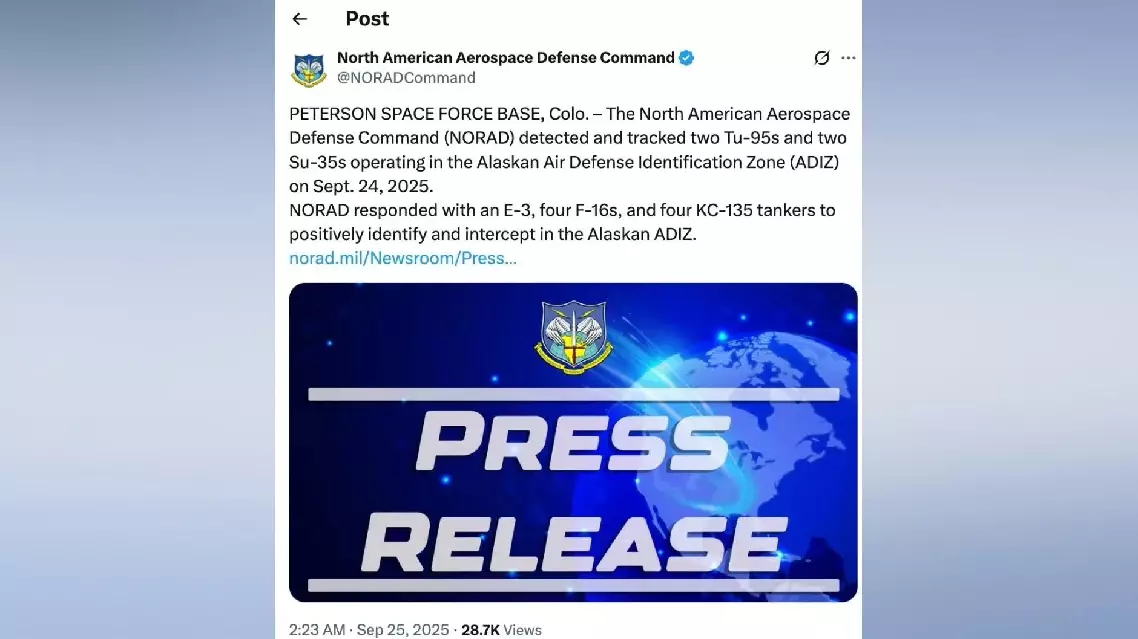
Four Russian warplanes were detected flying near Alaska on Wednesday, the North American Aerospace Defense Command (NORAD) said in a press release on Thursday.
NORAD detected and tracked two Tu-95s and two Su-35s operating in the Alaskan Air Defense Identification Zone, NORAD said.
NORAD responded by dispatching an E-3 early warning aircraft, four F-16 fighter jets, and four KC-135 tanker planes, which effectively identified and intercepted the Russian aircraft, it said.
"The Russian military aircraft remained in international airspace and did not enter American or Canadian sovereign airspace," NORAD said, noting that the Russian activity occurs regularly and is not seen as a threat.
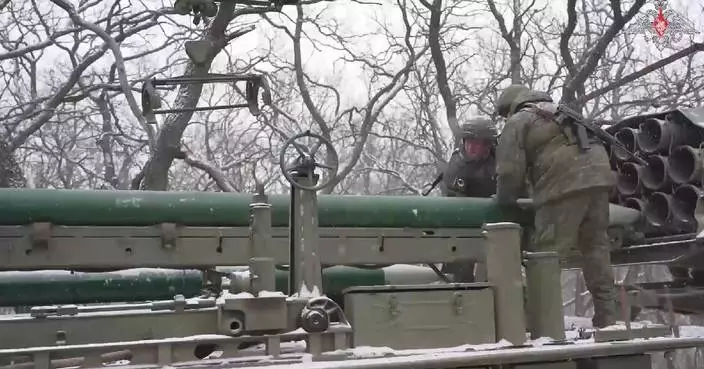
Russian Tu-95MS long-range bombers completed a planned patrol mission over the neutral waters of the Bering and Okhotsk Seas, the Russian Defense Ministry said Thursday.
The flight lasted more than 14 hours, during which the aircraft were escorted by Su-35S and Su-30SM fighter jets, the ministry said in a statement.
At certain stages of the mission, the Russian aircraft were accompanied by fighter jets from foreign countries, it added.
An air defense identification zone begins where sovereign airspace ends and is a defined stretch of international airspace that requires the ready identification of all aircraft in the interest of national security.
It is the ninth time this year NORAD has reported such an incident involving Russian aircraft flying near Alaska, according to its website.
Four Russian warplanes detected flying near Alaska: NORAD
Four Russian warplanes detected flying near Alaska: NORAD
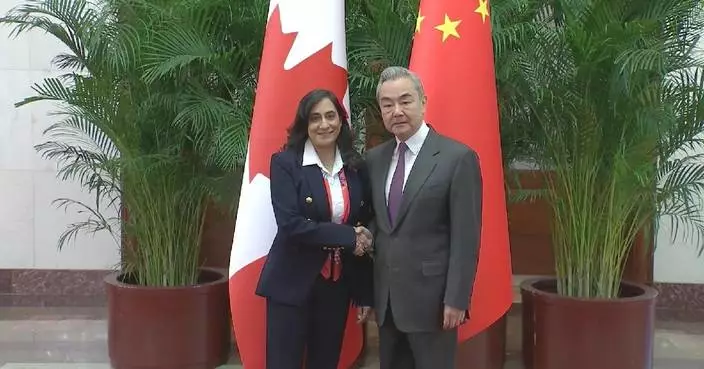
Canadian Prime Minister Mark Carney's official visit to China signals a policy shift towards building a more pragmatic relationship between the two countries, according to a Canadian researcher.
Carney arrived in Beijing on Wednesday to begin an official visit to China through Saturday, which marks the first trip by a Canadian Prime Minister to the country in eight years.
Robert Hanlon, director and principal investigator of Canada and the Asia Pacific Policy Project (CAPPP) at Thompson Rivers University in British Columbia, told the China Global Television Network (CGTN) that Carney's visit indicates Canada is recalibrating its strategic perception of China, which could cement the foundation for the country's economic diversification efforts and boost the development of bilateral cooperation.
"I think it's a clear message that he has moved Canada's strategy to a much more pragmatic, interest-based, -focused relationship with our trading partners, moving away from values-based narratives that we might have heard on previous governments. Canada has spoken about moving from what the Prime Minister's Office is calling "from reliance to resilience", and that means diversifying our economies and our trade everywhere in the world. And so China being our second largest trading partner, it makes perfect sense for our PM to head to Beijing," he said.
The scholar also noted the huge cooperation potential between the two sides in economic and trade fields, citing Canada's efforts to step up shipments of liquefied natural gas (LNG) and the planned construction of an oil pipeline in Alberta which aims to increase export access to Asian markets. "Canada and China both share tremendous economic opportunities together and so finding ways to enhance our exports. Canada specifically looking to build out its LNG and oil, kind of export market. We know Canada is a major producer of critical minerals and China is a buyer. And so there's a lot of synergy between that kind of those kind of markets," he said.

Canadian PM's visit to China paves way for more pragmatic trade ties: scholar