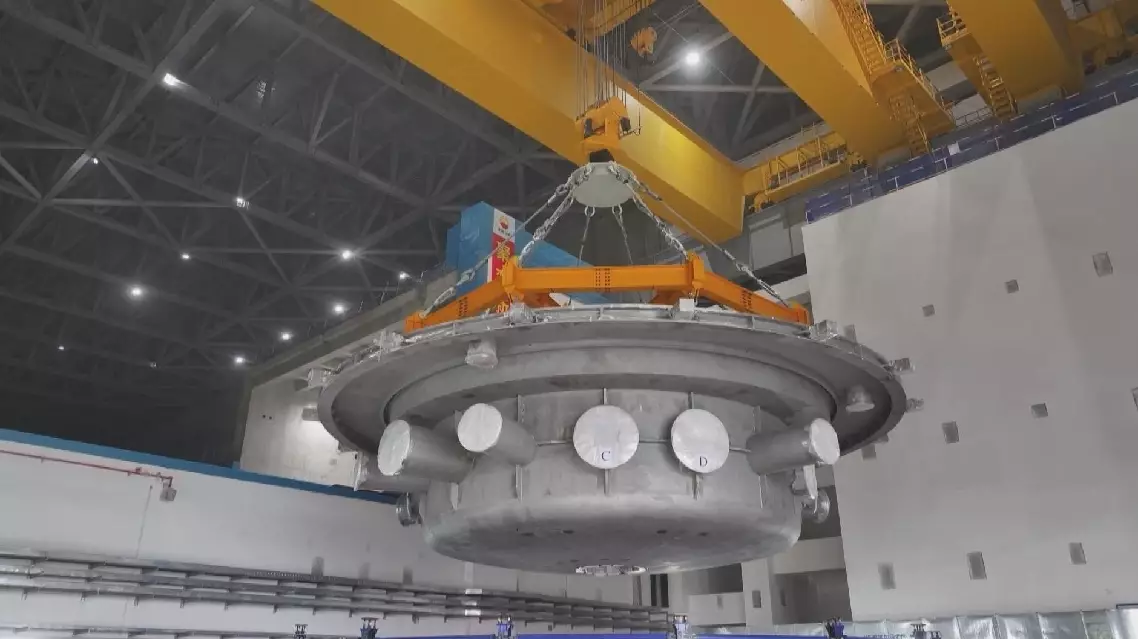
The Burning Plasma Experimental Superconducting Tokamak (BEST), an experimental compact fusion device under construction in Hefei City, east China's Anhui Province, has successfully installed its first key component, the Dewar base, marking a milestone on the path toward the world's first electricity generation from fusion power.
Fusion energy, often hailed as the ideal "ultimate energy source," seeks to replicate the nuclear fusion process that powers the sun.
Unlike previous fusion experimental devices, BEST is designed to demonstrate actual "burning" of deuterium-tritium plasma. Since the project's full-scale assembly began in May this year, the facility has attracted significant public attention.
At the heart of BEST lies the Dewar, a core component that functions like a giant high-vacuum thermos flask. It insulates the superconducting magnets, which must operate at minus 269 degrees Celsius, enabling them to confine plasma heated to over 100 million degrees.
The Dewar base serves as the foundation of BEST and will eventually support more than 6,000 tons of equipment.
Weighing over 400 tons, measuring about 18 meters in diameter and five meters in height, the Dewar base is not only the heaviest single component of BEST's main machine, but also the largest vacuum component ever produced by Chinese fusion research scientists.
With the Dewar base successfully installed, other core components of the main machine will be gradually assembled, meaning the BEST device is on course for completion by the end of 2027.
China achieves milestone in compact fusion project with key component installation
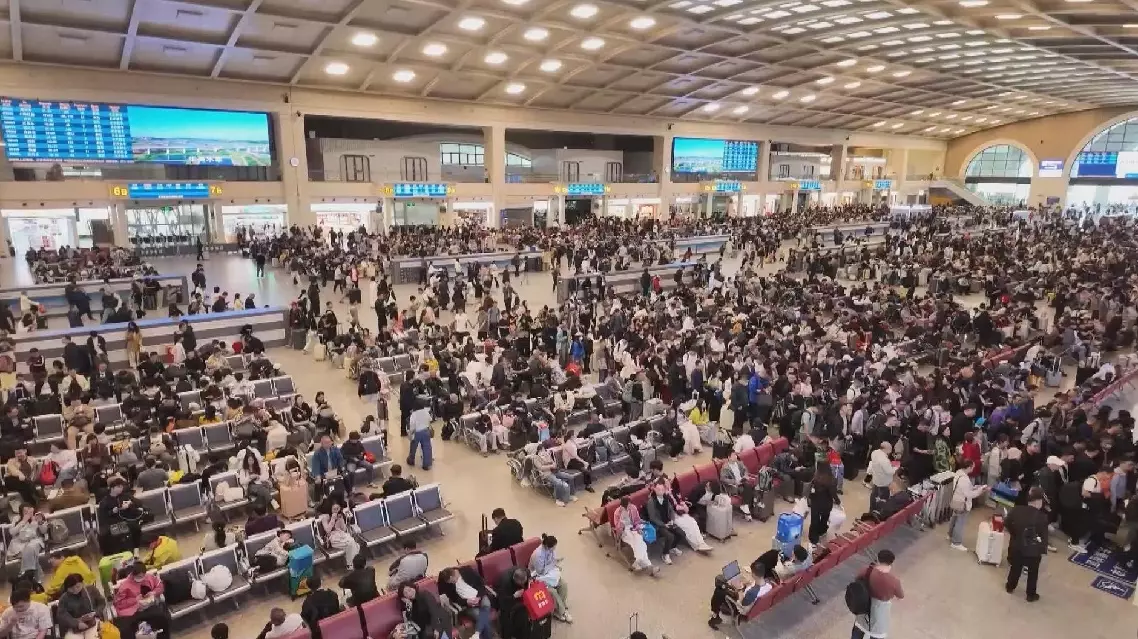
China’s transport authorities mobilized rail, road, air and waterway resources on Tuesday, the final day of the five‑day May Day holiday, to manage the peak return flow as passenger volumes surged nationwide.
The national railway system expects 23 million passenger trips on the day, with operators adding 2,225 extra trains and deploying capacity on popular routes and peak hours to handle the return flow from smaller cities to major hubs.
In Zhengzhou, central China's Henan Province, 134 trains have been temporarily added for high-demand directions including the Beijing-Tianjin-Hebei region, the Yangtze River Delta, and the Guangdong-Hong Kong-Macao Greater Bay Area.
"Railway return travel peaks today. In light of short stops and high passenger volumes, we have strengthened coordination with intermediate stations and offered guidance to passengers for smooth boarding and alighting to prevent crowding and stampedes," said Ji Yudi, a conductor of China Railway Zhengzhou Group.
Regional operators in Beijing, Chengdu and other cities have also proactively coordinated with local transit authorities to extend bus and subway operating hours, increase nighttime service frequency, and boost taxi and ride-hailing availability to ensure seamless transfers for late-arriving passengers.
With respect to highways, the national highway network is projected to record approximately 61 million vehicle trips on Tuesday. The peak traffic window is between 16:00 and 18:00, with congestion and slow-moving traffic likely around major city entry and exit points, as well as airport expressways in major cities like Beijing, Shanghai, Guangzhou and Chengdu.
To ease holiday congestion, traffic police in south China's Guangdong Province have rolled out tidal lanes and flow control measures at 24 key highway sections in nine cities.
"Using a highway interconnect system, we have conducted remote flow diversion. During this morning's peak return period, traffic efficiency on the Erenhot-Guangzhou Expressway improved significantly, showing no sign of congestion," said Dai Zhouwu, a local traffic police officer.
By water, an estimated 1.035 million passenger trips are expected to be made across the country on Tuesday, marking a 1.4-percent increase year on year.
To ensure smooth strait crossing from south China's Hainan Province, the maritime authorities in Zhanjiang City, south China's Guangdong Province have urged operators to supplement fixed sailings with extra voyages and optimized crew rotations to meet surging vessel demand.
Meanwhile, China's civil aviation sector is projected to carry 2.3 million passengers on Tuesday.
The Chengdu Shuangliu International Airport, one of the country's busiest airports in southwest China's Sichuan Province, are offering free luggage pick-up and delivering services to passengers arriving from Beijing, Shanghai, Guangzhou, and Shenzhen.
China’s transport network braces for record May Day return traffic