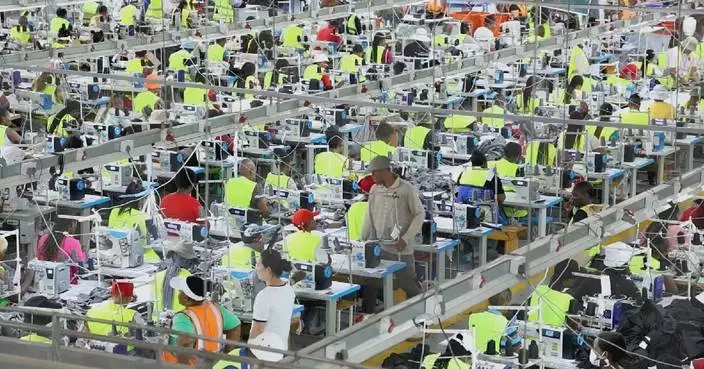
Factories on the Chinese mainland are helping Hong Kong solve its long-standing housing shortage with the construction of 30,000 new "Light Public Housing" units.
The project is enabled by the Greater Bay Area initiative, China's national strategy to develop a world-class city cluster on the country's southern coast, driven by economic reform, innovation and integration.
That connectivity is helping provide an affordable, transitional housing scheme for Hong Kong residents waiting for a permanent rental home.
Cao Meiling is among the thousands who have moved into these transitional units, built in record time for those waiting for permanent public housing. Her unit contains a bright kitchen and proper living space, while a small basketball court stands just outside.
The unit is life-changing, as her husband has been sick for seven years and she is his only caretaker.
"We are a two-person family, but they gave us a larger unit for my husband's wheelchair. The government covers our entire rent here -- 1,630 Hong Kong dollars," said Cao.
The entire light housing project, with over 2,000 units, went from ground-breaking to handing over keys within just one year. The speed construction was made possible by a housing factory in Zhaoqing City of south China's Guangdong Province.
At the factory, Hong Kong entrepreneur Eric Kwong personally oversees the construction project. Taking a page from auto manufacturing, he has developed a method of factory home building called MiC, or Modular Integrated Construction.
"We carry some of the on-site work to the factory, interior fit-out, bathroom and toilet, windows and doors. It will be much shorter construction time, with better waste controlling and also safety," Kwong said.
Each module leaves the factory 95 percent complete before heading to Hong Kong for final assembly. On a busy day, the plant churns out 250 units, slashing construction time by months.
"Basically, it's move-in condition. From the Greater Bay Area, we have all the resources, such as human resources, supply chains. If you compare it to build on-site in Hong Kong, I think you can save at least 10 to 15 percent," said Kwong.
Currently, a third of Hong Kong's population lives in public housing, but more than 200,000 people still live in so-called "coffin homes" - subdivided flats that are barely big enough for a bed to fit in.
The average wait for public housing here is over five years, leaving many people stuck in dense, often unsafe neighborhoods. The Hong Kong government has pledged to eradicate subdivided flats by 2049.
Secretary for Housing Winnie Ho is tightening regulations on subdivided flats and pushing modular construction to close the gap.
By 2027, Hong Kong is expected to have 20 Light Public Housing blocks, comprising the first step in tackling the subdivided unit issue.
"I think Hong Kong has demonstrated the benefit of 'one country, two systems.' We follow the international high standards of our building quality, and in the Greater Bay Area mainland cities, they have very good factories. Without these factories, this cannot be achieved," said Ho.
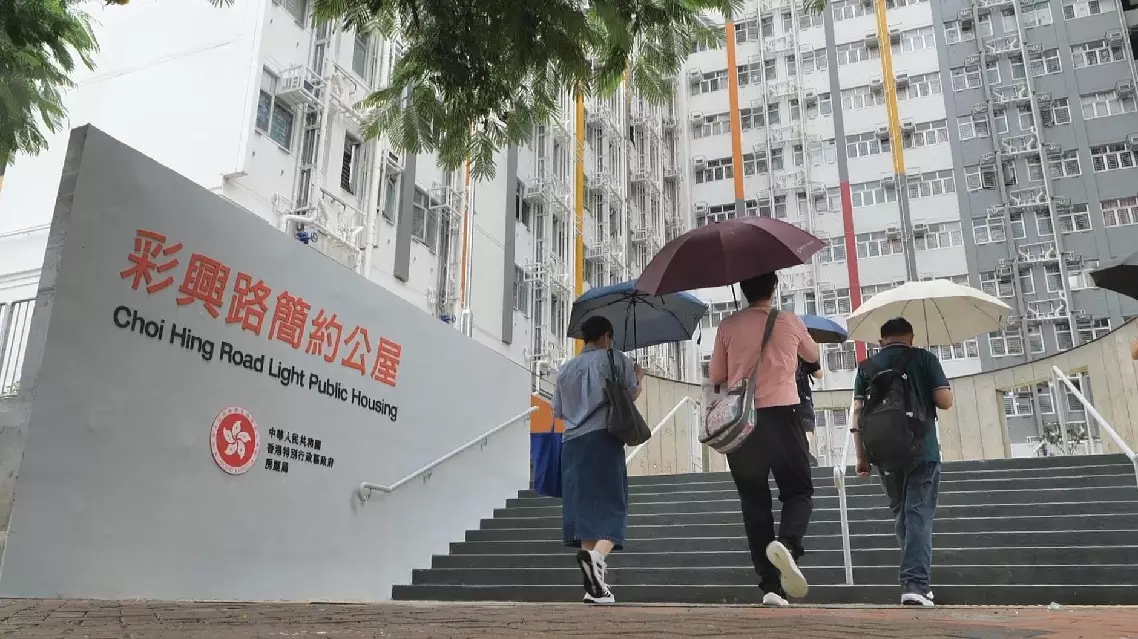
Chinese mainland housing factories speed up HK's affordable housing projects