Guanyang Village, in Nanjing County of east China's Fujian Province, is developing a tourism sector featuring its unique local cultures, buildings and old banyan trees, creating more income and employment opportunities for villagers.
Guanyang Village, along with six other Chinese villages, were named among the 55 new "Best Tourism Villages 2024" by the UN Tourism (UNWTO by 2023), making China the top-ranking country on the 2024 and all-time list.
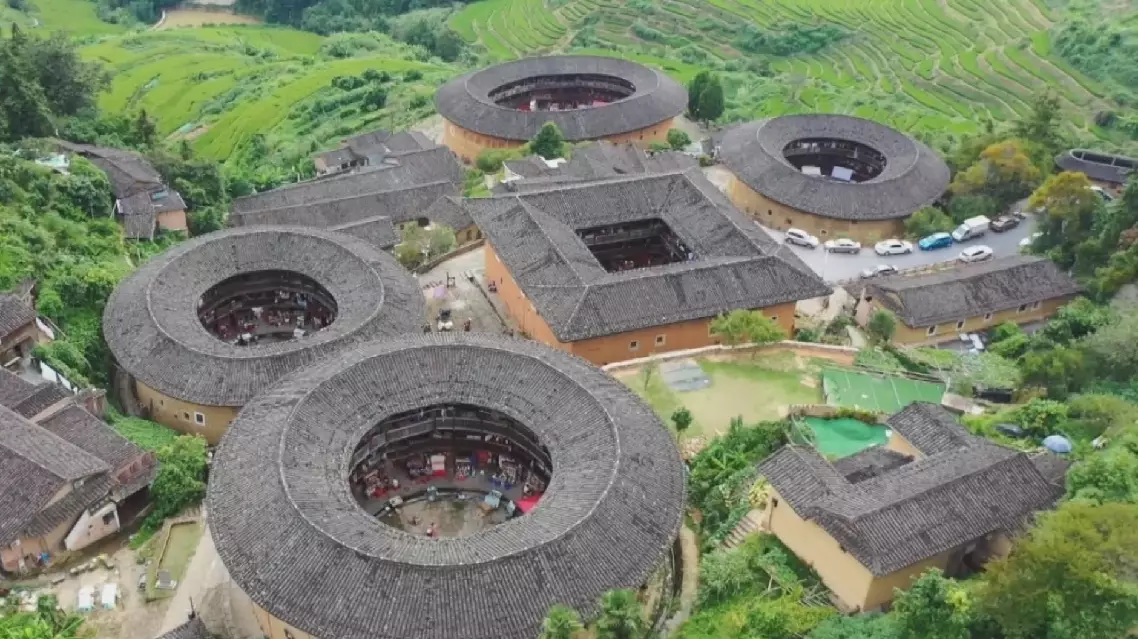
Fujian tulou - a type of large, enclosed and fortified earth building of traditional Hakka communal residence, is one of the most significant symbols of the 700-year-old village.
Huaiyuanlou is a typical example of Fujian's round, inner-corridor-style tulou, with a four-story outer ring building standing 14.5 meters tall.
"Our tulou buildings are mainly made of earth, wood, and large pebbles. The beam structure of the tulou adopts a through-beam type with mortise and tenon joints, so it is strong against earthquakes," said Jian Rongwei, former curator of Nanjing County Museum.
Heguilou is a square, five-story earth building, 21.5 meters in height, making it the tallest known Fujian tulou. Constructed on 3,000 square meters of marshy land, its builders used over 200 pinewood piles to create the foundation. After nearly three centuries, the building remains sturdy and stable.
"It's amazing that our ancestors could build such a building hundreds of years ago. It’s really fantastic," said a tourist from China's Taiwan region.
In 2008, 20 tulou, including Huaiyuan and Hegui, were inscribed on the World Heritage List. This spurred a surge in tourism in Guanyang Village. Some villagers have renovated traditional tulou into guesthouses, preserving their original character while incorporating modern amenities.
"We want to build some unique guesthouse with our local characteristics to show everyone the original state of our indigenous residents. The occupancy rate is good so far," said Jian Zhiming, person in charge of a tulou guesthouse project.
"It's quite comfortable and very quiet. Most importantly, I want to experience the old local and traditional culture, so I came here with my children," said a tourist from northwest China's Shaanxi Province.
The banyan tree group consisting of eight century-old banyan trees is another iconic landscape of Guanyang Village. Many tourists from home and abroad came to see the old trees.
"The tree, actually I saw it from far away. And I said like wow, such a beautiful, tall tree. There is a deep history behind this place, and I truly learned a lot. But also the pleasant feeling I had when I talked to local people here, and all the interactions they made it very happy, pleasant experience, I would say," said a tourist from Poland.
"After more than a decade of development, the average annual income per capita in our village has reached nearly 30,000 yuan (over 4,200 US dollars). There are now more than 20 high-end guesthouses among over 100 hotels in operation. The annual tourist volume has increased from a few hundred thousand in the beginning to more than two million now," said Jian Wenjiong, head of Guanyang Village.
Centuries-old village in Fujian develops tourism with unique tulou buildings, folk cultures