A total of 102 once dried-up springs across China have resumed stable outflow thanks to the country's continuous restoration efforts over the past few decades, sparking inspirations for cultural creative industries and boosting local tourism sectors.
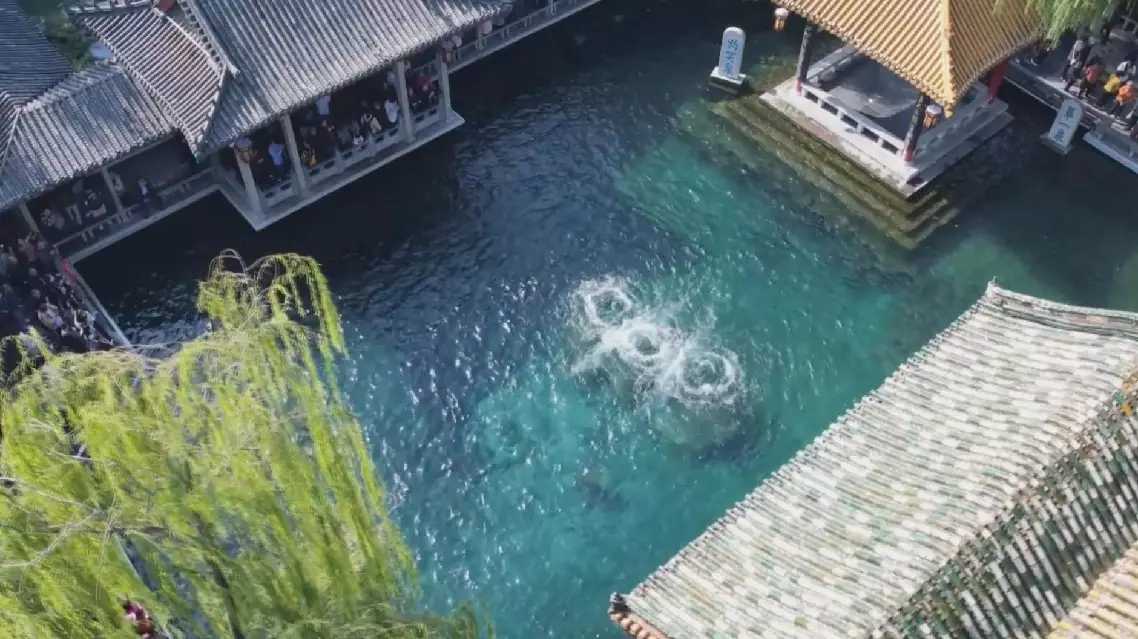
Jinan, known as the "City of Springs" in east China's Shandong Province, boasts more than 1,200 natural springs, among which the Baotu Spring is considered the most famous one and a calling card of the city.
Continuous rainfall since Sept. 27 has led to a sustained rise in the Baotu Spring's groundwater level. As of 06:00 on Tuesday, the spring's water level hit 30.29 meters -- the highest recorded since 1966, sources at the spring's scenic area revealed.
Since the 1970s, the Baotu Spring has seen seasonal hiatus many times, with one of the longest lasting 926 days.
Over the past few years, the local government has striven to protect the spring with water replenishment and improve the ecological environment in the spring's supply area.
The continuous gushing of the spring's three holes has not only fascinated tourists from home and abroad, but also inspired innovations of the cultural and creative sectors, further boosting the city's economic growth and cultural connotation.
"I've heard from the elders at home that the spring once stopped flowing for periods of time, with the longest lasting 926 days. The revival of the spring has not only changed the cityscape but also brought us designers a continuous source of inspiration," said Liu Xinya, a designer of spring-themed cultural and creative products.
At an outlet of the Nanlao Spring in Jinci Temple in north China's Shanxi Province, crystal-clear water poured from a weathered stone dragon's mouth, sparkling in the sunlight as visitors jostled to capture its fleeting cascade.
Jinci Temple, built as a shrine dedicated to the first feudal lord of the Jin State during the early Western Zhou Dynasty (1046-771 BC), houses a wealth of cultural heritage that dates back to the Song Dynasty (960-1279).
The history of the development and use of Jinci springs spans over 2,000 years. The abundant groundwater in the areas surrounding the temple even supported rice paddies until the mid-1990s, though the provincial capital city of Taiyuan is situated on the arid Loess Plateau, where rice cultivation is typically challenging.
However, the flow of Jinci springs gradually diminished due to excessive groundwater extraction and large-scale coal mining that began in the 1950s, ultimately leading to their drying up in 1994. Since then, the water level in the vicinity of the springs has continued to drop by approximately two meters annually, reaching its lowest point in 2008 at 27.76 meters below the spring's outlet.
The revival began with rising groundwater levels, followed by small springs bubbling up, and finally, the Nanlao Spring resumed its natural flow on May 14, 2023. Since them, the spring has experienced increasingly stable flow and higher water levels each year, ultimately reaching 1.23 meters above the outlet this year and achieving 332 consecutive days of continuous flow by the end of July.
Visitors, both locals and tourists, are flocking to Jinci to see the revitalized historic spring. The temple received 457,000 visits in July, setting a new record for that period of time of year.
"Over the past few years, through a series of measures such as water replenishment, coal mining restrictions and increased greening, the Nanlao Spring resumed natural flow in May 2023 and has now achieved stable outflow. Now the spring looks exactly as what I saw in my childhood. With the spring's revitalization, more visitors have been attracted to the Jinci Temple, while the agricultural, cultural and tourism industries in the surrounding villages have also been energized," said Zhao Jinsheng, a local shutterbug.
The revival of this ancient spring required persistent efforts over three decades, including significant reductions in groundwater utilization, measures to replenish the springs, the closure of nearby coal mines, and afforestation initiatives.
Reducing groundwater use became imperative, and in 2019, a project was launched to connect nearly 100,000 residents across 61 villages in Jinyuan District, home to Jinci Temple, to the municipal water supply sourced from the Yellow River diversion project, ending their long reliance on well water.
The project resulted in the closure of 54 wells and an annual reduction in groundwater extraction by 6 million cubic meters. Moreover, Shanxi was designated as a national pilot province for controlling groundwater over-extraction in 2018, granting Taiyuan access to special funding from the central government to support these efforts.
Under the continuous water managements and restoration efforts, many previously dried-up springs in Xingtai City, north China's Hebei Province have also successively come back to like.
The spring area in Xingtai and some surrounding areas covers 3,843 square kilometers, encompassing Xingtai’s urban area, as well as counties like Neiqiu and Shahe.
Historically abundant in water resources, Xingtai faced challenges in the 1980s as urban expansion and economic development led to significant declines in groundwater levels. Meanwhile, after years of implementation of water management projects and restoration efforts, many of the once dried-up springs resumed outflow.
"Today, I will show you how springs have brought us a new way of life. Xingtai has historically been a place rich in water resources and fertile soil, with numerous springs. However, in the 1980s, with the expansion of urbanization and economic development, the groundwater level continuously dropped, leading to a gradual decrease and cessation of spring flow. After years of sustained management, since 2022, 16 springs in Xintai's main urban area have successively resumed their flow," said Lu Lijun, chief of a creative industry park that aims to transform idle industrial plants into a creative cultural space integrating art studios, art institutions and creative exhibitions.
The creative town has integrated the city's spring resources into cultural innovation and tourism, attracting people to admire the beauty of the springs and experience the city's profound culture inseparable with the springs.
Improving ecological system helps revive ancient springs in China