Skip to Content Facebook Feature Image

Trump scores golden gifts as United States and Seoul advance trade talks

News

Trump scores golden gifts as United States and Seoul advance trade talks
News

News

Trump scores golden gifts as United States and Seoul advance trade talks

2025-10-29 23:12 Last Updated At:23:20

GYEONGJU, South Korea (AP) — The United States and South Korea advanced trade talks on Wednesday, addressing details of $350 billion that would be invested in the American economy, after negotiations and ceremonies that included the presentation of a gold medal and crown to President Donald Trump.

Both were gifts from the country’s president, Lee Jae Myung, who dialed up the flattery while Washington and Seoul worked to nail down financial promises during the last stop of Trump’s Asia trip.

More Images
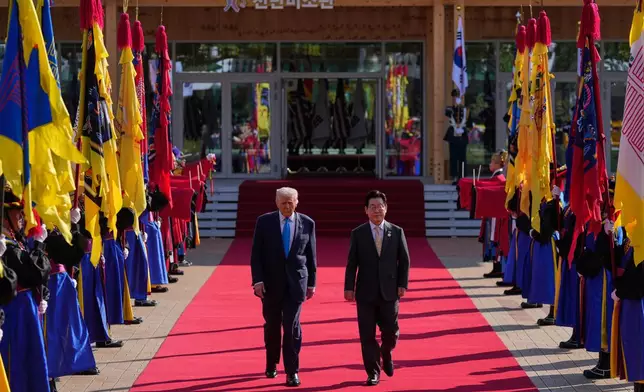
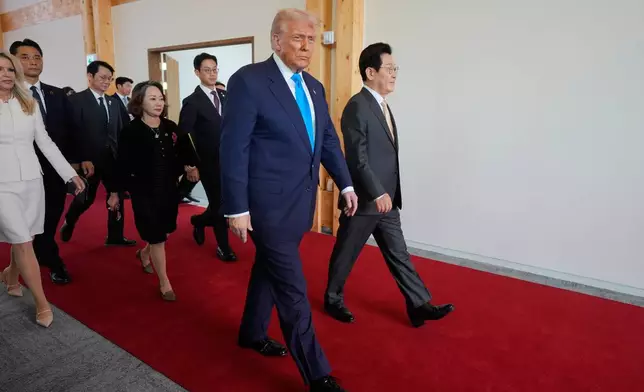
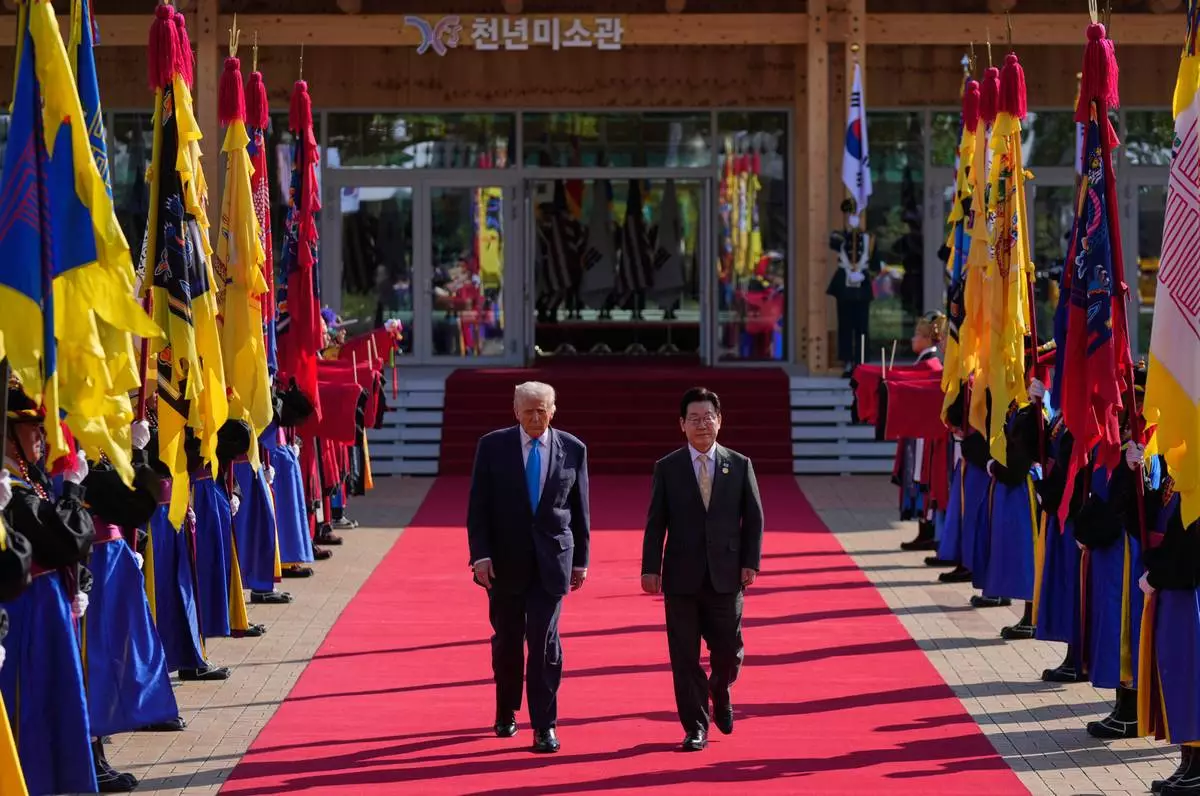
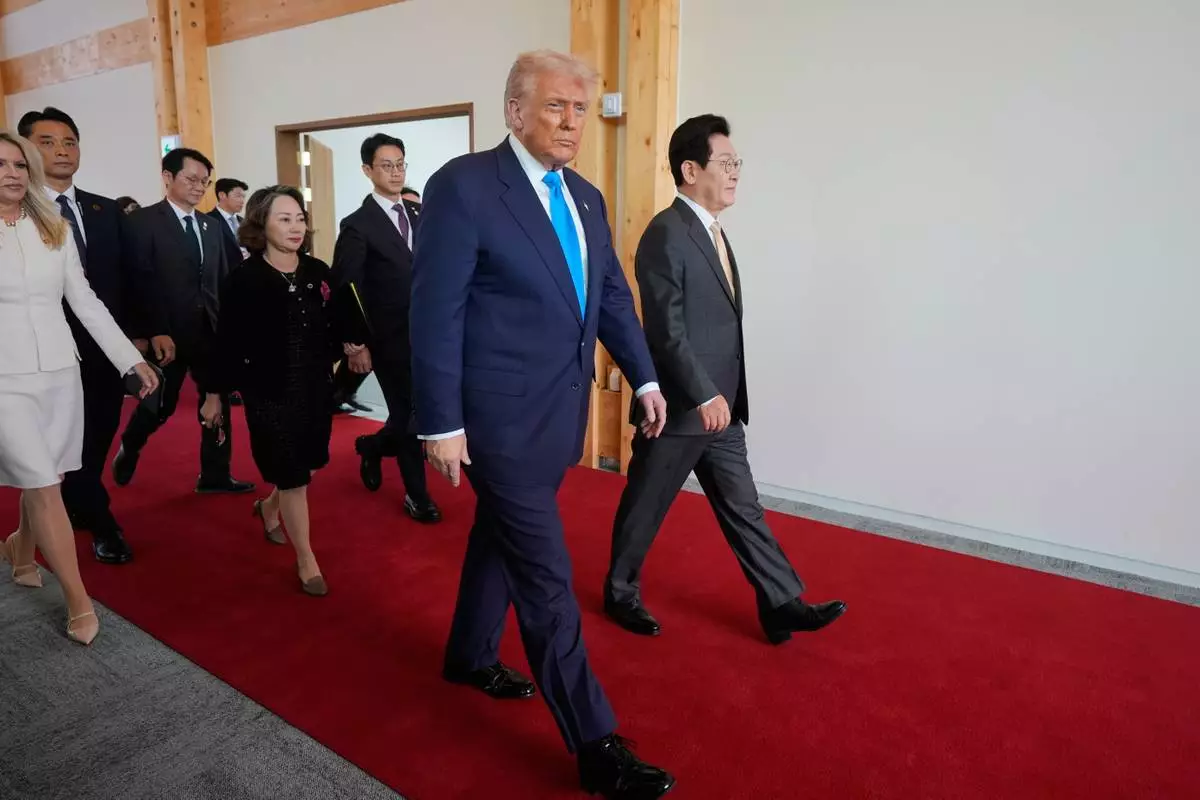
President Donald Trump and South Korean President Lee Jae Myung walk in a welcome ceremony at the Gyeongju National Museum in Gyeongju, South Korea, Wednesday, Oct. 29, 2025. (AP Photo/Mark Schiefelbein)
President Donald Trump and South Korean President Lee Jae Myung walk in a welcome ceremony at the Gyeongju National Museum in Gyeongju, South Korea, Wednesday, Oct. 29, 2025. (AP Photo/Mark Schiefelbein)

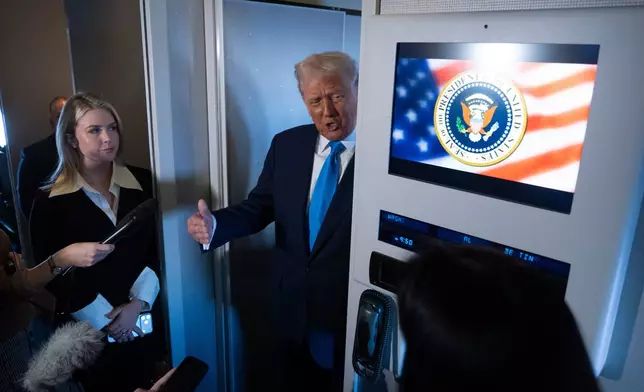
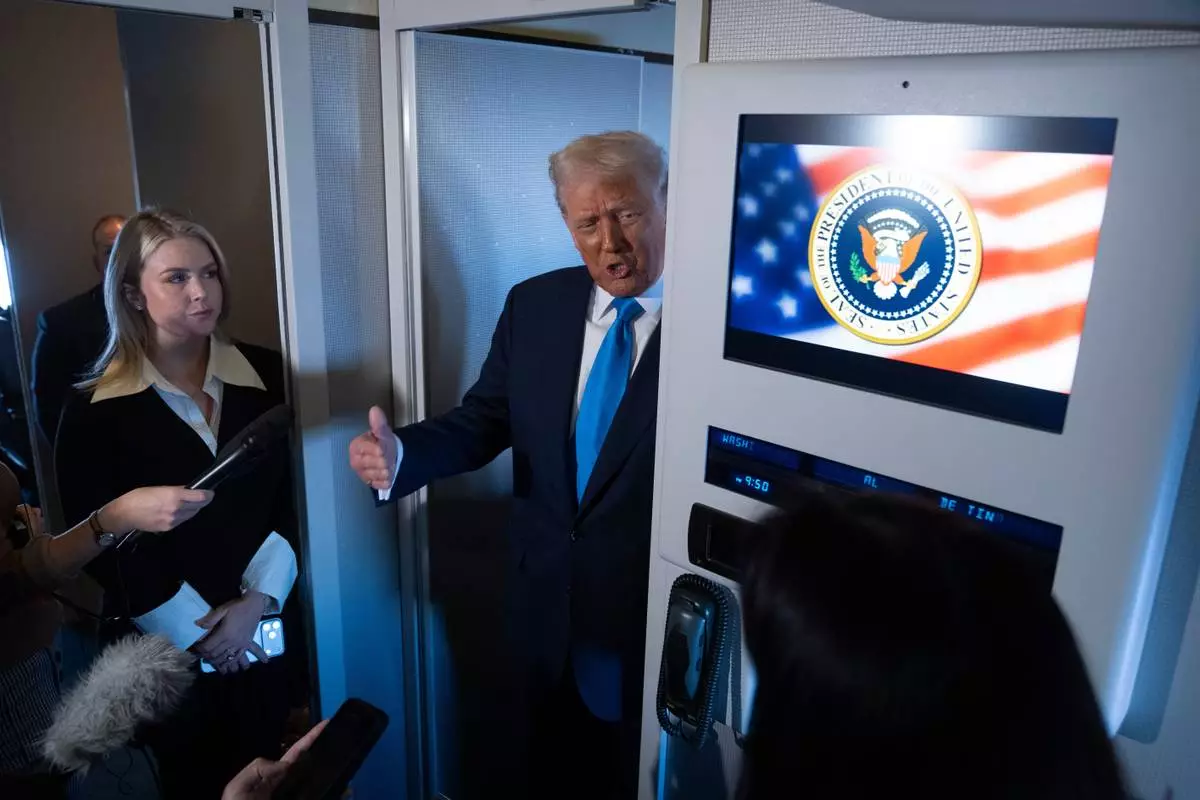
President Donald Trump speaks to reporters as Press Secretary Karoline Leavitt, left, listens, aboard Air Force One as he travels from Tokyo, Japan, to South Korea, Wednesday, Oct. 29, 2025. (AP Photo/Mark Schiefelbein)
President Donald Trump speaks to reporters as Press Secretary Karoline Leavitt, left, listens, aboard Air Force One as he travels from Tokyo, Japan, to South Korea, Wednesday, Oct. 29, 2025. (AP Photo/Mark Schiefelbein)

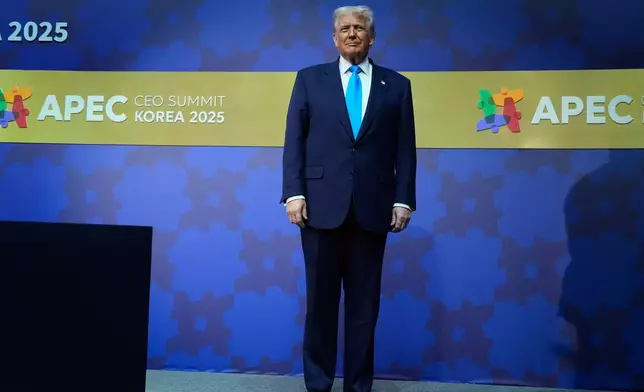
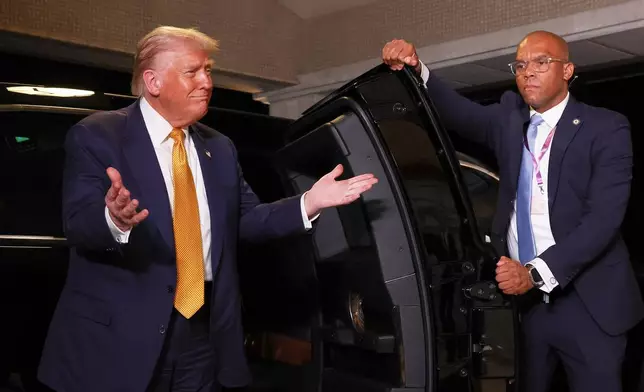
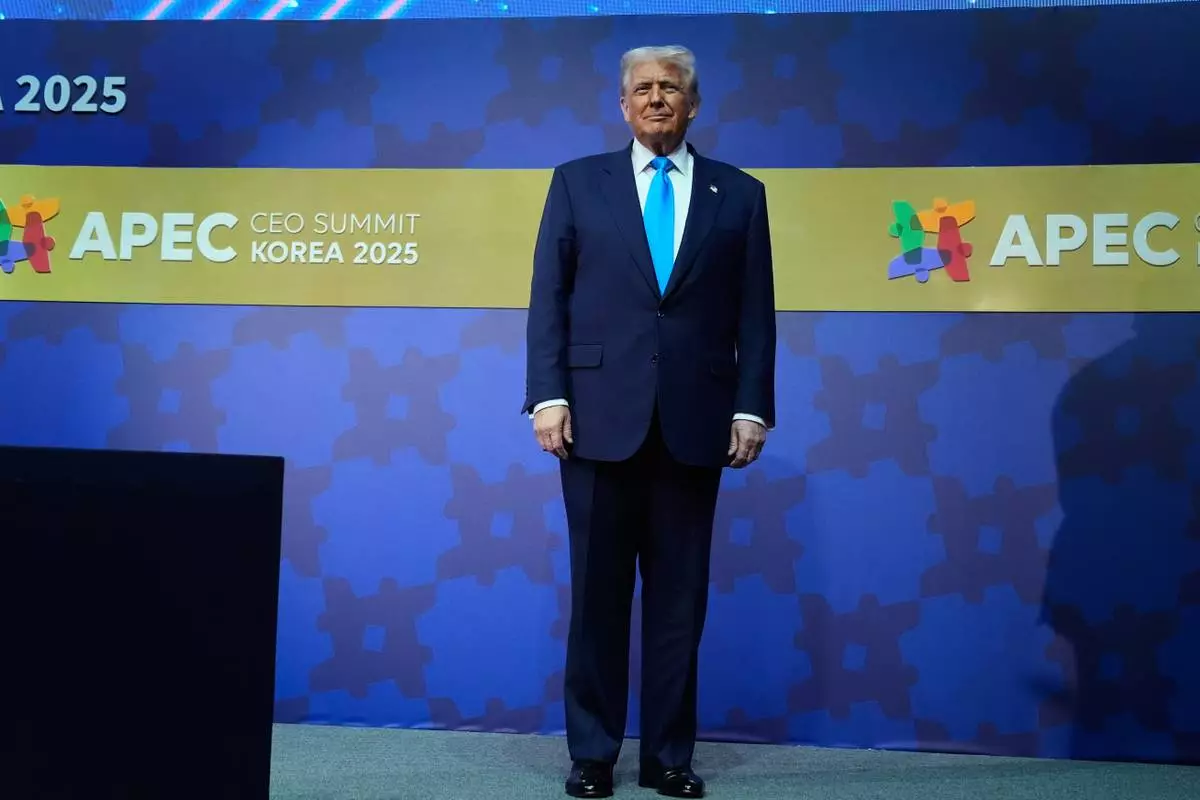
President Donald Trump arrives at an Asia-Pacific Economic Cooperation (APEC) CEO luncheon in Gyoeongju, South Korea, Wednesday, Oct. 29, 2025. (AP Photo/Mark Schiefelbein)
President Donald Trump arrives at an Asia-Pacific Economic Cooperation (APEC) CEO luncheon in Gyoeongju, South Korea, Wednesday, Oct. 29, 2025. (AP Photo/Mark Schiefelbein)

President Donald Trump, center, and South Korean President Lee Jae Myung, right, attend a high honor ceremony at the Gyeongju National Museum in Gyoeongju, South Korea, Wednesday, Oct. 29, 2025. (AP Photo/Mark Schiefelbein)
President Donald Trump, center, and South Korean President Lee Jae Myung, right, attend a high honor ceremony at the Gyeongju National Museum in Gyoeongju, South Korea, Wednesday, Oct. 29, 2025. (AP Photo/Mark Schiefelbein)
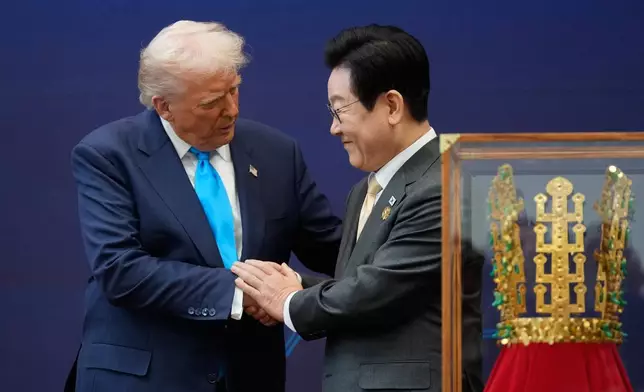
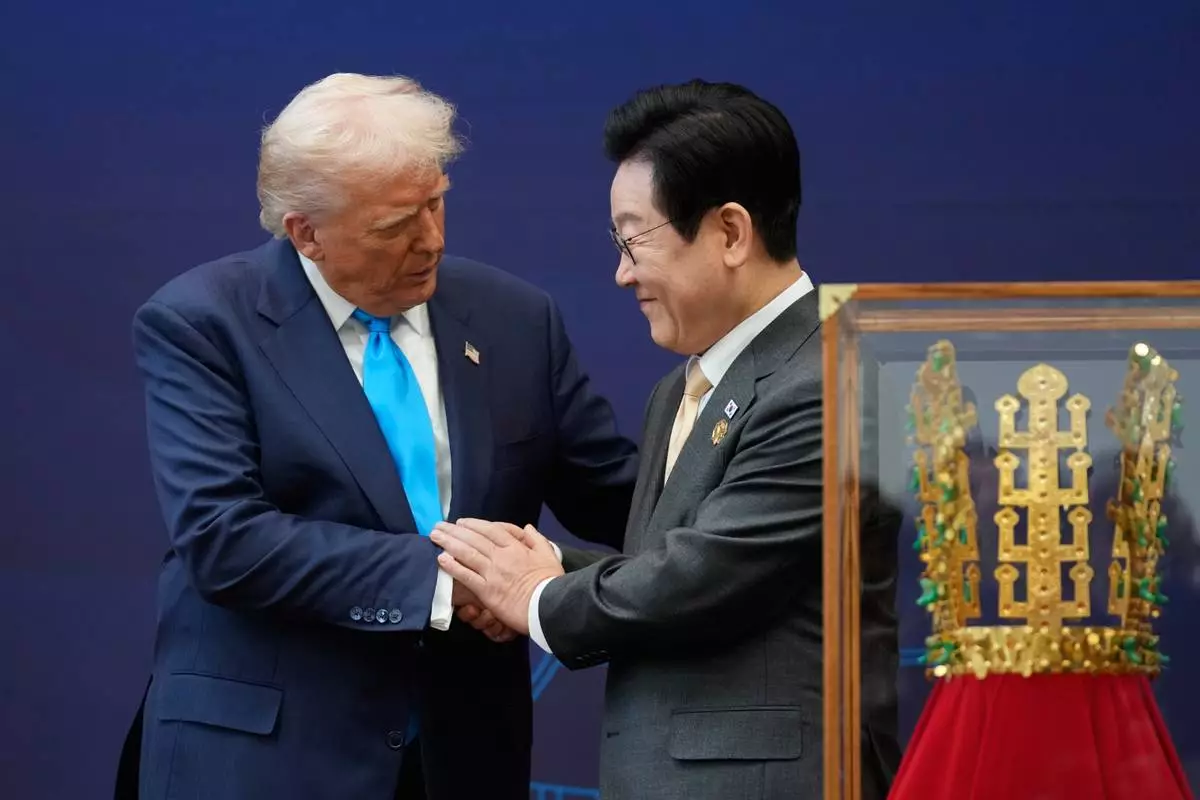
President Donald Trump shakes hands with South Korean President Lee Jae Myung as they attend a high honor ceremony at the Gyeongju National Museum in Gyoeongju, South Korea, Wednesday, Oct. 29, 2025. (AP Photo/Mark Schiefelbein)

President Donald Trump shakes hands with South Korean President Lee Jae Myung as they attend a high honor ceremony at the Gyeongju National Museum in Gyoeongju, South Korea, Wednesday, Oct. 29, 2025. (AP Photo/Mark Schiefelbein)

President Donald Trump, left, and Japan's Emperor Naruhito talk during their meeting at the Imperial Palace in Tokyo, Oct. 27, 2025. (Issei Kato/Pool Photo via AP)

President Donald Trump, left, and Japan's Emperor Naruhito talk during their meeting at the Imperial Palace in Tokyo, Oct. 27, 2025. (Issei Kato/Pool Photo via AP)

Although both sides said progress has been made — Trump said things were “pretty much finalized” — no agreement has been signed yet. The framework includes gradual investments, cooperation on shipbuilding and the lowering of Trump’s tariffs on South Korea's automobile exports, according to Kim Yong-beom, Lee's chief of staff for policy. The White House did not immediately respond to a request for comment.

Kim said the two countries have agreed to keep reciprocal tariffs at 15%, as they have been since August, and further agreed to apply that rate to automobiles and auto parts, South Korea’s largest exports to the United States. Autos and parts had been facing a 25% tariff, putting automakers such as Hyundai and Kia at a disadvantage against Japanese and European competitors, which face 15%.

Despite the lack of immediate confirmation from U.S. officials on those points, it was apparent progress had been made on difficult issues after a day of adulation for the visiting American president from his hosts.

There was a special lunch menu featuring U.S.-raised beef and a gold-adorned brownie. A band played Trump’s campaign anthem of “Y.M.C.A.” when he stepped off Air Force One. Lee told him that “you are indeed making America great again.”

Trump can be mercurial and demanding, but he has a soft spot for pomp and circumstance. He was particularly impressed by a choreographed display of colorful flags as he walked along the red carpet.

“That was some spectacle, and some beautiful scene,” Trump told Lee during their meeting. “It was so perfect, so flawlessly done.”

Earlier in the day, Trump even softened his rhetoric on international trade, which he normally describes in predatory terms where someone is always trying to rip off the United States.

“The best deals are deals that work for everybody,” he said during a business forum.

Trump was visiting while South Korea is hosting the annual Asia-Pacific Economic Cooperation summit in the historical city of Gyeongju. He previously stopped in Japan, where he bonded with the new prime minister, and Malaysia, where he attended a summit of the Association of Southeast Asian Nations.

The Republican president has been trying to tie up trade deals along the way, eager to show that his confrontational approach of tariffs is paying dividends for Americans who are uneasy about the job market and watching a federal government shutdown extend into its fifth week.

However, South Korea has been particularly tough to crack, with the sticking point being Trump's demand for $350 billion of direct investment in the U.S.

Korean officials say putting up cash could destabilize their own economy, and they’d rather offer loans and loan guarantees instead. The country would also need a swap line to manage the flow of its currency into the U.S.

Trump, after meeting with Lee, said “we made our deal pretty much finalized." He did not provide any details.

Oh Hyunjoo, a deputy national security director for South Korea, told reporters earlier in the week that the negotiations have been proceeding “a little bit more slowly” than expected.

“We haven’t yet been able to reach an agreement on matters such as the structure of investments, their formats and how the profits will be distributed,” she said Monday.

It’s a contrast from Trump’s experience in Japan, where the government has worked to deliver the $550 billion in investments it promised as part of an earlier trade agreement. Commerce Secretary Howard Lutnick announced up to $490 billion in specific commitments during a dinner with business leaders in Tokyo.

Lee, speaking at the business forum before Trump arrived, warned against trade barriers.

“At a time when protectionism and nationalism are on the rise and nations focus on their immediate survival, words like ‘cooperation,’ ‘coexistence’ and ‘inclusive growth’ may sound hollow," he said. "Yet, paradoxically, it is in times of crisis like this that APEC’s role as a platform for solidarity shines brighter.”

Lee took office in June and had a warm meeting with Trump at the White House in August, when he praised Oval Office renovations and suggested building a Trump Tower in North Korea.

He took a similar approach when Trump visited on Wednesday. The gold medal presented to Trump represents the Grand Order of Mugunghwa, the country’s highest honor, and Trump is the first U.S. president to receive it.

Trump said “it’s as beautiful as it can possibly be” and “I’d like to wear it right now.”

Next was a replica of a royal crown from the Silla Kingdom, which existed from 57 B.C. to 935 A.D. The original crown was found in a tomb in Gyeongju, the kingdom’s capital.

Besides trade disagreements, there have been other points of tension between Washington and Seoul this year. More than 300 South Koreans were detained during a U.S. immigration raid on a Hyundai plant in Georgia in September, sparking a sense of outrage and betrayal.

Lee said at the time companies would most likely hesitate to make future investments unless the visa system was improved.

“If that’s not possible, then establishing a local factory in the United States will either come with severe disadvantages or become very difficult for our companies," he said.

Asked Monday about the immigration raid, Trump said, “I was opposed to getting them out,” and he said an improved visa system would make it easier for companies to bring in skilled workers.

While in South Korea, Trump is also expected to hold a closely watched meeting on Thursday with Chinese leader Xi Jinping. Washington and Beijing have clashed over trade, but both sides have indicated that they're willing to dial down tensions.

Trump told reporters aboard Air Force One on Wednesday that he expects to lower tariffs targeting China over the flow of fentanyl ingredients.

“They’ll be doing what they can do,” he said. Trump added that “China is going to be working with me.”

Trump sounded resigned to the idea that he wouldn't get to meet North Korean leader Kim Jong Un on this trip. The president previously floated the possibility of extending his stay in South Korea, but on Wednesday said “the schedule was very tight.”

North Korea has so far dismissed overtures from Washington and Seoul, saying it won’t resume diplomacy with the United States unless Washington drops its demand for the North’s denuclearization. North Korea said Wednesday it fired sea-to-surface cruise missiles into its western waters, in the latest display of its growing military capabilities as Trump visits South Korea.

Trump brushed off the weapons test, saying “he’s been launching missiles for decades, right?”

The two leaders met during Trump's first term, although their conversations did not produce any agreements about North Korea's nuclear program.

Associated Press writers Kim Tong-hyung and Hyung-jin Kim contributed from Seoul, South Korea, and Josh Boak contributed from Tokyo.
President Donald Trump and South Korean President Lee Jae Myung walk in a welcome ceremony at the Gyeongju National Museum in Gyeongju, South Korea, Wednesday, Oct. 29, 2025. (AP Photo/Mark Schiefelbein)
President Donald Trump and South Korean President Lee Jae Myung walk in a welcome ceremony at the Gyeongju National Museum in Gyeongju, South Korea, Wednesday, Oct. 29, 2025. (AP Photo/Mark Schiefelbein)

President Donald Trump speaks to reporters as Press Secretary Karoline Leavitt, left, listens, aboard Air Force One as he travels from Tokyo, Japan, to South Korea, Wednesday, Oct. 29, 2025. (AP Photo/Mark Schiefelbein)
President Donald Trump speaks to reporters as Press Secretary Karoline Leavitt, left, listens, aboard Air Force One as he travels from Tokyo, Japan, to South Korea, Wednesday, Oct. 29, 2025. (AP Photo/Mark Schiefelbein)

President Donald Trump arrives at an Asia-Pacific Economic Cooperation (APEC) CEO luncheon in Gyoeongju, South Korea, Wednesday, Oct. 29, 2025. (AP Photo/Mark Schiefelbein)
President Donald Trump arrives at an Asia-Pacific Economic Cooperation (APEC) CEO luncheon in Gyoeongju, South Korea, Wednesday, Oct. 29, 2025. (AP Photo/Mark Schiefelbein)

President Donald Trump, center, and South Korean President Lee Jae Myung, right, attend a high honor ceremony at the Gyeongju National Museum in Gyoeongju, South Korea, Wednesday, Oct. 29, 2025. (AP Photo/Mark Schiefelbein)
President Donald Trump, center, and South Korean President Lee Jae Myung, right, attend a high honor ceremony at the Gyeongju National Museum in Gyoeongju, South Korea, Wednesday, Oct. 29, 2025. (AP Photo/Mark Schiefelbein)
President Donald Trump shakes hands with South Korean President Lee Jae Myung as they attend a high honor ceremony at the Gyeongju National Museum in Gyoeongju, South Korea, Wednesday, Oct. 29, 2025. (AP Photo/Mark Schiefelbein)

President Donald Trump shakes hands with South Korean President Lee Jae Myung as they attend a high honor ceremony at the Gyeongju National Museum in Gyoeongju, South Korea, Wednesday, Oct. 29, 2025. (AP Photo/Mark Schiefelbein)

President Donald Trump, left, and Japan's Emperor Naruhito talk during their meeting at the Imperial Palace in Tokyo, Oct. 27, 2025. (Issei Kato/Pool Photo via AP)


President Donald Trump, left, and Japan's Emperor Naruhito talk during their meeting at the Imperial Palace in Tokyo, Oct. 27, 2025. (Issei Kato/Pool Photo via AP)

HAMIMA, Syria (AP) — A trickle of civilians left a contested area east of Aleppo on Thursday after a warning by the Syrian military to evacuate ahead of an anticipated government military offensive against Kurdish-led forces.

Government officials and some residents who managed to get out said the Kurdish-led Syrian Democratic Forces prevented people from leaving via the corridor designated by the military along the main road leading west from the town of Maskana through Deir Hafer to the town of Hamima.

The SDF denied the reports that they were blocking the evacuation.

In Hamima, ambulances and government officials were gathered beginning early in the morning waiting to receive the evacuees and take them to shelters, but few arrived.

Farhat Khorto, a member of the executive office of Aleppo Governorate who was waiting there, claimed that there were "nearly two hundred civilian cars and hundreds of people who wanted to leave” the Deir Hafer area but that they were prevented by the SDF. He said the SDF was warning residents they could face “sniping operations or booby-trapped explosives” along that route.

Some families said they got out of the evacuation zone by taking back roads or going part of the distance on foot.

“We tried to leave this morning, but the SDF prevented us. So we left on foot … we walked about seven to eight kilometers until we hit the main road, and there the civil defense took us and things were good then,” said Saleh al-Othman, who said he fled Deir Hafer with more than 50 relatives.

Yasser al-Hasno, also from Deir Hafer, said he and his family left via back roads because the main routes were closed and finally crossed a small river on foot to get out of the evacuation area.

Another Deir Hafer resident who crossed the river on foot, Ahmad al-Ali, said, “We only made it here by bribing people. They still have not allowed a single person to go through the main crossing."

Farhad Shami, a spokesman for the SDF, said the allegations that the group had prevented civilians from leaving were “baseless.” He suggested that government shelling was deterring residents from moving.

The SDF later issued a statement also denying that it had blocked civilians from fleeing. It said that “any displacement of civilians under threat of force by Damascus constitutes a war crime" and called on the international community to condemn it.

“Today, the people of Deir Hafer have demonstrated their unwavering commitment to their land and homes, and no party can deprive them of their right to remain there under military pressure,” it said.

The Syrian army’s announcement late Wednesday — which said civilians would be able to evacuate through the “humanitarian corridor” from 9 a.m. to 5 p.m. Thursday — appeared to signal plans for an offensive against the SDF in the area east of Aleppo. Already there have been limited exchanges of fire between the two sides.

Thursday evening, the military said it would extend the humanitarian corridor for another day.

The Syrian military called on the SDF and other armed groups to withdraw to the other side of the Euphrates River, to the east of the contested zone. The SDF controls large swaths of northeastern Syria east of the river.

The tensions in the Deir Hafer area come after several days of intense clashes last week in Aleppo city that ended with the evacuation of Kurdish fighters and government forces taking control of three contested neighborhoods.

The fighting broke out as negotiations have stalled between Damascus and the SDF over an agreement reached last March to integrate their forces and for the central government to take control of institutions including border crossings and oil fields in the northeast.

Some of the factions that make up the new Syrian army, which was formed after the fall of former President Bashar Assad in a rebel offensive in December 2024, were previously Turkey-backed insurgent groups that have a long history of clashing with Kurdish forces.

The SDF for years has been the main U.S. partner in Syria in fighting against the Islamic State group, but Turkey considers the SDF a terrorist organization because of its association with Kurdish separatist insurgents in Turkey.

Despite the long-running U.S. support for the SDF, the Trump administration has also developed close ties with the government of interim Syrian President Ahmad al-Sharaa and has so far avoided publicly taking sides in the clashes in Aleppo.

Ilham Ahmed, head of foreign relations for the SDF-affiliated Kurdish-led administration in northeast Syria, at a press conference Thursday said SDF officials were in contact with the United States and Turkey and had presented several initiatives for de-escalation. She said that claims by Damascus that the SDF had failed to implement the March agreement were false.

——

Associated Press journalist Hogir Al Abdo in Qamishli, Syria, contributed.

Members of the Syrian military police stand at a humanitarian crossing declared by the Syrian army in the village of Hamima, in the eastern Aleppo countryside, near the front line with the Kurdish-led Syrian Democratic Forces in Deir Hafer, Syria, Thursday, Jan. 15, 2026. (AP Photo/Ghaith Alsayed)

Members of the Syrian military police stand at a humanitarian crossing declared by the Syrian army in the village of Hamima, in the eastern Aleppo countryside, near the front line with the Kurdish-led Syrian Democratic Forces in Deir Hafer, Syria, Thursday, Jan. 15, 2026. (AP Photo/Ghaith Alsayed)

Members of the Syrian Civil Defense, stand next to their vehicles at a humanitarian crossing declared by the Syrian army in the village of Hamima, in the eastern Aleppo countryside, near the front line with the Kurdish-led Syrian Democratic Forces in Deir Hafer, Syria, Thursday, Jan. 15, 2026. (AP Photo/Ghaith Alsayed)

Members of the Syrian Civil Defense, stand next to their vehicles at a humanitarian crossing declared by the Syrian army in the village of Hamima, in the eastern Aleppo countryside, near the front line with the Kurdish-led Syrian Democratic Forces in Deir Hafer, Syria, Thursday, Jan. 15, 2026. (AP Photo/Ghaith Alsayed)

A displaced Syrian family rides in the back of a truck near a humanitarian crossing declared by the Syrian army next to a river in the village of Rasm Al-Abboud, in the eastern Aleppo countryside, near the front line with the Kurdish-led Syrian Democratic Forces in Deir Hafer, Syria, Thursday, Jan. 15, 2026. (AP Photo/Omar Albam)

A displaced Syrian family rides in the back of a truck near a humanitarian crossing declared by the Syrian army next to a river in the village of Rasm Al-Abboud, in the eastern Aleppo countryside, near the front line with the Kurdish-led Syrian Democratic Forces in Deir Hafer, Syria, Thursday, Jan. 15, 2026. (AP Photo/Omar Albam)

Displaced Syrian children and women ride in the back of a truck near a humanitarian crossing declared by the Syrian army in the village of Hamima, in the eastern Aleppo countryside, near the front line with the Kurdish-led Syrian Democratic Forces in Deir Hafer, Syria, Thursday, Jan. 15, 2026. (AP Photo/Omar Albam)

Displaced Syrian children and women ride in the back of a truck near a humanitarian crossing declared by the Syrian army in the village of Hamima, in the eastern Aleppo countryside, near the front line with the Kurdish-led Syrian Democratic Forces in Deir Hafer, Syria, Thursday, Jan. 15, 2026. (AP Photo/Omar Albam)

Displaced Syrians at a river crossing near the village of Jarirat al Imam, in the eastern Aleppo countryside, near the front line with the Kurdish-led Syrian Democratic Forces in Deir Hafer, Syria, Thursday, Jan. 15, 2026. (AP Photo/Omar Albam)

Displaced Syrians at a river crossing near the village of Jarirat al Imam, in the eastern Aleppo countryside, near the front line with the Kurdish-led Syrian Democratic Forces in Deir Hafer, Syria, Thursday, Jan. 15, 2026. (AP Photo/Omar Albam)

Recommended Articles