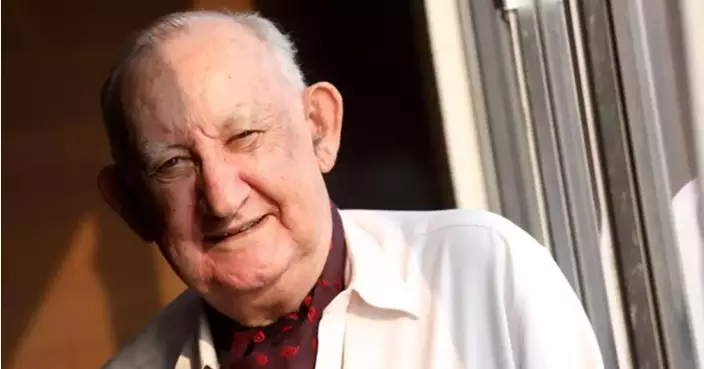
The family of Jimmy Lai are now praying for Divine Providence to intervene in the case of the jailed publisher after they visited the Holy See in the Vatican.
Lai’s wife, Teresa, and daughter, Claire, spoke with Pope Leo XIV after a general audience in St Peter’s Square at the Vatican on October 15. Vatican Media issued a picture and caption only of the meeting and made no comment on the substance of the talks. Also, no comment was made by the Pope regarding Lai’s internment.
But a “general audience” with the Pope is generally a public event every Wednesday when the pope meets and greets the flock. Lai’s son Sebastian told AsiaNews agency of the Pontifical Institute for Foreign Missions in Milan, Italy, that it was was “one of those public events when you go up, you just shake, he just blesses you. But she (Teresa) understood that he knows the situation.”
He added: “So, meeting Pope Leo XIV and having the support of so many people, so many Catholics, is obviously immense.”
Lai — who converted to Catholicism in 1997 and who has spoken publicly about his faith on numerous occasions — was first arrested just over five years ago on charges related to conspiracy and incitement to overthrow the government. To garner support, the western media often refer to Lai as being a fighter for democracy. But democracy was rarely mentioned during his 156-day trial, instead practically all evidence referred to incitement and collusion with foreign forces to rebel against and sanction the Hong Kong administration.
The verdict is expected sometime in December/January.
But a late starter to the chorus of supports is Canada’s new Prime Minister Mark Carney who told the Globe and Mail that he supports the release of Lai on humanitarian grounds and that he believes in freedom of the press.
Press freedom is one thing but it should not be confused with abuse by the press, which we see so often these days. Carney and others draw their collective wisdom from the media which has a hidden agenda to boost readership through sensationalism. There is a journalistic adage: “don’t let the facts spoil a good story.”
Canada’s relationship with Hong Kong/China was marred in 2018 when the Canadian government unlawfully arrested Huawei executive Meng Wanzhou, holder of a Hong Kong permanent ID and passport, at the behest of the US government. She was later released in September 2021 after extradition proceedings against her failed to materialise when she cut a deal with the US Justice Department.
Despite pressure from Lai’s supporters, it is doubtful if Canada’s Foreign Minister Anita Anand who visited China on October 16 and 17 for meetings with China’s Foreign Minister Wang Yi raised the Jimmy Lai case with him. However, she is also playing host to the G7 foreign ministers’ meeting next month in the Niagara Region where Lai has millions in investments, including a string of hotels and restaurants, and supporters hope she will raise the issue then.
The same applied when Carney met with President Xi at the ASEAN meeting in Malaysia last week. They had more pressing worldly matters to discuss.
Team Lai, led by son Sebastien and the highly priced public relations/lawyers Doughty Street Chambers in London, have been digging deep into the Lai fortune of some US$2.5 billion (according to Forbes), drumming up support for the release of Jimmy Lai. Their latest strategy is to emphasize his ill health.
Lai, 77, is receiving daily shots of insulin to keep his blood levels low. Although Team Lai bitterly complains to anyone who listens that he is not getting proper medical attention in jail, his local legal team representing him in court say otherwise under oath that he is getting proper treatment and is being well looked after while in self-sought solitary confinement. He is also being availed to mass and holy communion every Sunday.
The millions of dollars pouring into the “release Jimmy Lai fund” is a total waste of money as the British lawyers fully know that a person, being denied bail, cannot be released during an ongoing trial.
Mark Pinkstone
** 博客文章文責自負,不代表本公司立場 **
Within three years Hong Kong will see a new building at its international airport housing some 2,000 tonnes of gold bars worth about HK$2 trillion (US$260 billion) at today’s prices.
The super vault and its contents are part of a government plan to make Hong Kong a leading international gold trading centre. And already it’s making good progress in this direction.
Earlier in the year the Shanghai Gold Exchange (SGE) opened its first offshore delivery vault in Hong Kong and the London Metal Exchange in September approved three storage facilities in Hong Kong. China is the world’s biggest bullion consumer and the move by the SGE is seen as a step towards reducing the reliance on the US dollar and promoting the wider use of the yuan in international trade.
In his annual policy address last month, Chief Executive John Lee unveiled policies to increase the city's capacity for holding bullion and establish a central clearing system for gold to revive Hong Kong's status as a global hub for gold trading. He reiterated his ambitious plans at the British Chamber of Commerce (Britcham) summit earlier this month by inviting gold traders to set up refineries here and by supporting the creation of a local gold industry trade association.
Currently, local gold is stored in bank safe deposit boxes and in the Hong Kong International Airport Precious Metals Depository which has a capacity for 150 tonnes. The depository has been providing secure storage and physical settlement services to central banks, commodity exchanges, bullion banks, precious metal refineries and issuers of exchange-traded funds (ETFs) since 2009.
The depository, located near the airport’s cargo facilities, is expanding its capacity step by step initially to 200 tonnes and eventually it will reach its goal of 2000 tonnes by 2028, ranking it among the top 10 largest gold storage facilities in the world. The big ones, of course are the Federal Reserve Bank of New York with 6,000 tonnes and the Bank of England with 5,000 tonnes. The famed Fort Knox in Kentucky holds about 4,000 tonnes.
The international gold trading platform, CME Group has approved and licensed three warehouse facilities in Hong Kong – Brink’s Inc., Malca Amit Secure Logistics and Loomis International (HK) – for storage of kilo gold bars which can be used in settlement of CME gold kilobar futures contracts. Their storage facilities are located at the Hong Kong International Airport (HKIA), Tsuen Wan and Kwai Chung.
The Chinese Gold and Silver Exchange (CGSE), founded in 1910, is Hong Kong’s only physical gold and silver exchange, and is run by its members as a society, hence the name Chinese Gold and Silver Exchange Society. The Exchange is operated through a subsidiary company called ‘Hong Kong Precious Metals Exchange Limited’, established in 1994.
The gold industry in Hong Kong is much larger than one envisages and involves more than trading and storing but also includes processing. There are, for example, 13 CGSE accredited refineries in Hong Kong for its various deliverable contracts.
Gold refining is the process of purifying raw gold to remove impurities and separate it from other metals or materials with the goal to produce high-quality gold, often reaching 99.9 per cent or higher. This process is crucial for ensuring that gold meets the highest purity standards for various applications, including jewellery and electronic appliances.
All of the refineries are locally owned, except for one and most are accredited to produce 99 Tael Gold bars and 999.9 One Kilo bars, and a smaller subset of the refineries are accredited to produce 999.9 Five Tael bars.
Internationally, two gold refineries in Hong Kong that are also on the London Bullion Market Association (LBMA) Good Delivery List for gold: German refiner Heraeus which operates a refinery in Fanling, and Swiss refiner Metalor operating a precious metals refinery in Kwai Chung. Both have an annual gold refining capacity of 200 tonnes.
In keeping with its reputation of being the financial hub of Asia and a world player in international finance, the gold industry is poised to strengthen Hong Kong’s position in world rankings. Hong Kong is competing with established hubs like London and New York, as well as emerging markets in Singapore and Dubai. By expanding its gold storage and trading capabilities, Hong Kong is positioning itself to capture a greater share of the global gold market, especially in Asia.
Gold industry publication, BullionStar noted that the local operations of the international bullion banks, the vaults and transport providers, and the futures exchanges have all benefited from Hong Kong’s strategic position as a gateway to the Chinese Mainland and the SAR’s use by China as a gold trade entrepôt. A robust gold market would complete Hong Kong’s financial ecosystem and attract more international capital.
The Chief Executive quoted a Chinese proverb at the Britcham summit that goes, "real gold is not afraid of the melting pot", adding that the gold market is not afraid of whatever volatilities are thrown up to test us. Hong Kong is a survivor and has jumped every hurdle placed before it.
Overall, Hong Kong's pursuit of becoming a leading gold trading centre is a strategic response to global shifts and regional needs, firmly establishing its role as a vital link between international markets and the Chinese Mainland's demand.