China's Shenzhou-21 spaceflight crew consists of three types of astronauts, namely spacecraft pilot, flight engineer, and payload specialist.
This marks the second time that a flight crew has included all three types of astronauts following the Shenzhou-16 mission carried out two years ago.
The three astronauts Zhang Lu, Wu Fei and Zhang Hongzhang will be launched at 23:44 Friday (Beijing Time). Zhang Lu, who was a crew member of the Shenzhou-15 mission, will be the commander.
"I will serve as a leader during extravehicular activities. For Wu, he will take on more of the extravehicular operations and some experiments in the Mengtian lab module. As for Zhang Hongzhang, his tasks include plant cultivation and cell experiments. Since his expertise is in electro-chemistry, he will also handle aspects related to electricity, such as work involving batteries. He is both more professional and more meticulous in that field," said Zhang Lu.
With the full completion of China's space station, the country's third batch of astronauts, selected by the end of 2020, was expanded to include new roles beyond spacecraft pilots, adding flight engineers and payload specialists.
Among the 18 new astronauts selected in 2020, there are seven spacecraft pilots, seven flight engineers, and four payload specialists.
In recent years, the China Manned Space Program has seen a growing diversity of roles.
In 2023, Zhu Yangzhu became the first flight engineer to perform a spacewalk on the Shenzhou-16 mission. In 2024, Wang Haoze became China's first female flight engineer on Shenzhou-19.
The Shenzhou-20 mission in 2025 featured Wang Jie as another flight engineer, and now, Shenzhou-21 welcomes its fourth, Wu Fei.
"As a flight engineer, my primary responsibility is to care for, maintain, and upgrade the space station complex which consists of more than ten key subsystems, such as environmental control and life support system, GNC (guidance, navigation and control) system, power and communications, and all of them are vital. Secondly, astronauts face many threats in space. We must firmly master all emergency procedures to safeguard the safety of both the crew and the spacecraft. Thirdly, I'm also responsible for testing new technologies. The technologies and equipment we validate on the space station today will lay a strong foundation for our future missions, to the Moon and even to Mars," said Wu.
In May 2023, astronaut Gui Haichao made history as the country's first payload specialist on Shenzhou-16 mission, conducting extensive space science experiments with his colleagues.
Zhang Hongzhang, now the second of the four third-generation payload specialists to fly, will work closely with teammates and ground research teams to continue scientific research started on Shenzhou-20, while conducting new studies under China's national space laboratory framework.
"As a payload specialist and scientific researcher, my goal is to increase my initiative aboard the space station and improve research efficiency. I hope to carry out more complex studies, so that our scientific work can go further and contribute to faster technological progress," said Zhang Hongzhang.
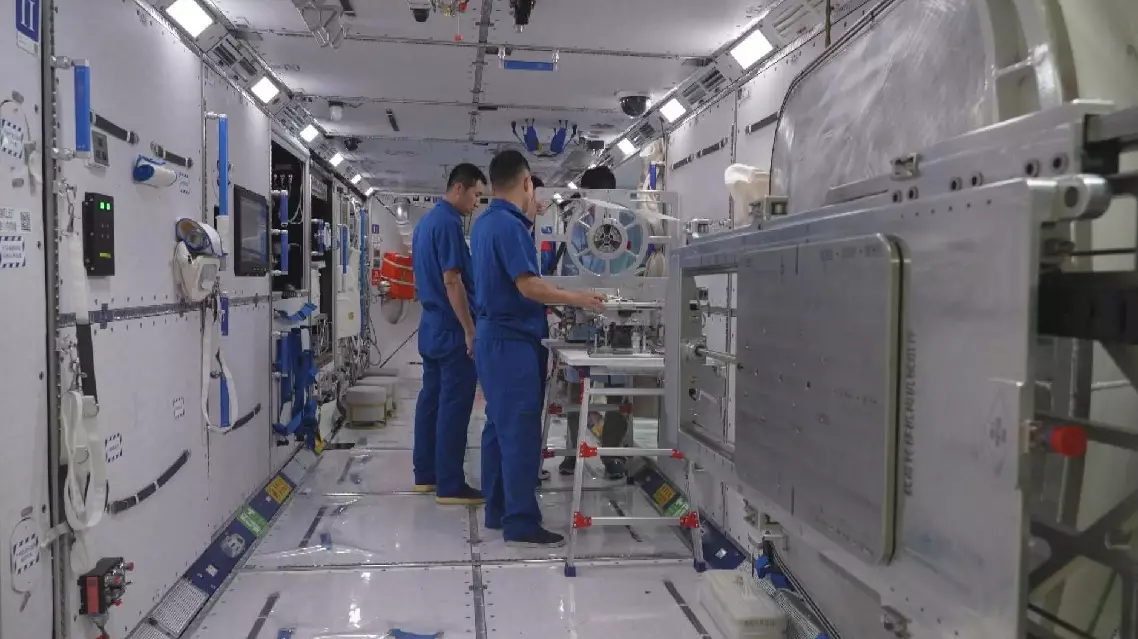
China's Shenzhou-21 crew consists of pilot, flight engineer, and payload specialist