The exquisitely-designed ceremonial attire for China's upcoming 15th National Games, which originated from China's traditional horse-face skirt, is expected to become an eye-catching element when used at the awards ceremony at the grand event.
The games, set to run Sunday through November 21, is co-hosted by Guangdong Province and the neighboring Hong Kong and Macao Special Administrative Regions (SARs), highlighting the integrated development of the Guangdong-Hong Kong-Macao Greater Bay Area city cluster in south China.
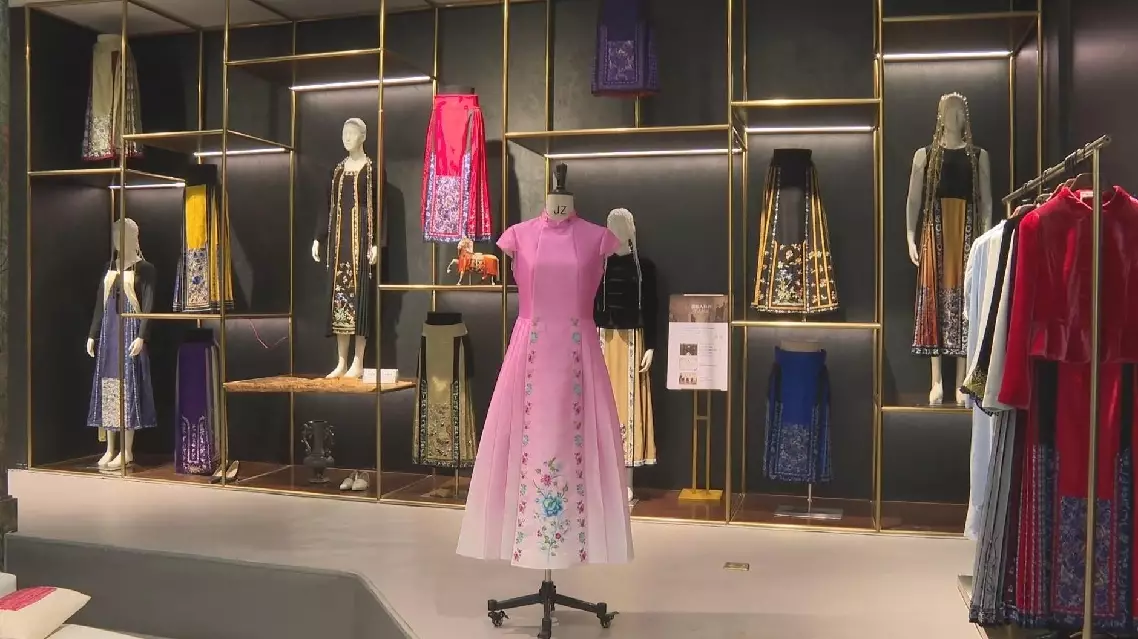
The horse-face skirt is a type of traditional clothing that features a high, flat front and pleated sides. It originated in ancient China's Song Dynasty (960-1279) and maintained its popularity during the Ming and Qing Dynasties (1368-1911).
The ceremonial dress cleverly blends the elegance of the cheongsam with the solemnity of the horse-face skirt, possessing both the dignified charm of traditional design and the dynamic fashion of modern tailoring. The vivid peony pattern on the skirt highlights the sporting style of the National Games.
"Our design philosophy is 'preserving tradition while innovating.' Preserving tradition means retaining the core form of the horse-face skirt, while innovation means incorporating modern elements. The biggest challenge we faced was how to make the traditionally formal horse-face skirt convey the power of sports and the ceremonial feel of an awards ceremony," said Huang Yini, a designer of the ceremonial attire.
The designer team scoured over 300 patterns on antique horse-face skirts from the Ming and Qing Dynasties, to make the re-designed style meet the needs of modern sports scenarios.
"Our biggest breakthrough was designing the kind of horse-face midi-skirt into a one-piece dress, combining a three-dimensional cut with a dignified cheongsam collar. We also innovated in the fabric, using a new type of material for the dress," Huang said. From March to the end of July, the team revised more than a dozen design drafts and made several adjustments on patterns. In early August, they officially supplied more than 1,500 sets of the ceremonial attire to the event's organizers.
The Sanlan embroidery pattern, subtly visible on the dress, comes from the traditional embroidery techniques of the Greater Bay Area. The embroidery threads, in varying shades of blue, are layered to create a gradient effect.
"We hope this outfit possesses both traditional charm and showcases the vibrant beauty of the Greater Bay Area. This is because it's more than just clothing. It's a calling card for Chinese culture, embodying the warmth and elegance of traditional Chinese formal wear," Huang said.
The National Games, held every four years, is China's highest level and largest national multi-sports event.
A grand opening ceremony of the event is scheduled for Sunday night in Guangzhou, the capital of Guangdong Province.
Ceremonial attire combining traditional paradigms, modern technique to shine at National Games