The ninth Sino-German Automotive Conference opened on Wednesday in northeast China's Jilin Province, with more than 400 industry representatives from home and abroad gathering to explore new trends in the global automotive industry and discuss opportunities for cooperation.
The attendees gathered in Changchun, the provincial capital of Jilin known as the cradle of China's automobile industry.
With the global shift toward intelligent, electrified and environmentally friendly vehicles in full swing, a German legislator in attendance emphasized that these trends open fresh avenues for China-Germany collaboration.
"In the development of automotive [industries of] China and Germany, [what is] new is autonomous driving, Internet-driven cars, electrification, of course, digitization, maybe AI-driving cars. This is a new era. This gives us a good basis for cooperation in the next years," said Hans-Peter Friedrich, former vice president of the German Bundestag and chairman of the German-Chinese Parliamentary Group.
Walter Jansen, who heads the Sales and Business Development at Advectus Solutions Germany GmbH, stressed that consumers are seeking the "full spectrum" of possibilities that AI can offer.
"The customer journey is only satisfying if the whole experience is easy for the customer, and that can be supported by AI. We use some AI from China, but we also have very good AI in Germany, so that's another opportunity for cooperation," said Walter Jansen, a senior executive at technology firm Advectus Solutions Germany GmbH.
Others pointed out that the intelligent automotive technologies now constitute a key competitive element in the industry, and that China and the Global South markets have the potential to become the only markets remaining to drive vehicles sales up to 2040.
"Chinese enterprises have already demonstrated globally leading capabilities in fields such as autonomous driving and intelligent cockpit technologies, from research and development to mass production -- as well as in global market expansion," said Ron Zheng, Senior Partner at Roland Berger, a global consulting firm.
The conference also features three thematic sessions on Sino-German investment project matchmaking, opportunities in the global expansion of China's automotive industry chain, and the role of digitization in building the automotive industry ecosystem.
As a pivotal hub for China-Germany automotive cooperation, Jilin Province has witnessed the steady expansion of this partnership. The province serves as a major base for FAW-Volkswagen, a joint venture established in 1991 between China FAW Group Co., Ltd. and German carmaker Volkswagen.
In late October, the Changchun-headquartered company celebrated a milestone as its 30 millionth car produced in China rolled off the assembly line at its plant in the city.
From initially producing a single Jetta model under one brand, FAW-Volkswagen has expanded its portfolio to 33 fuel-powered and new energy vehicles (NEVs) models, mirroring the evolution of bilateral auto cooperation from technology introduction and basic production to joint research and development and a shared industrial ecosystem.
The company's operations now span six plants in five Chinese cities, namely Changchun, Chengdu, Foshan, Qingdao and Tianjin.
"FAW-Volkswagen will launch four new energy vehicle models developed on VW Group's all-new CSP(China Scalable Platform)at the Changchun base, and we plan to bring them onto the market one after another in 2027. By then, the Changchun base will form a product portfolio covering high-end, intelligent fuel-powered vehicles alongside all-new hybrid and pure electric models," said Sun Zhiguo, planning director of FAW-Volkswagen Automotive.
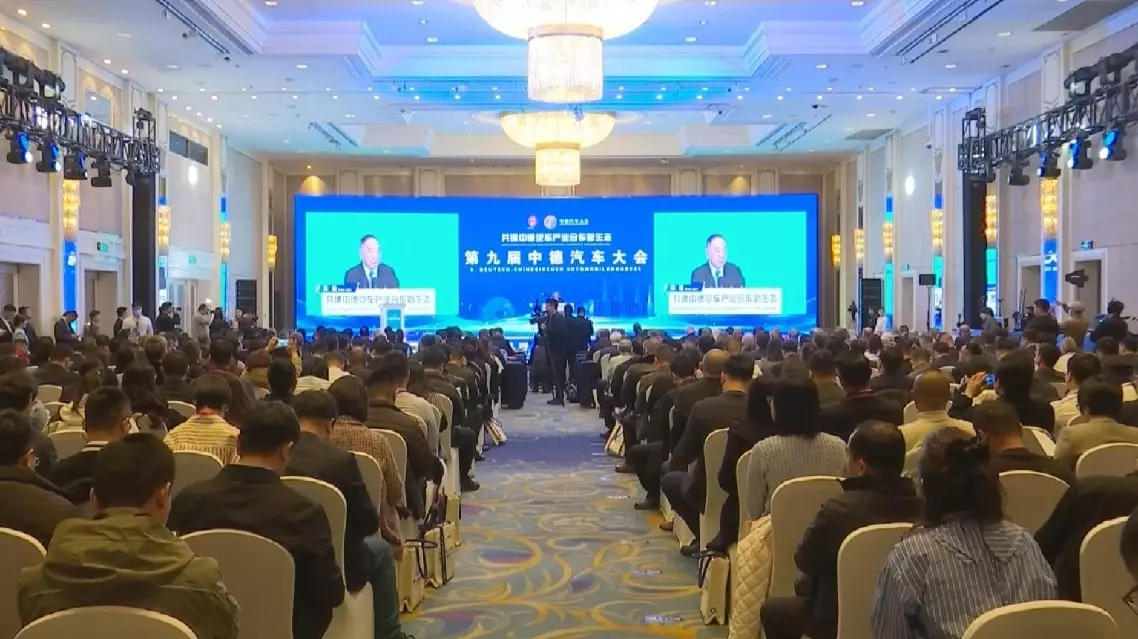
China-Germany auto conference highlights cooperation in AI-powered, green vehicles