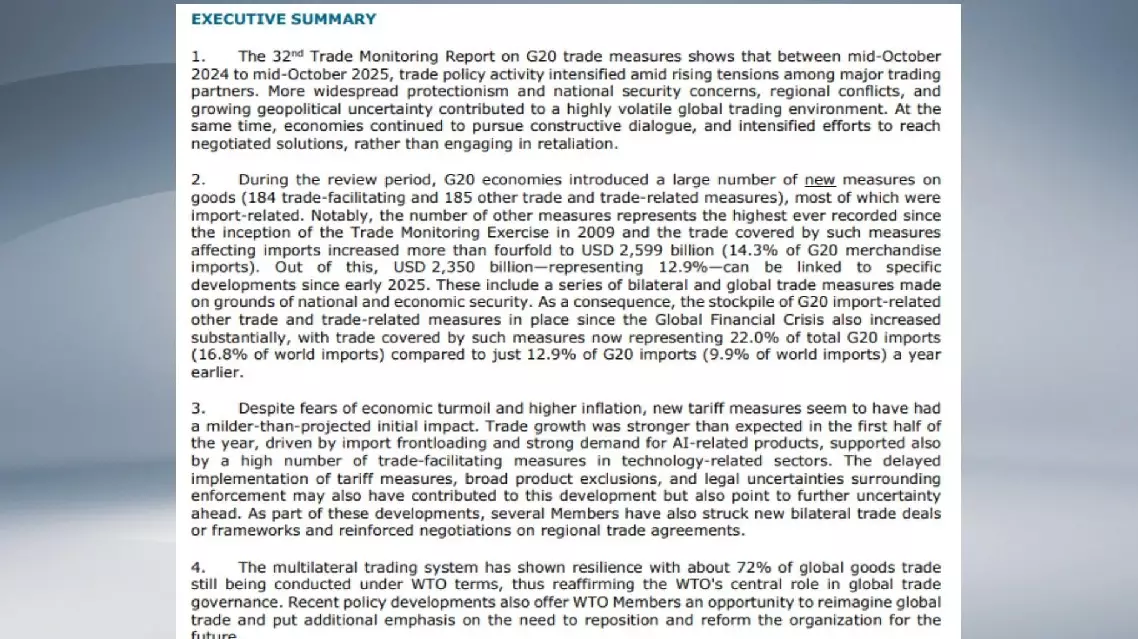
From mid-Oct 2024 to mid-Oct 2025, the import trade volume of G20 economies had increased more than fourfold, compared with the previous monitoring period, according to the latest report from the World Trade Organization (WTO) released on Thursday.
Under the impact of tariffs, G20 economies have been taking trade facilitation measures, which led to an almost-double growth in terms of trade coverage compared with that of the last report period.
WTO chief Ngozi Okonjo-Iweala believes that although the global trade system has been undergoing the most serious attacks in eight decodes, it still demonstrates strong resilience, as most of the WTO members have been continuing normal trade exchanges.
She also pointed out that although there is a significant rise of protectionism, more facilitation measures have also been introduced in the meantime, showcasing members' willingness to lower trade costs.
The organization's economists forecast the world merchandise trade volume is expected to jump to 2.4 percent this year, but the outlook for 2026 will decline to 0.5 percent.
The surging demand for AI-related products and the continuing trade growth among most WTO members, especially developing economies, were key drivers of trade growth in the first half of 2025.
The report also said that economies have been exchanging more constructive dialogues, so as to reach solutions via negotiations.
Import trade volume of G20 economies increases fourfold: WTO reports
Chinese Premier Li Qiang on Thursday presided over a State Council executive meeting that studied work on building a unified national market and reviewed and approved a plan for the development of a modern emergency response system during the 15th Five-Year Plan period (2026-2030).
Noting that building a unified national market is essential to advancing high-quality development, the meeting called for deepening institutional frameworks in areas such as property rights protection, market access, fair competition, social credit and market exit mechanisms.
The meeting also urged efforts to advance high-standard connectivity of market infrastructure to facilitate smooth economic circulation and effectively reduce logistics costs across society.
Emergency management is critical to protecting people's lives and property, the meeting said. It called for accelerating the development of a modern emergency response system, deepening reform and innovation in emergency management, and improving coordinated response mechanisms.
Efforts should be made to strengthen risk prevention at the source, enhance monitoring, forecasting and early warning, and accelerate a shift in governance toward proactive prevention, according to the meeting.
A draft revision of the Law on the People's Bank of China was also discussed and approved in principle at the meeting, which decided to submit the draft to the Standing Committee of the National People's Congress for deliberation.
Chinese premier chairs State Council executive meeting