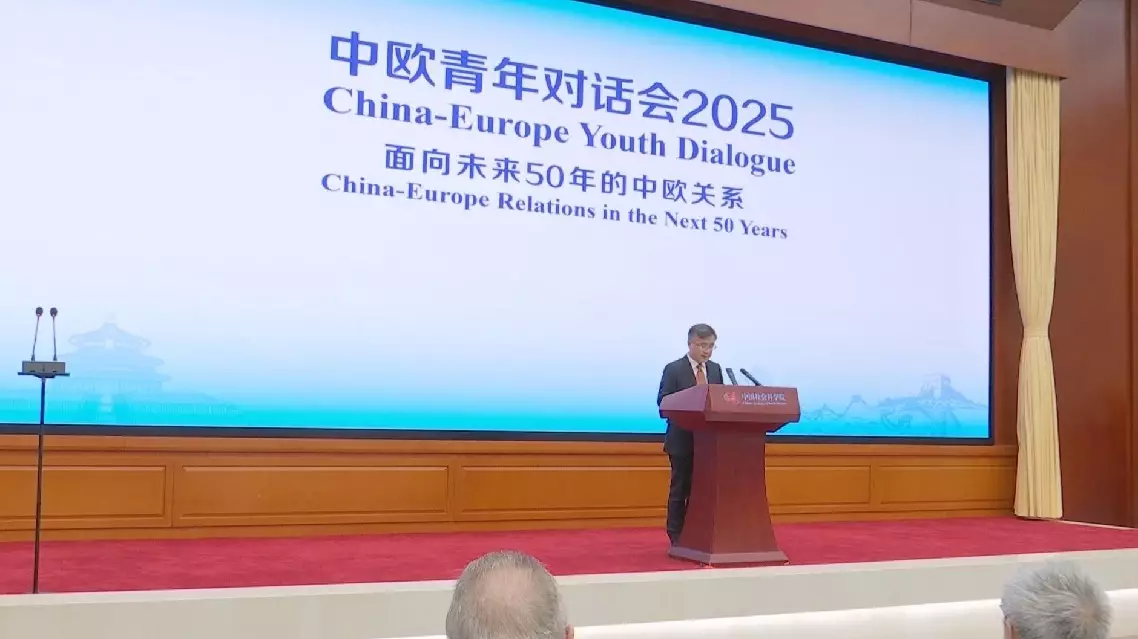
A high-level symposium on China-Europe youth exchanges opened in Beijing on Monday, bringing together former officials, scholars and young participants to discuss how future generations can boost cooperation and deepen engagement over the coming decades.
Organized by the Institute of European Studies at the Chinese Academy of Social Sciences (CASS), the event has brought together over 60 representatives from 30 European countries and about 60 students and young scholars from China. It aims to strengthen China-EU relations by promoting people-to-people links and encouraging greater economic and political engagement.
A series of parallel forums themed on topics including economics, culture and technology were also held, with many agreeing it is young people that will play an increasingly important role in shaping future China-EU relations and fostering broader global understandings.
On the sidelines of the event, former world leaders and youth delegates shared their views on the importance of building trust and expanding cross-border exchanges, particularly against the current backdrop of global challenges.
"To see us, the European Union, as a partner of the United States, in challenging China, I don’t think this it's the correct answer and correct relations. From this perspective, extremely important are not only economic relations, flow of the capital, transfer of technology, joint ventures, trade, export, import to and from (different countries), but also people to people exchanges," said Grzegorz Kolodko, the former Polish deputy prime minister.
As youth exchanges continue to grow, supported by China's expanded visa-free policies and rising cultural interactions through film, music and the arts, many believe the onus will now fall on the younger generations to strengthen cross-cultural ties.
"Young people are the bridge and energy of China-Europe relations. We can look beyond misunderstandings, communicate with openness, and turn ideas into actions, and work [together] on some practical areas like green innovation or cultural exchange," said Kong Yuan, an associate research fellow at the Institute of European Studies under CASS.
This year marks 50 years since China established formal diplomatic relations with the European Economic Community, the predecessor of the European Union, which was later upgraded to a comprehensive strategic partnership in 2003.
China and the European Union remained each other's second-largest trading partners last year. In the first three quarters of 2025, bilateral trade rose by more than 5 percent to hit 4.4 trillion yuan (nearly 620 billion U.S. dollars), according to official data.
Importance of enhancing China-EU youth exchanges highlighted at Beijing symposium