China's foreign exchange market remained sound in October with relatively balanced supply and demand in the market, said the State Administration of Foreign Exchange (SAFE) on Monday.
In October, banks in China saw 1.5194 trillion yuan (about 214 billion U.S. dollars) in foreign exchange settlement and 1.394 trillion yuan (about 196 billion U.S. dollars) in foreign exchange sales.
Regarding the foreign exchange market situation in October, despite increased volatility in international financial markets and a generally strengthening U.S. dollar index since the same month, China's foreign exchange market has maintained stable and sound operation, according to the SAFE.
The foreign exchange market maintained basic equilibrium in supply and demand during October. The foreign exchange settlement surplus stood at 17.7 billion U.S. dollars, narrowing from the previous month and showing a more balanced condition.
Enterprises and other entities bought or sold foreign currencies in an orderly manner based on actual needs, with banks' buying and selling rates remaining broadly in line with the average level of the first nine months.
Meanwhile, cross-border capital flows remained stable. Affected by the country's National Day and Mid-Autumn Festival holidays from Oct 1 to 8, the non-banking sector including enterprises and individuals saw a small net cross-border capital outflow in September, while October witnessed increased net cross-border capital inflows. The average monthly cross-border payment surplus over the two months stood at 24 billion U.S. dollars.
Specifically, goods trade maintained high net capital inflows, while cross-border expenditures such as resident outbound travel and dividend payments by foreign-invested enterprises saw seasonal declines. The net outflow of services trade and investment income narrowed compared with the previous month.
China's foreign exchange market maintains steady operation in October

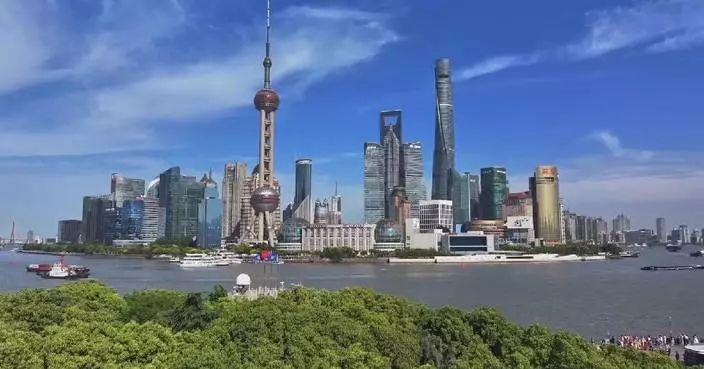
The two-day 2025 Brain-Computer Interface (BCI) Conference concluded on Friday in Shanghai, where multiple globally leading "China solutions" took center stage.
Under the theme "Brain connects the world, wisdom gathers in Shanghai," the event gathered research teams from major universities, leading industry developers, and experts across the BCI sector to strengthen the connection between research, application, and policy.
As part of the event, the first BCI competition featured four categories—fatigue detection, emotion recognition, brain-controlled robotic cars, and brain-controlled robotic arms - with 40 out of nearly 100 teams from across China received prizes.
In the BCI Industry Innovation Exhibition Zone, more than a dozen frontier-tech companies presented cutting-edge technologies ranging from key components to comprehensive system-level solutions.
Exhibits spanned the entire technology chain, from underlying hardware to clinical applications, covering fields such as sleep intervention, mental illness treatment, and rehabilitation for degenerative diseases—highlighting the latest trends in BCI development.
"We completed the first domestic clinical trial this March, and next year we will launch large-scale clinical trials," said an exhibitor named Chen Yaoxu.
Shanghai has established China's first future industry cluster dedicated to BCI technologies. During the conference, several new innovation platforms—including a BCI service platform and a joint laboratory for digital neuromedicine - were inaugurated.
"We are guided by clinical needs and clinical scenarios. At the same time, we are opening high-quality EEG datasets for enterprises to support their algorithm research and guide them in developing concrete products that truly address real-world needs," said Wang Zhuoyao, BCI Project manager of Shanghai Municipal Science and Technology Commission.
Shanghai conference highlights China's cutting-edge brain-computer interface innovations