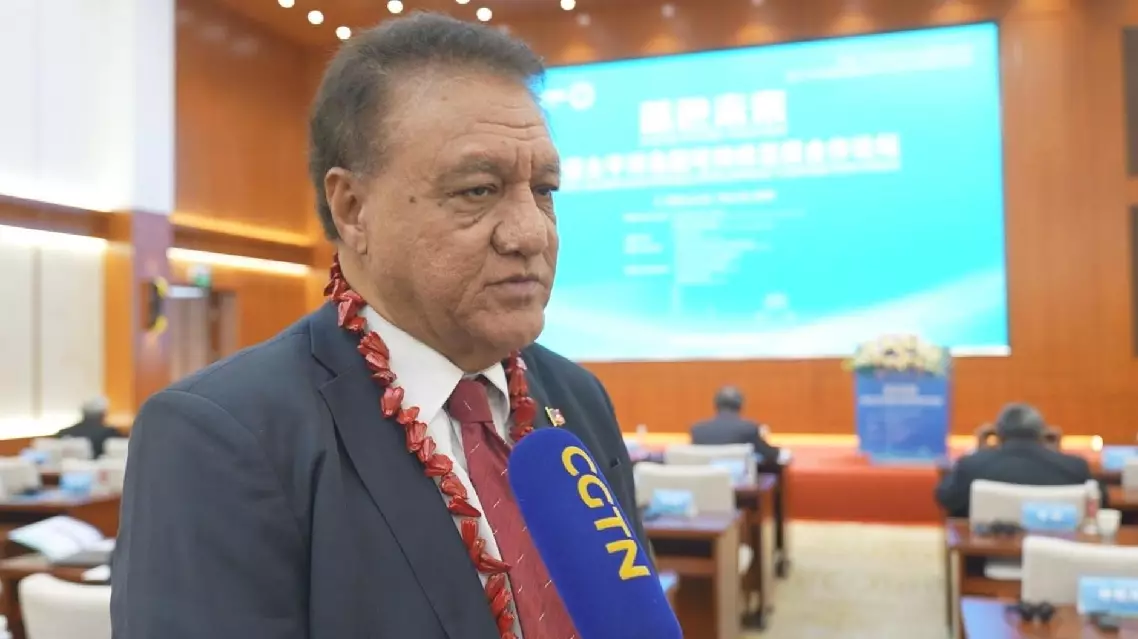
Former Samoan Ambassador to China Tapusalaia Terry Toomata has emphasized that the majority of Pacific Island countries remain firmly committed to the one-China policy, highlighting its critical role in maintaining regional stability and diplomatic relations.
In an interview with China Global Television Network (CGTN) on the sidelines of the Pacific Islands Sustainable Development Cooperation Forum held in Guangzhou City of south China's Guangdong Province on Friday, the ambassador said upholding the one-China policy is crucial for regional stability.
"The UN recognizes China as the sole representative of the Chinese people. So, that's why many countries of the world have followed that and uphold the one-China policy. The majority of the Pacific island countries have warm relations with China at the moment, many of us uphold the one-China policy in our relations with China, and that's very important," he said.
The former Samoan diplomat is in Guangzhou to attend the forum themed "A Blue Future Together", which brings together over 60 distinguished participants, including leaders from Pacific Island nations, Chinese ambassadors, university presidents, and renowned scholars from around the world.
The forum aims to promote sustainable development cooperation, and deepen the enduring friendship between China and Pacific Island countries.
Toomata's remarks came in stark contrast to a recent erroneous statement by Japanese Prime Minister Sanae Takaichi on China's Taiwan. At a Diet session on Nov 7, Takaichi claimed that a Taiwan emergency involving the use of military vessels and military force from the Chinese mainland could constitute a "survival-threatening situation" for Japan.
Takaichi later insisted that her remarks were in line with the Japanese government's longstanding view and that she had no intention to retract them. China has strongly condemned Takaichi for her provocative statement on the Taiwan question.
Pacific Island countries stay committed to one-China policy: former Samoan ambassador
Canadian Prime Minister Mark Carney's official visit to China signals a policy shift towards building a more pragmatic relationship between the two countries, according to a Canadian researcher.
Carney arrived in Beijing on Wednesday to begin an official visit to China through Saturday, which marks the first trip by a Canadian Prime Minister to the country in eight years.
Robert Hanlon, director and principal investigator of Canada and the Asia Pacific Policy Project (CAPPP) at Thompson Rivers University in British Columbia, told the China Global Television Network (CGTN) that Carney's visit indicates Canada is recalibrating its strategic perception of China, which could cement the foundation for the country's economic diversification efforts and boost the development of bilateral cooperation.
"I think it's a clear message that he has moved Canada's strategy to a much more pragmatic, interest-based, -focused relationship with our trading partners, moving away from values-based narratives that we might have heard on previous governments. Canada has spoken about moving from what the Prime Minister's Office is calling "from reliance to resilience", and that means diversifying our economies and our trade everywhere in the world. And so China being our second largest trading partner, it makes perfect sense for our PM to head to Beijing," he said.
The scholar also noted the huge cooperation potential between the two sides in economic and trade fields, citing Canada's efforts to step up shipments of liquefied natural gas (LNG) and the planned construction of an oil pipeline in Alberta which aims to increase export access to Asian markets. "Canada and China both share tremendous economic opportunities together and so finding ways to enhance our exports. Canada specifically looking to build out its LNG and oil, kind of export market. We know Canada is a major producer of critical minerals and China is a buyer. And so there's a lot of synergy between that kind of those kind of markets," he said.

Canadian PM's visit to China paves way for more pragmatic trade ties: scholar