After a potential space debris impact, the Shenzhou-20 spaceship, currently docked with China's space station, will make an uncrewed return to Earth, according to Ji Qiming, a project spokesperson with the country's manned space program .
Following a suspected debris strike on Shenzhou-20's viewport, the three astronauts originally scheduled to return to Earth aboard the spacecraft were redirected to Shenzhou-21, which brought them home safely on Nov. 14.
China launched the Shenzhou-22 on Nov. 25 to provide a new return vehicle for the orbiting crew -- completing the first emergency launch in the history of its manned space program.
During a subsequent spacewalk, the Shenzhou-21 crew, who are now undertaking a six-month orbital stay, may be tasked with inspecting the cracked viewport. They may also perform protective work on it using specialized devices delivered by the Shenzhou-22 launch -- a procedure still being validated in ground tests, said Ji in a interview with China Media Group (CMG).
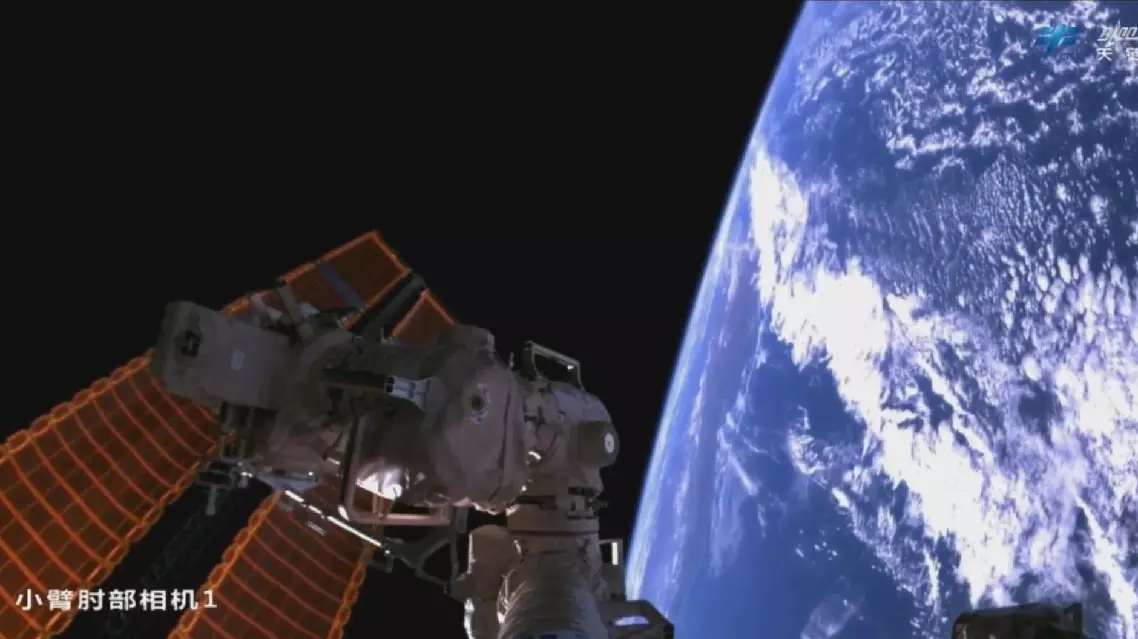
A day prior to their planned return on Nov. 5, the Shenzhou-20 crew spotted an anomaly on the viewport's edge -- a triangular, paint-like mark. They photographed it from multiple angles and under different lights, while the station's robotic arm cameras were employed to take supplemental external pictures.
"We eventually reached a consensus: there must have been a crack, a penetrating one that had gone through the glass, from the inner surface to the outer surface," said Jia Shijin, chief designer of the crewed spaceship system from the China Academy of Space Technology.
After this initial investigation, ground teams conducted extensive simulations and tests, and commissioned two research institutions to perform wind tunnel tests for independent verification, Jia revealed.
In a worst-case scenario, the cracks could spread, causing the outer pane to detach, with this leading to the failure of the inner pressure-sealing glass, resulting in cabin depressurization and the ingress of high-speed gases, Jia explained.
He said that further and more detailed investigation will be conducted after the return of the Shenzhou-20 spaceship.
"Through our initial assessment of the crack, we believe the space debris is less than one millimeter in size, but moving at a very high speed. The entire crack is over 10 millimeters in size. From one corner, it looks like it has been pierced through. But as the spaceship is still in orbit, we can't see it with our own eyes. We may be able to observe it more closely after the Shenzhou-20 spacecraft returns," Jia said.
Following the principle of astronaut safety first, China opted for the historic alternative return and emergency launch procedures.
Ji said that Shenzhou-20's unmanned return mission will generate meaningful real-world experimental data for subsequent missions.
Four mice traveled to space aboard Shenzhou-21 spaceship. They were initially scheduled for a 5-to-7-day experiment on orbit, but instead stayed for about two weeks before returning with the Shenzhou-20 crew, according to Wu Dawei from the China Astronaut Research and Training Center. All mice returned in healthy condition, Wu said.
With the emergency launch of Shenzhou-22, the development of subsequent spacecraft has been accelerated across the board. Shenzhou-23, originally scheduled for delivery in March next year, is expected to be completed two months ahead of schedule; Shenzhou-24 is also being pushed forward with full force, aiming for delivery next summer.
As the astronaut crew number usually matches with that of the spacecraft mission, the next crew will be named "Shenzhou-23 astronaut crew", meaning that the "Shenzhou-22 astronaut crew" will remain permanently vacant in the sequence.
"This serves as a reminder to the entire project: we should never assume our work is perfect. For manned spaceflight, the work is never ending; perfection is our eternal goal, and we must continuously strive towards it. Even if we have done our utmost, there are still uncertainties from the space environment. I think this serves as a warning to everyone," he said.
China's Shenzhou-20 spaceship to make uncrewed return to Earth