NEW YORK (AP) — The U.S. Department of Health and Human Services on Thursday outlined a strategy to expand its use of artificial intelligence, building on the Trump administration’s enthusiastic embrace of the rapidly advancing technology while raising questions about how health information would be protected.
HHS billed the plan as a “first step” focused largely on making its work more efficient and coordinating AI adoption across divisions. But the 20-page document also teased some grander plans to promote AI innovation, including in the analysis of patient health data and in drug development.
“For too long, our Department has been bogged down by bureaucracy and busy-work,” Deputy HHS Secretary Jim O’Neill wrote in an introduction to the strategy. “It is time to tear down these barriers to progress and unite in our use of technology to Make America Healthy Again.”
The new strategy signals how leaders across the Trump administration have embraced AI innovation, encouraging employees across the federal workforce to use chatbots and AI assistants for their daily tasks. As generative AI technology made significant leaps under President Joe Biden’s administration, he issued an executive order to establish guardrails for their use. But when President Donald Trump came into office, he repealed that order and his administration has sought to remove barriers to the use of AI across the federal government.
Experts said the administration's willingness to modernize government operations presents both opportunities and risks. Some said that AI innovation within HHS demanded rigorous standards because it was dealing with sensitive data and questioned whether those would be met under the leadership of Health Secretary Robert F. Kennedy Jr. Some in Kennedy’s own “Make America Health Again” movement have also voiced concerns about tech companies having access to people’s personal information.
HHS’s new plan calls for embracing a “try-first” culture to help staff become more productive and capable through the use of AI. Earlier this year, HHS made the popular AI model ChatGPT available to every employee in the department.
The document identifies five key pillars for its AI strategy moving forward, including creating a governance structure that manages risk, designing a suite of AI resources for use across the department, empowering employees to use AI tools, funding programs to set standards for the use of AI in research and development and incorporating AI in public health and patient care.
It says HHS divisions are already working on promoting the use of AI “to deliver personalized, context-aware health guidance to patients by securely accessing and interpreting their medical records in real time.” Some in Kennedy's Make America Healthy Again movement have expressed concerns about the use of AI tools to analyze health data and say they aren't comfortable with the U.S. health department working with big tech companies to access people's personal information.
HHS previously faced criticism for pushing legal boundaries in its sharing of sensitive data when it handed over Medicaid recipients' personal health data to Immigration and Customs Enforcement officials.
Oren Etzioni, an artificial intelligence expert who founded a nonprofit to fight political deepfakes, said HHS’s enthusiasm for using AI in health care was worth celebrating but warned that speed shouldn’t come at the expense of safety.
“The HHS strategy lays out ambitious goals — centralized data infrastructure, rapid deployment of AI tools, and an AI-enabled workforce — but ambition brings risk when dealing with the most sensitive data Americans have: their health information,” he said.
Etzioni said the strategy’s call for “gold standard science,” risk assessments and transparency in AI development appear to be positive signs. But he said he doubted whether HHS could meet those standards under the leadership of Kennedy, who he said has often flouted rigor and scientific principles.
Darrell West, senior fellow in the Brooking Institution’s Center for Technology Innovation, noted the document promises to strengthen risk management but doesn’t include detailed information about how that will be done.
“There are a lot of unanswered questions about how sensitive medical information will be handled and the way data will be shared,” he said. “There are clear safeguards in place for individual records, but not as many protections for aggregated information being analyzed by AI tools. I would like to understand how officials plan to balance the use of medical information to improve operations with privacy protections that safeguard people’s personal information.”
Still, West, said, if done carefully, “this could become a transformative example of a modernized agency that performs at a much higher level than before.”
The strategy says HHS had 271 active or planned AI implementations in the 2024 financial year, a number it projects will increase by 70% in 2025.
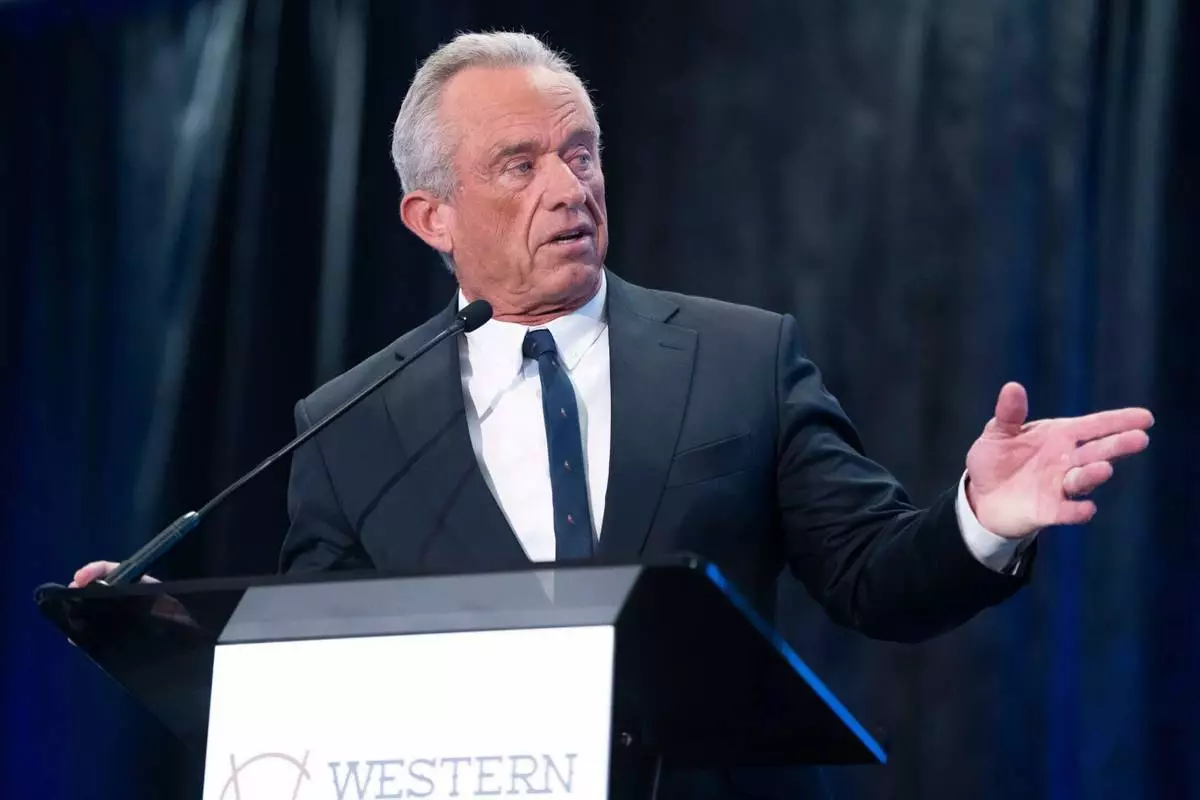
U.S. Secretary of Health and Human Services Robert F. Kennedy Jr. speaks during the Western Governors' Association meeting Thursday, Nov. 20, 2025, in Scottsdale, Ariz. (AP Photo/Rebecca Noble)

KENNER, La. (AP) — The doors of Carmela Diaz's taco joint are locked, the tables are devoid of customers and no one is working in the kitchen. It's one of many once-thriving Hispanic businesses, from Nicaraguan eateries to Honduran restaurants, emptied out in recent weeks in neighborhoods with lots of signs in Spanish but increasingly fewer people on the streets.
In the city of Kenner, which has the highest concentration of Hispanic residents in Louisiana, a federal immigration crackdown aiming for 5,000 arrests has devastated an economy already struggling from ramped-up enforcement efforts this year, some business owners say, and had far-reaching impacts on both immigrants and U.S. citizens alike.
“Fewer and fewer people came,” said a crying Diaz, whose Taqueria La Conquistadora has been closed for several weeks now with both customers and workers afraid to leave home. “There were days we didn’t sell anything. That’s why I made the decision to close the business — because there was no business.”
On Wednesday, convoys of federal vehicles began rumbling back and forth down Kenner's main commercial streets as the Department of Homeland Security commenced the latest in a series of immigration enforcement operations that have included surges in Los Angeles, Chicago and Charlotte, North Carolina. Bystanders have posted videos of federal agents detaining people outside Kenner businesses and at construction sites.
Border Patrol commander Gregory Bovino also made an appearance in the city, surrounded by agents in tactical gear, to tout to reporters the launch of the operation dubbed Catahoula Crunch, a name derived from the big game hound that is the Louisiana state dog.
The state's Hispanic population has boomed in the last two decades, with many of them arriving in the aftermath of 2005's Hurricane Katrina to help rebuild. In Kenner, just west of New Orleans between the Mississippi River and Lake Pontchartrain, Hispanics make up about 30% of residents.
Diaz, who is from El Salvador, arrived in 2006 after years of doing farm work in Texas. She opened food trucks, earning enough to buy a home in Kenner, and her business has since expanded to a fleet of trucks and two brick-and-mortar restaurants.
Nearly all that is shuttered at the moment because of the crackdown, and Diaz is scraping by through making home deliveries to people fearful of being swept up by agents regardless of their legal status.
“They don’t respect anyone,” Diaz said. “They don’t ask for documents. They don’t investigate. They slap the handcuffs on them and take them away.”
Mayra Pineda, CEO of the Louisiana Hispanic Chamber of Commerce and a Kenner resident for decades, fears for the future if the crackdown continues for months as planned.
“How are these business owners going to survive?” she said. “I don’t know. But let’s be clear — it’s not only on the Hispanic community but bad for all of us, for the economy in general.”
Kenner Police Chief Keith Conley described the federal immigration operation as a “prayer answered for us.”
The chief said while crime is decreasing in the city, he has raised concerns about violent crimes involving immigrants who entered the U.S. illegally. The police department shared a dozen press releases documenting crimes – between 2022 and 2025 – where they say the person arrested had entered the country illegally. The cases included sex crimes, a murder, gang activity and shootings.
Based on the most recent crime report published by the Louisiana Statistical Analysis Center, in 2023 in Kenner a total of 4,436 total “offenses” were committed, which included 863 “crimes against persons.”
Conley said that while violent crimes are concerning, one of the “blights" that “we see and feel every day” are traffic stops and car accidents, that involve drivers who are illegal immigrants that are uninsured and unlicensed.
State Sen. Kirk Talbot, a Republican who represents a portion of Kenner, said he believes the federal operation will ultimately “benefit the city” and that residents who are in the U.S. legally have “nothing to be afraid of.”
“I think the people that come here illegally – who flee authorities and, especially, ones that have criminal records -- need to obey the law and they need to be caught and deported,” Talbot said.
While Kenner has closely worked with federal immigration agents before, especially under the 287(g) program that allows local police to question the immigration status of suspects in their custody, Conley said local officers are not currently aiding in the federal operation. However, he said, the department is ready to assist in the operation if asked.
DHS spokesperson Tricia McLaughlin said Thursday that federal agents have already made dozens of arrests, though the agency has not released a full list of people detained.
“Americans should be able to live without fear of violent criminal illegal aliens harming them, their families, or their neighbors,” McLaughlin said in a statement. “In just 24 hours on the ground, our law enforcement officers have arrested violent criminals with rap sheets that include homicide, kidnapping, child abuse, robbery, theft, and assault.”
The office of Mayor Michael Glaser, a former police chief, declined to comment on his stance on the operation. But it said the crackdown “falls under federal jurisdiction” and the mayor expects all agencies operating in the city to conduct themselves “professionally, lawfully and with respect for our community.”
However, the city's police are among the hundreds of local and state law enforcement agencies nationwide that have signed agreements to be part of an Immigration and Customs Enforcement program that authorizes them to hold detainees for potential deportation.
Sergio Perez, a Guatemalan immigrant and U.S. citizen who has lived in Kenner since 2010, said he has loved ones there who lack legal permission to be in the country and risk being detained or deported. He also worries that anyone who is Hispanic is at risk of abuse by federal agents, regardless of their immigration status.
While Perez considers Kenner home — a place where it is easy to find favorite dishes like “caldo de res,” a hearty beef and vegetable stew — he is prepared to leave the country if family members are deported.
“They don’t want us here,” Perez said. “It’s like you are in someone’s house and you don’t feel welcome. They’re just killing our spirit.”
Cline reported from Baton Rouge, Louisiana. Associated Press writer Valerie Gonzalez in McAllen, Texas, contributed.
Brook is a corps member for The Associated Press/Report for America Statehouse News Initiative. Report for America is a nonprofit national service program that places journalists in local newsrooms to report on undercovered issues.
Carmela Diaz speaks inside her closed restaurant in the midst of a Customs and Border Protection immigration crackdown in Kenner, La., Thursday, Dec. 4, 2025. (AP Photo/Gerald Herbert)
U.S. Border Patrol agents arrive at a Home Depot in Kenner, La.,Wednesday, Dec. 3, 2025. (AP Photo/Gerald Herbert)
A Customs and Border Protection agent exits a vehicle after agents apprehended two people during an operation Thursday, Dec. 4, 2025, in Kenner, La. (AP Photo/Gerald Herbert)
Carmela Diaz poses inside her closed restaurant in the midst of a Customs and Border Protection immigration crackdown in Kenner, La., Thursday, Dec. 4, 2025. (AP Photo/Gerald Herbert)
Carmela Diaz speaks inside her closed restaurant in the midst of a Customs and Border Protection immigration crackdown in Kenner, La., Thursday, Dec. 4, 2025. (AP Photo/Gerald Herbert)