A Chinese envoy to the United Nations on Friday called on the international community to work together to confront the root causes of the Palestinian question.
On Friday, the 80th session of the United Nations General Assembly adopted several resolutions related to Palestine and the Middle East, as recommended by the Special Political and Decolonization Committee (Fourth Committee) of the United Nations.
The resolutions were adopted to address issues such as the operations of the United Nations Relief and Works Agency for Palestine Refugees in the Near East (UNRWA), aid for Palestinian refugees, and the occupied Palestinian territories. Both the United States and Israel voted against related resolutions.
Sun Lei, China's deputy permanent representative to the United Nations, said at the meeting that China firmly support the Palestinian people's just cause of regaining their legitimate national rights and has continued to provide humanitarian and development assistance to Palestine.
China calls on the international community to work together to confront the root causes of the Palestinian issue, take strong actions, and address the historical injustice suffered by the Palestinian people, Sun stressed.
"The Palestinian question is at the core of the Middle East issue. It is a matter concerning international fairness and justice, and bears on the regional situation. China has consistently called for a comprehensive and lasting ceasefire in Gaza and improve the humanitarian situation as soon as possible. Observing the principle of Palestinians governing Palestine, China emphasizes the post-conflict governance and reconstruction in Gaza. Most importantly, we will strive to anchor efforts towards the two-State solution, and promote the realization of the political settlement of the Palestinian question at an early date," he added.
Chinese envoy urges int'l community to confront root causes of Palestinian question

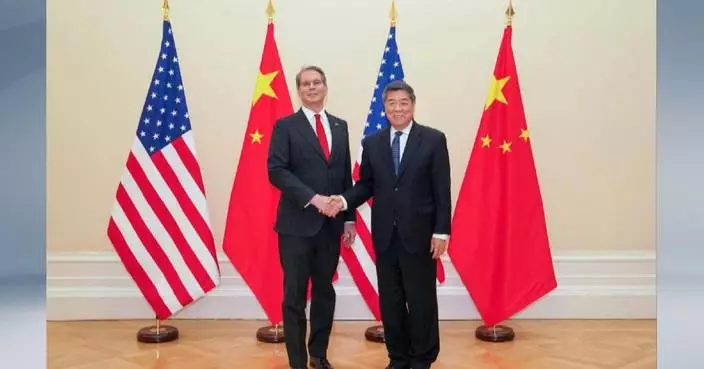
Officials and business leaders from both China and the United States gathered in Berkeley, California on Friday to discuss the future of trade and investment between China and the San Francisco Bay Area, with many hoping to overcome the recent strain brought by the Trump administration's tariffs.
The China Council for the Promotion of International Trade hosted a business breakfast exchange meeting on Friday morning, with the council's chairman Ren Hongbin sending out a clear message of the vast economic potential which is there to be tapped into.
"The Chinese economy is very much innovation driven. And the strategic emerging industries, such as new energy, new materials, low carbon, aerospace, bio-pharmacy and the low-altitude economy, will generate a trillion-yuan level or even larger markets. So, I think that will provide enormous opportunities and room for China and U.S. companies to cooperate," said Ren.
He further stressed the China International Supply Chain Expo in Beijing as an example of an event where San Francisco Bay Area companies like NVIDIA and Apple were active participants and direct beneficiaries.
Meanwhile, Chinese Consul General in San Francisco Zhang Jianmin said that against the backdrop of a global economic slowdown, greater cooperation in the innovation sector is now more important than ever.
"The [San Francisco] Bay Area is home to many of the world's top tech companies and offers a sound innovation ecosystem. China has a super big market, rich application scenarios and a complete industrial supporting system. There exists tremendous potential for both sides to have more mutually beneficial cooperation by tapping into their complementary strengths," said Zhang.
Attendees did voice concerns over how the Trump administration's tariffs are impacting business.
With China accounting for nearly 30 percent of the Port of Oakland's total trade volume, the port's executive director Kristi McKenney stressed the need for greater stability and certainty.
"The tariffs in many cases were never actually implemented or were changed before they were implemented. So those linkages are a bit more challenging. I think the bigger issue will be certainty in the economy. And if there's lack of certainty, if we see economic difficulty, then you're going to see job losses," said McKenney.
Oakland's Mayor Barbara Lee said that it is very much business as usual, despite the recent difficulties.
"While we understand the challenges of tariffs, the exports and imports are still continuing, and our port is still a large containerized port doing business with China. And we're going to strengthen that relationship. We may have our differences on issues, on policies, but we here in Oakland understand that we're a global city and we believe the trade brings friendships, brings understanding, and also brings economic benefits to both countries," she said.
Chinese, US officials, business leaders meet in California to deepen mutual understanding