MONT-TREMBLANT, Quebec (AP) — Alice Robinson of New Zealand raced to her second straight women's World Cup giant slalom victory Saturday at Mont-Tremblant, while American star Mikaela Shiffrin finished sixth.
Robinson led after the first run and had a combined time of 2 minutes, 16.18 seconds in the first of two races at the resort northwest of Montreal.
Click to Gallery
Alice Robinson, of New Zealand, middle, celebrates her first place finish with Zrinka Ljutic , of Croatia, left, who took second and Valerie Grenier, of Canada, who finished third in the women's World Cup giant slalom in Mont Tremblant, Quebec, Saturday, Dec. 6, 2025. (Sean Kilpatrick/The Canadian Press via AP)
Zrinka Ljutic, of Croatia, skis to a second place finish in the women's World Cup giant slalom in Mont Tremblant, Quebec, Saturday, Dec. 6, 2025. (Sean Kilpatrick/The Canadian Press via AP)
Valerie Grenier, of Canada, celebrates a third place finish in the women's World Cup giant slalom in Mont Tremblant, Quebec, Saturday, Dec. 6, 2025. (Sean Kilpatrick/The Canadian Press via AP)
Alice Robinson, of New Zealand, middle, celebrates her first place finish with Zrinka Ljutic , of Croatia, left, who took second and Valerie Grenier, of Canada, who finished third in the women's World Cup giant slalom in Mont Tremblant, Quebec, Saturday, Dec. 6, 2025. (Sean Kilpatrick/The Canadian Press via AP)
Alice Robinson, of New Zealand, celebrates her first place finish in the women's World Cup giant slalom in Mont Tremblant, Quebec, Saturday, Dec. 6, 2025. (Sean Kilpatrick/The Canadian Press via AP)
Alice Robinson, of New Zealand, celebrates her first place finish in the women's World Cup giant slalom in Mont Tremblant, Quebec, Saturday, Dec. 6, 2025. (Sean Kilpatrick/The Canadian Press via AP)
“I was a bit nervous this morning because the conditions here were so different compared to last weekend, so I wasn’t sure the good skiing from last weekend necessarily meant it was going to be good this weekend,” Robinson said. “I’m really happy to roll it through in these conditions which were really tough today.”
She has six career World Cup victories, also winning a week ago at Copper Mountain in Colorado. That victory made her the women's World Cup victory leader among skiers from a non-European or North American nation.
Zrinka Ljutic of Croatia was second, 0.94 seconds back. Valerie Grenier of Canada was third, a second behind on her home course.
“It was a big reaction, big tears in my eyes,” Grenier said. “I still can’t believe it happened. With my teammates jumping into my arms, it made me cry a lot."
Switzerland’s Camille Rast (2:17.39) and France’s Clara Direz (2:17.69) rounded out the top five. Shiffrin (2:17.83), who was third after the opening run, posted only the 20th-fastest second run.
The course and the steady snowfall through the entire first run appeared to cause trouble for several skiers, including some of the favorites.
Austria’s Julia Scheib, who won the first giant slamom of the season and led standings entering the day, failed to complete her opening run, as did Sweden’s Sara Hector, fifth in the standings and the first out of the gate Saturday.
A second giant slalom is set for Sunday.
AP Olympics: https://apnews.com/hub/milan-cortina-2026-winter-olympics

Zrinka Ljutic, of Croatia, skis to a second place finish in the women's World Cup giant slalom in Mont Tremblant, Quebec, Saturday, Dec. 6, 2025. (Sean Kilpatrick/The Canadian Press via AP)

Valerie Grenier, of Canada, celebrates a third place finish in the women's World Cup giant slalom in Mont Tremblant, Quebec, Saturday, Dec. 6, 2025. (Sean Kilpatrick/The Canadian Press via AP)

Alice Robinson, of New Zealand, middle, celebrates her first place finish with Zrinka Ljutic , of Croatia, left, who took second and Valerie Grenier, of Canada, who finished third in the women's World Cup giant slalom in Mont Tremblant, Quebec, Saturday, Dec. 6, 2025. (Sean Kilpatrick/The Canadian Press via AP)

Alice Robinson, of New Zealand, celebrates her first place finish in the women's World Cup giant slalom in Mont Tremblant, Quebec, Saturday, Dec. 6, 2025. (Sean Kilpatrick/The Canadian Press via AP)

Alice Robinson, of New Zealand, celebrates her first place finish in the women's World Cup giant slalom in Mont Tremblant, Quebec, Saturday, Dec. 6, 2025. (Sean Kilpatrick/The Canadian Press via AP)
DES MOINES, Iowa (AP) — The near-daily changes in U.S. gas prices are dizzying for drivers, who are left feeling frustrated and cash-strapped by the highest fuel costs since 2022.
With the Iran war pushing up prices worldwide, the U.S. average for a gallon of gas topped $4 on Tuesday, according to AAA.
Prices can change from one day to the next or from one nearby station to another, forcing drivers in the U.S. to game out the right moment to fill up or hunt for cheaper prices.
Experts say differences in price aren’t typically decided by any individual gas retailer, and most of them aren't pocketing the extra pennies when prices rise. The uncertainty at the pump is trickling down from a massive, volatile oil and gas market that's making it hard for gas stations to keep up.
Lonnie McQuirter, director of operations at 36 Lyn Refuel Station in south Minneapolis, said his margins have gotten much tighter. About a mile (1.6 kilometers) off Interstate 35, the neighborhood convenience store posted $3.399 a gallon for regular gas on Wednesday, which is about 18 cents lower than the metro average, according to AAA.
“We price based on what we’re able to buy fuel at, and how well we can operate,” McQuirter said. He declined to speculate about his competitors, saying, “They’ve got different economics.”
Wholesale fuel prices, which shift multiple times a day, are the main reason McQuirter said he's charging more than a month ago. He's also facing higher credit card fees and rising costs to maintain pumps.
In times like these, with consumers “screaming for help,” McQuirter said small operators like him act more on emotion than greed.
“We’re in our stores every day looking our customers in the eye,” he said. “It really takes a toll when people are having to cut back on certain things in order to afford to live.”
A lot of it is outside the gas retailer’s control. Roughly half the price at the pump pays for the cost of crude oil, the main ingredient in gasoline, according to the U.S. Energy Information Administration. About 20% goes to refiners who turn crude into gas.
Those costs have risen as crude oil prices jumped in response to the war and shipping disruptions in the Strait of Hormuz. Gas retailers are adjusting the price at the pump to account for the higher price they just paid for their next shipment of gasoline.
Taxes — federal, state and local — account for nearly 20% of the price, while about 10% is left for retailers, who still have to pay for transportation, labor and other expenses.
Retailers' markup has averaged about 38 cents a gallon over the past five years, according to the convenience store trade group NACS, citing data from research firm OPIS. After expenses, stations may keep roughly 15 cents per gallon, said Jeff Lenard, a vice president at NACS.
“Some make more, some make less,” Lenard said.
Patrick De Haan, head of petroleum analysis at GasBuddy, compared it to a homeowner’s role in setting their sale price.
“If I was selling a house today, I’d be beholden to whatever the housing market is,” De Haan said. “That’s the same for gas station owners. Whatever the price of oil and gasoline are, they are a price taker, not maker.”
Although the national average just passed $4 a gallon, the price that drivers pay varies widely by state, city and station.
Taxes alone can create large gaps. California's gas taxes and fees totaled about 71 cents per gallon last year, compared with roughly 9 cents in Alaska.
Distance from refineries, the type of retailer, how much volume the location goes through and whether there are other fuel options nearby also play a role.
Gas stations near competitors may choose to price gasoline competitively on large outdoor signs to attract drivers, hoping they'll come inside and buy higher-margin items, said Neal Walters, a partner focused on energy at the global management consulting firm Kearney.
“It’s one of the only retail locations where you don’t have to go into the store to find out what you’re paying,” Walters said.
While U.S. retailers sell hundreds of millions of gallons of gas a day nationwide, they typically won't see large gains when prices rise.
“The margins shrink when prices go up because it’s harder for them to pass along the increases as quickly as they themselves get them,” De Haan of GasBuddy said.
When oil prices start to fall, retailers may recover some of those losses, particularly if there’s uncertainty about future supply costs. Prices can rocket up but tend to drift down like a falling feather, said Garrett Golding, assistant vice president for energy programs at the Federal Reserve Bank of Dallas.
Higher gas prices can also hurt sales inside the gas stations, if customers who are being squeezed at the pump spend less on other things.
“So it’s not always the case that higher prices mean the service station owners are actually doing better,” Golding said.
Most profits in the oil and gas supply chain are made upstream, he said, by companies that extract and refine crude oil. Still, Golding says they aren't necessarily celebrating; at some point, a significant spike in prices could start to hurt demand.
“It may be a good stretch of days or weeks for them,” he said, “but they’re also cautious of what it could portend.”
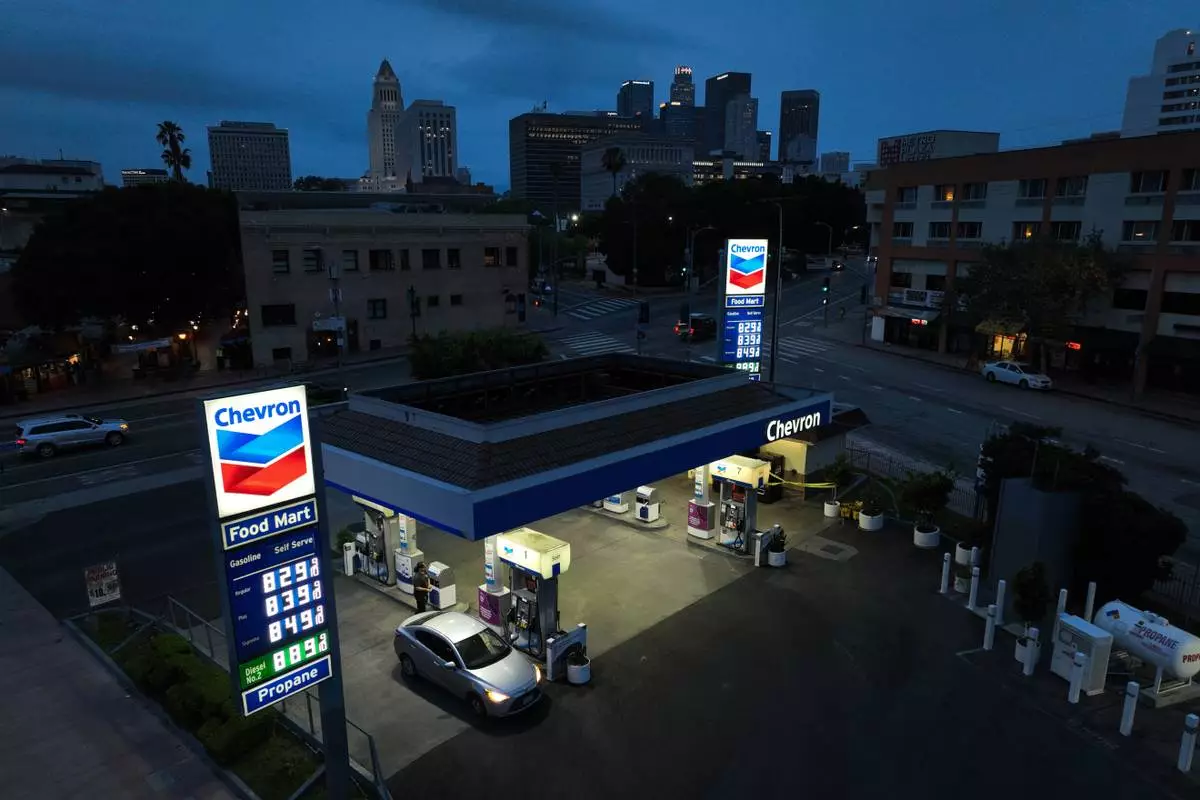
Gas prices are displayed at a Chevron gas station, in downtown Los Angeles, Tuesday, March 31, 2026. (AP Photo/Jae C. Hong)