MELBOURNE, Australia (AP) — Riley Allen, a 15-year-old schoolboy living on an Outback sheep ranch, doesn’t know how he’ll keep in touch with his circle of far-flung friends once Australia's world-first social media ban takes effect on Wednesday.
Riley’s family lives 5 kilometers (3 miles) from Wudinna, a community of just over 1,000 in South Australia state. But some of his school friends live as far as 70 kilometers (43 miles) away.
Click to Gallery
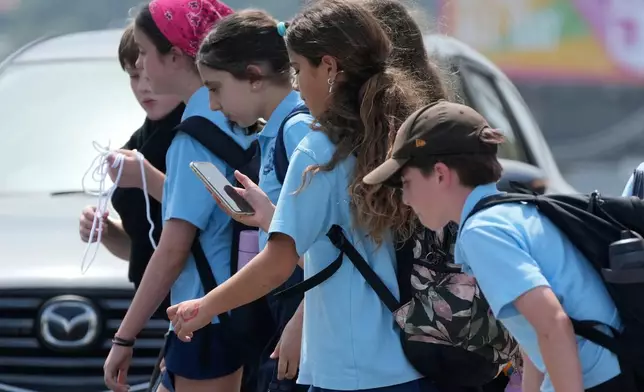
A school girl uses her phone as she walks with a group of kids in Sydney, Monday, Dec. 8, 2025. (AP Photo/Rick Rycroft)
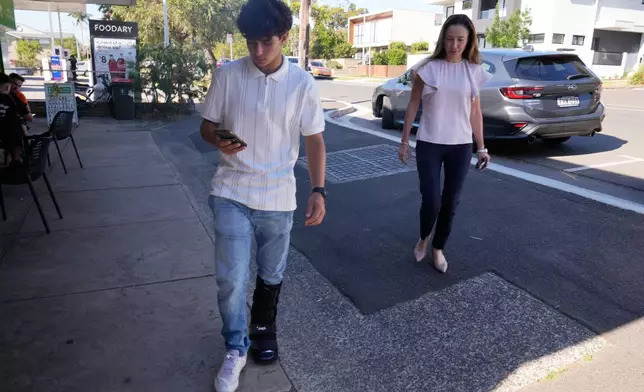
Noah Jones, left, uses his phone as his mother Renee, walks toward him in Sydney, Tuesday, Dec. 9, 2025. (AP Photo/Rick Rycroft)

Noah Jones shows a warning on his phone that says he cannot access a social media site as his mother Renee, walks toward him in Sydney, Tuesday, Dec. 9, 2025. (AP Photo/Rick Rycroft)
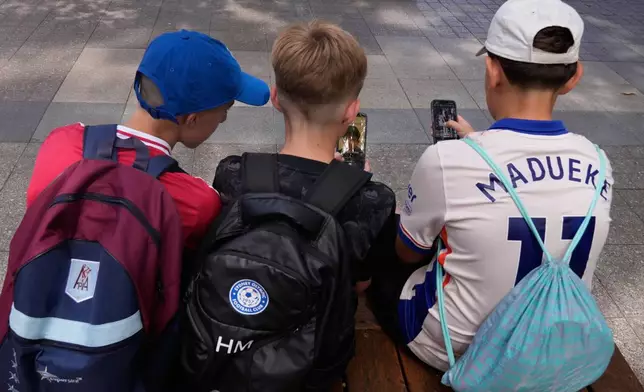
Hugo Winwood-Smith, right, Hardy Macpherson and Edan Abou, left, all 11-years-old, use their phones while sitting outside a school in Sydney, Monday, Dec. 8, 2025. (AP Photo/Rick Rycroft)
“I don’t think the impact will be very positive for us. We don’t have a lot out here to get in contact with each other,” Riley said.
“I’m not sure how we’re going to keep in touch over the holidays with each other,” he said, referring to the Southern Hemisphere summer break that starts on Thursday.
Riley and others younger than 16 will be banned by law from holding accounts with Facebook, Instagram, Kick, Reddit, Snapchat, Threads, TikTok, X, YouTube and Twitch from Wednesday. The platforms face fines of up to 49.5 million Australian dollars ($32.9 million) if they fail to take reasonable steps to remove the accounts.
Meta, which owns Facebook, Instagram and Threads, was the first tech giant to react, beginning to exclude suspected young children from last week.
Riley holds accounts with most of the age-restricted platforms and had been asked by some to verify that he is at least 16. But by Monday, he had not been ousted by any.
Riley’s schoolteacher mother, Sonia Allen, said she wouldn’t help her son get around the ban, but suspects other parents will.
“I wouldn’t. I do know there are other people that would. If the rule is there, the rule is there. But I know what kids are like, and I’ve been a kid before, and they’re going to get around it if they can,” she said.
While the law allows parents no discretion to allow their children to hold social media accounts, Allen said there was a role for parents in regulating their children’s social media use.
A year ago, she banned Riley from social media for several weeks.
“In the past with Riley, we’ve had to take measures to limit his usage because we found him on social media at midnight and he wasn’t getting his homework done and things like that. We ended up taking it off him for a couple of months,” Allen said. “From that, he’s learned to use it a more responsibly.”
Riley, who turns 16 in April, said he understood the ban’s objectives, but there are other ways to achieve them. He suggested a 10 p.m. enforced social media curfew for young children to prevent them losing sleep.
Riley has an ally in Australia’s largest city, Sydney: schoolboy Noah Jones, who turns 16 in August.
Noah is one of two 15-year-old plaintiffs in a constitutional challenge to the law in the High Court. The other in the case brought by the Sydney-based rights group Digital Freedom Project is schoolgirl Macy Neyland.
They claim the law improperly robs 2.6 million young Australians of a right to freedom of political communication implied in Australia’s constitution.
The Australian government is committed to defeating the challenge on behalf of what they say is an overwhelming majority of parents who demand government action against social media harms.
Many restricted children have told media they welcome their exclusion from platforms with design features that encourage them to spend more time on screens while also serving up content that can harm their health and well-being.
The parents’ group Heaps Up Alliance, which lobbied for the social media age restriction, backs the theory behind the blanket ban that “when everybody misses out, nobody misses out.”
Before Parliament passed the ban last year, more than 140 Australian and international academics with expertise in fields related to technology and child welfare signed an open letter to Prime Minister Anthony Albanese opposing a social media age limit as “too blunt an instrument to address risks effectively.”
Noah said the ban would lead to young Australians swapping from age-restricted platforms to more dangerous, less regulated options.
“I’m against this social media ban because as young Australians, we’ll be completely silenced and cut off from our country and the rest of the world,” Noah said. “We’ve just grown up with this our entire lives, and now it's just being taken away from us all of a sudden. We wouldn’t even know what else we could do.”
His mother, Renee Jones, is also involved in the court case as her son’s litigation guardian, because as a child he can’t make legal decisions himself.
She considers herself a relatively strict parent on social media, and never allowed Noah or his two older brothers to take devices into their bedrooms. But she supports Noah’s stance.
“My parents would never have dreamed that my children could be so fortunate to have this library of knowledge,” Jones said.
“But I really credit Noah as a young person who recognizes the dangers of social media. It’s not all sunshine and lollypops,” she added.
Digital Freedom Project president John Ruddick, who is also a state lawmaker for the minor Libertarian Party, said he had initially intended to apply for a court injunction in a bid to prevent the ban taking effect on Wednesday. But his lawyers advised against it.
A directions hearing will be held in late February to set a hearing date for the constitutional challenge that will be heard by the full bench of seven judges.
Ruddick said the case wasn’t funded by any tech giant, but they would be “extremely welcome” to make a financial contribution.
Ruddick expected children would get around the ban by means including using virtual private networks to make them appear to be offshore.
“They’re going to get around it so they’re then going to be on an underground social media and, to make it worse, without parental supervision,” Ruddick said.
“It’s much better for it to be out in the open and for parents to play a very, very active role … in monitoring what they’re doing on social media,” he added.

A school girl uses her phone as she walks with a group of kids in Sydney, Monday, Dec. 8, 2025. (AP Photo/Rick Rycroft)

Noah Jones, left, uses his phone as his mother Renee, walks toward him in Sydney, Tuesday, Dec. 9, 2025. (AP Photo/Rick Rycroft)
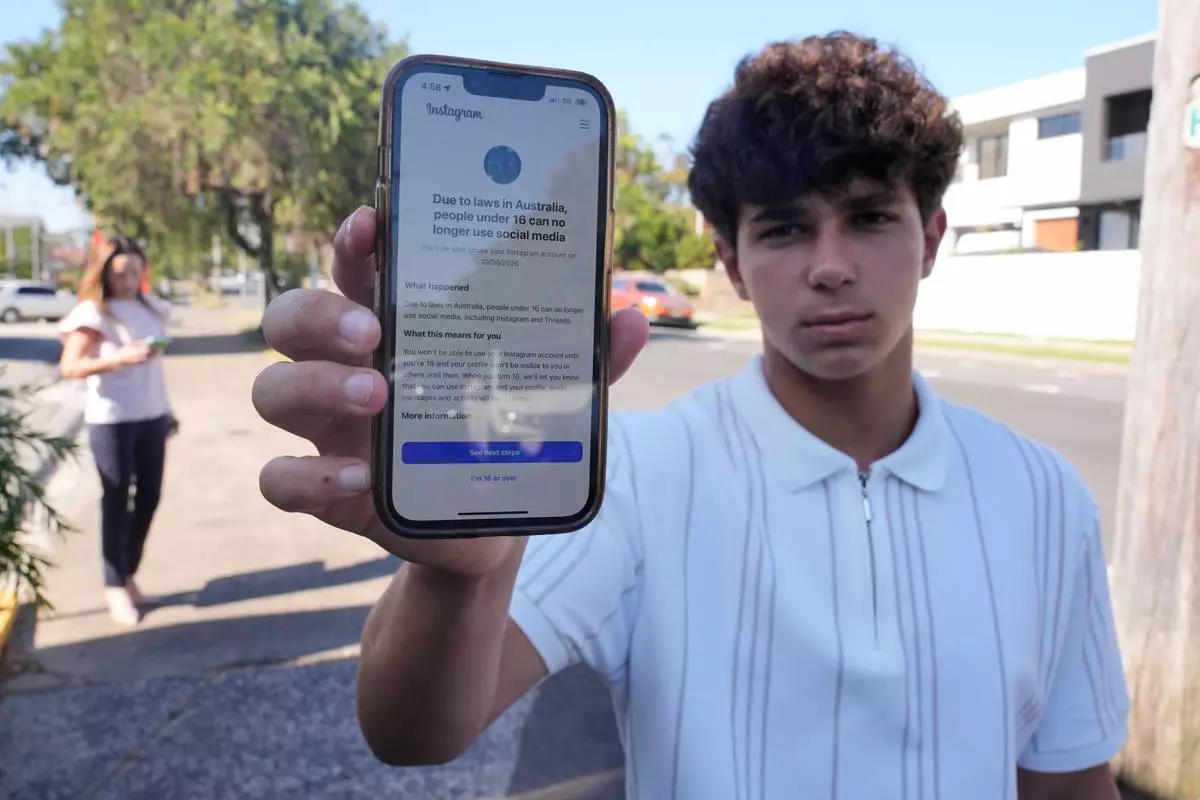
Noah Jones shows a warning on his phone that says he cannot access a social media site as his mother Renee, walks toward him in Sydney, Tuesday, Dec. 9, 2025. (AP Photo/Rick Rycroft)
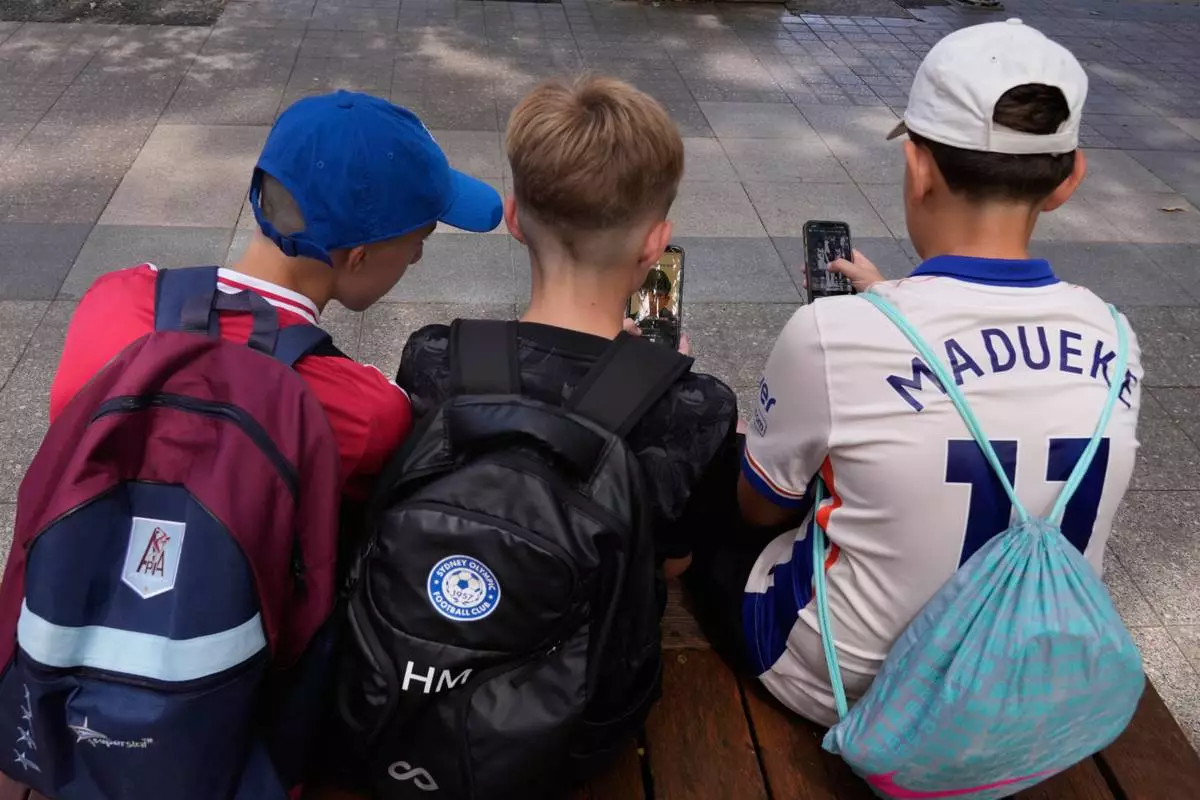
Hugo Winwood-Smith, right, Hardy Macpherson and Edan Abou, left, all 11-years-old, use their phones while sitting outside a school in Sydney, Monday, Dec. 8, 2025. (AP Photo/Rick Rycroft)