After a 156-day trial, the verdict in Jimmy Lai Chee-ying’s case for conspiracy to collude with foreign forces has finally landed. All three charges were proven. The judge said the prosecution witnesses were clear and convincing—honest, reliable, and hard to shake. On top of that, a mountain of messages between Lai and others backed them up too, making the case about as airtight as it gets.
One line in the judgment really jumped off the page: the court said Lai carried deep hatred toward China’s ruling regime, and that his one and only goal was the downfall of the central authorities. Once that’s on the table, the bigger—and frankly colder—picture comes into focus: teaming up with the United States to chase a “China collapse.” Re-reading the witnesses’ evidence, and Lai’s US activity before and after the 2019 turmoil, the pattern is hard to miss—he’d long been laying tracks for a secret “Shina-implosion” agenda —using “Shina”, a largely archaic and now offensive term for China. That lined up neatly with the “all-out war” posture against China being pushed by US hawkish politicians at the time.
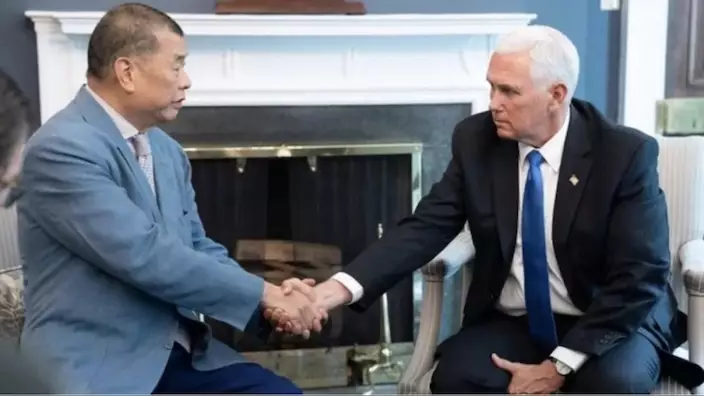
Pence spoke. Lai radicalised. “Shina-implosion” became the plan.
Accomplice witness—and “Fight for freedom, Stand with Hong Kong” leader—Chan Tsz-wah told the court that in early 2020, Lai met the figure nicknamed “Lam Chau Bar” (Liu Zudi) and others at Lai’s villa in Taipei’s Yangmingshan.
Lai’s pitch was blunt: if foreign countries hit China with embargo-style sanctions, and if different “blocs” could be unified and amplified with grassroots force, then what he called a “Shina-implosion” could be triggered: meaning China would collapse from within. And if that collapse came, Lai said, that would be the perfect opening for the United States to transplant democracy into China
Lai didn’t just hope “Shina-implosion” was possible—he seemed convinced after meetings with US top politicians that it was coming, because he believed the US was about to go into full confrontation with China, and that the timing was right to topple China’s regime.
Six months before that Taipei meeting, in July 2019, Lai—helped by his aide Mark Simon and certain behind-the-scenes political operators—met separately with Vice President Mike Pence, Secretary of State Mike Pompeo, and National Security Adviser John Bolton. All three were hawks, right down to the bone. Lai claimed it was about “Hong Kong’s autonomous status,” but it’s far more likely they were discussing a US “new Cold War” against China, and Hong Kong’s role inside that strategy.
When Washington “flipped the table”
Pompeo and Bolton had already floated the idea that the Chinese Communist Party would end up like the Soviet Communist Party—heading toward eventual disintegration. In that story, the US “wins” the ideological war, then gets to transplant American-style democracy into China. That was exactly Lai’s long-held “ideal,” and once he felt those heavyweight allies were onside, his confidence in making “Shina-implosion” happen only grew.
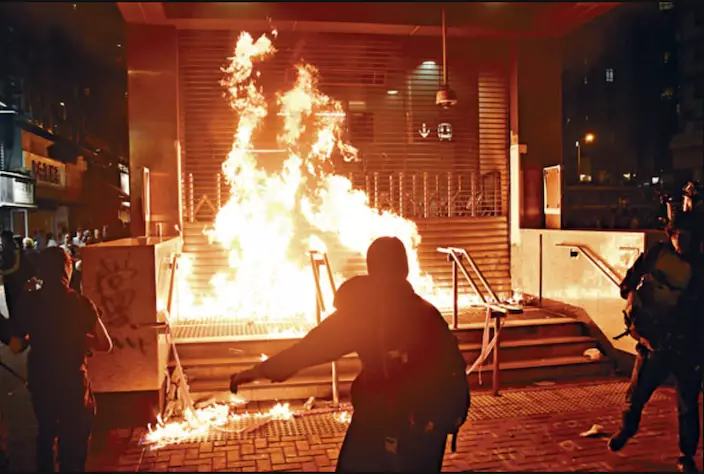
He weaponised his media to shake Hong Kong—US anti-China hawks cheered it on.
And this didn’t start in 2019. A year earlier (October 2018) Pence delivered a speech that Lai saw as nothing less than a “declaration of war” on China, and it lit a fire under him. Cooperating witness and former Apple Daily editorial writer Yeung Ching-kee said that after reading Pence’s speech, Lai told him the US had “flipped the table” on China. Lai believed Washington would rally Japan and other Western countries to confront China, and would seize on China’s weakness to “kick it while it’s down.” In Lai’s mind, this wasn’t just a trade war—it was an “all-out war.” Yeung said that from that moment, Lai became even more radical.
So once Lai realised Pence, Pompeo, and Bolton were lining up a “new Cold War” against China, he then caught another “piece of good news”: President Donald Trump formally signed the Hong Kong Human Rights and Democracy Act on November 27. That’s why, in Taipei, he spoke so confidently to Chan Tsz-wah and Liu Zudi about the secret “Shina-implosion” plan.
According to the judgment, once Lai learned Trump had formally signed the Act, he told Martin Lee Chu-ming and Mark Simon in a WhatsApp group that Trump clearly understood Hong Kong was a powerful bargaining chip in US–China trade talks—and that Hong Kong would be able to draw more resources for the struggle. Then in June 2020, Lai wrote in The New York Times that the time had come to impose sanctions and punishment on China, and that this might be the best moment for the US to “manufacture a storm” and bring about the collapse of China’s regime.
After the NSL: same goal, quieter methods
Because Lai believed the US would win this “China–US war,” and that China’s regime would then crumble, he didn’t change course even after the National Security Law took effect—just as the judge put it. Instead, he simply moved in a more covert direction.
The judgment said Lai’s only intention was to seek the downfall of the central authorities—even if the final price was sacrificing the interests of people in the Chinese Mainland and in the HKSAR. That verdict nails the damage behind Lai’s offences. And the fact he ultimately couldn’t outrun the law is, plainly speaking, a blessing for Hong Kong.
Lai Ting-yiu
What Say You?
** 博客文章文責自負,不代表本公司立場 **