China's port cargo throughput has maintained comparatively rapid growth in the first 11 months of 2025, with foreign trade container throughput posting a strong increase, data from the Ministry of Transport showed on Friday.
From January to November, the country's cargo throughput at ports has exceeded 16.75 billion tons, showing a year-on-year growth of 4.4 percent. Container throughput reached 320 million 20-foot equivalent units (TEUs), up 6.6 percent compared to the same period of last year. Among them, the foreign trade container throughput increased by 9.5 percent year-on-year.
In recent days, a batch of new energy vehicle components have been steadily loaded onto ships at the automated container terminal in Qinzhou City of south China's Guangxi Zhuang Autonomous Region, and is set to be shipped to Thailand.
Leveraging deep cooperation with automotive companies in Guangxi and the Southwest region, the export volume of the entire vehicles and parts from the Beibu Gulf Port has surged by 33.5 percent year-on-year this year.
"This year, China's Beibu Gulf Port has adopted a 'two-wheel drive' approach to tap deeper into cargo sources and expand shipping routes, launching several new lines, including those to the Jakarta port in Indonesia, and Vietnam's Hai Phong port. From January to November, the number of foreign trade routes has reached 59, contributing to a steady increase in foreign trade cargo volume," said Li Kaishan, deputy general manager of Beibu Gulf Port Co., Ltd.
China's international container liner services now reach over 100 countries and regions, fostering a positive synergy between the expansion of its shipping network and the optimization of export structure.
The country's export goods are rapidly shifting from traditional low-value products such as agricultural products, textiles and light industrial products to high-tech and high value-added products, including precision instruments, high-end machinery, electric vehicles, and industrial robots.
In the first three quarters of this year, China's machinery and electronic products export increased by 9.6 percent year-on-year, accounting for 60.5 percent of the total.
Notably, green and low-carbon products, such as the country's "new trio" (electric vehicles, lithium batteries, and solar cells) and electric locomotives, have experienced double-digit growth, emerging as bright spots in foreign trade growth. "Next, we will develop a number of "100-million-ton" and "10-million-TEU" digital-intelligent and green port zones to comprehensively enhance port hub capacity. We will optimize international shipping routes and promote deep integration of container rail-water intermodal transport through tailored "one-port-one policy" strategies. This will provide stronger support for upgrading and improving the efficiency of China’s foreign trade," said Zhu Xuyu, deputy director of the water transport bureau of the Ministry of Transport.
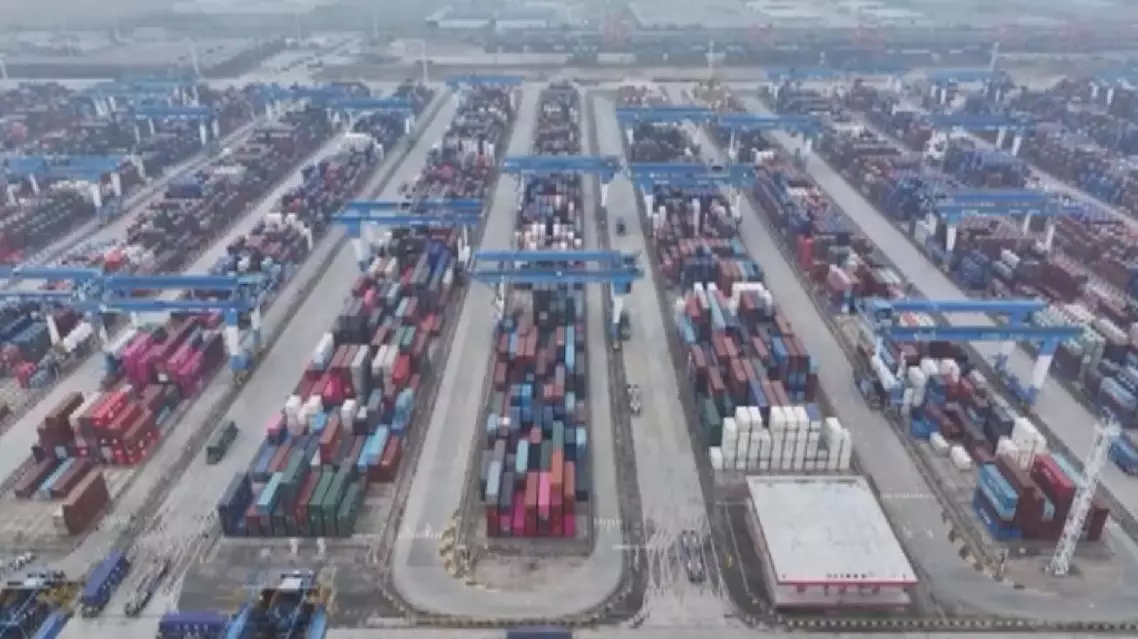
China's cargo throughput at ports grows 4.4 pct in first 11 months of 2025