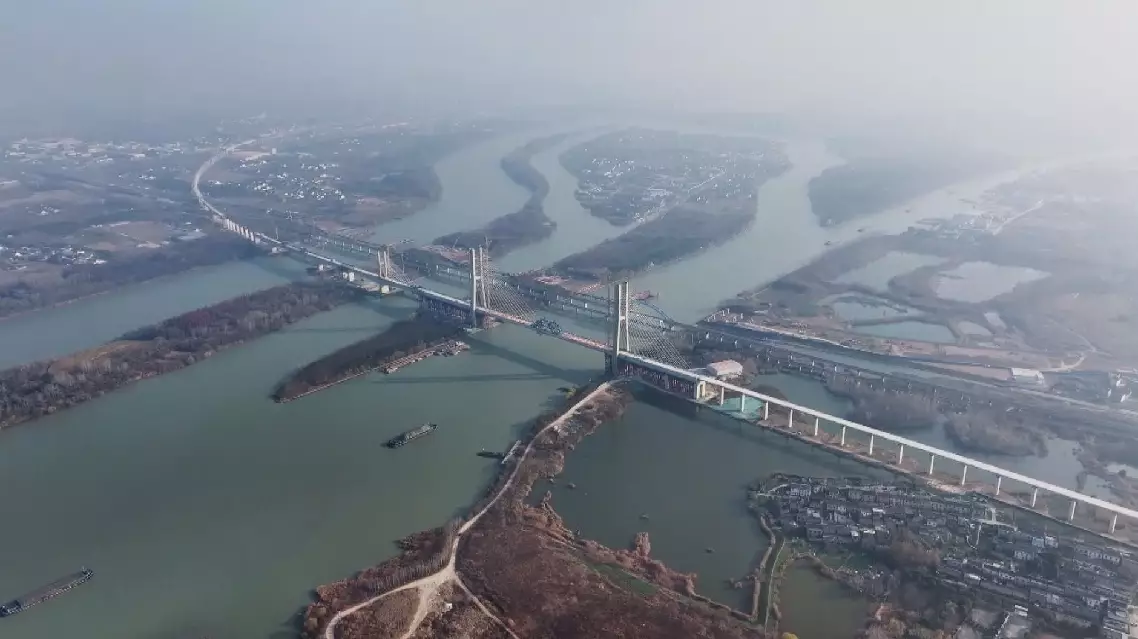
The Tongtaiyang Grand Bridge across the Beijing-Hangzhou Grand Canal, a pivotal project along the entire Shanghai-Chongqing-Chengdu High-speed Railway, was successfully closed on Friday, laying a critical foundation for the railway's on-schedule opening.
With a total length of 172.9 kilometers, the Tongtaiyang Grand Bridge is the world's longest high-speed railway bridge under construction. The bridge spans the northern bank of the Yangtze River in east China's Jiangsu Province, connecting the cities of Nantong, Taizhou, and Yangzhou. It crosses existing railways, highways and waterways a total of 116 times, presenting significant construction challenges.
The cable-stayed bridge across the Beijing-Hangzhou Grand Canal, which achieved closure this time, is one of the projects along the entire line with the longest span, tallest main towers and most complex technology.
"With an average of more than 300 vessels passing beneath the bridge daily, our construction project faces multiple challenges related to safety, navigation, and environmental protection. In coordination with multiple departments, we have established the 'canal guardian' mechanism, adopting a flexible scheduling model of 'timed waterway closure and dynamic vessel guidance' to minimize the impact on our construction to the greatest extent," said Li Bingfeng, person in charge of the bridge's construction.
The Shanghai-Chongqing-Chengdu High-speed Railway has a total length of about 2,100 kilometers and a designed maximum speed of 350 kilometers per hour.
Connecting six provincial-level regions, namely Shanghai, Jiangsu, Anhui, Hubei, Chongqing, and Sichuan, the railway is expected to further improve local transportation system and boost the high-quality economic development of the Yangtze River Economic Belt.
World's longest high-speed railway bridge under construction in east China sees new progress
Efforts are underway in Gaza City to salvage what remains of the territory's cultural heritage after nearly two years of war.
At the ruins of the Great Omari Mosque, Gaza's oldest and largest mosque, Palestinian workers have been clearing and sorting stones dating back more than 1,200 years using basic tools.
"The Great Omari Mosque represents the heart and soul of Gaza City, and Palestine as a whole. The value of these stones is not in their size, but in their deep and layered historical significance," said Husni Al-Mazloom, manager of the Great Omari Mosque restoration project.
Only fragments of the mosque's minarets and a few of its external walls remain standing.
"During the war, it was not only people, trees, and buildings that were targeted, but also thousands of years of human history. Most historical sites in Gaza City were struck and destroyed in an attempt to erase the historical identity of Gaza's people," said Palestinian historian Ayman Al-Balbisi.
Progress on the restoration project has been extremely slow, as Israel continues to restrict the entry of construction materials, even after nearly eight weeks of ceasefire.
On a positive note, however, the project provides locals with more income.
"Before working here, we were unemployed. When this opportunity became available for me and 20 other workers, it allowed us to provide for our families and cover basic needs. During the war, there was no work available for us at all," said worker Ali Al-Qaloushi.
Palestinians have accused Israel of deliberately targeting heritage sites. But Israel denied, saying its strikes followed international law and targeted Hamas tools near or beneath these locations.
The United Nations Educational, Scientific and Cultural Organization (UNESCO) has verified damage to 145 religious, cultural and historical sites in Gaza since October 2023, raising fears of irreversible loss in a territory whose history spans more than 5,000 years and carries the imprint of numerous civilizations.
Gazans race to preserve cultural heritage after two years of war