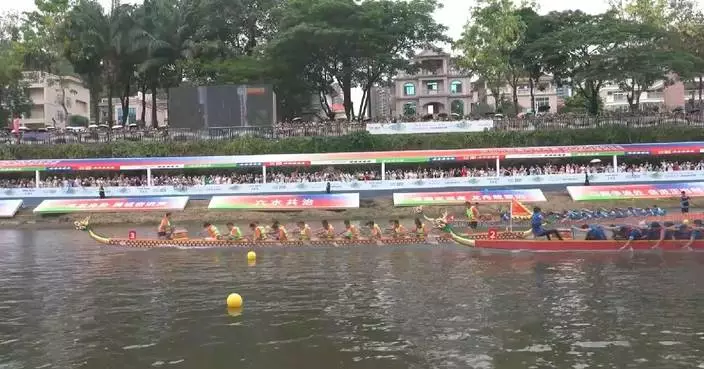
A joint drill on handling water emergencies among law enforcement forces from China, Laos, Myanmar, and Thailand was held on Thursday morning on the Lancang River in Xishuangbanna Dai Autonomous Prefecture, southwest China's Yunnan Province.
A total of 121 law enforcement personnel and 10 patrol vessels participated in the drill. The joint drill consisted of two parts, a fleet review and a real-combat exercise.
During the review, four drones carried the national flags of the participating countries as they flew over the exercise area. Ten law enforcement vessels from China, Laos, and Myanmar were reviewed in succession.
Following the review, the joint real-combat exercise focused on combating cross-border crimes. Upon receiving a clue, the law enforcement agencies of the four countries promptly activated their emergency response plans and coordinated actions, including waterborne inspections.
The successful conclusion of this drill comprehensively evaluated the rapid response, emergency handling, joint command, and cooperative operational capabilities of the four countries in addressing water emergencies along the Lancang-Mekong River and maintaining regional security.

Joint drill on handling water emergencies held among China, Laos, Myanmar, Thailand
The China (Inner Mongolia) Pilot Free Trade Zone is accelerating the implementation of reform measures including customs clearance facilitation at ports, in efforts to boost quality growth of the local region's open economy.
China expanded its pilot free trade zones (FTZs) to 23 in April with the establishment of the one in north China's Inner Mongolia Autonomous Region.
The State Council's plan on the new pilot FTZ specifies 19 reform and innovation measures, including developing border trade in an innovative way, strengthening international logistics services, improving the efficiency of technology transfer and application, and expanding external exchanges across multiple fields.
The China (Inner Mongolia) Pilot FTZ covers 119.74 square kilometers and comprises three subzones in Hohhot, capital of the autonomous region, Manzhouli, a northern border city, and Erenhot, an inland port on the China-Mongolia border, each tasked with differentiated functions and the development of industries tailored to local conditions.
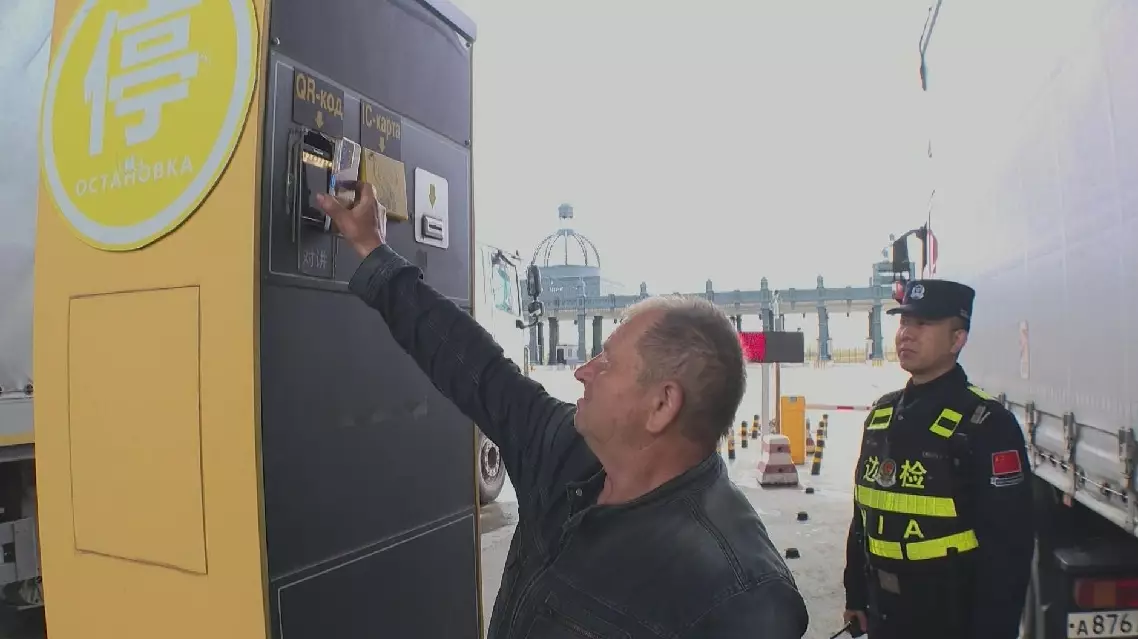
At the intelligent freight checkpoint of the Manzhouli inland port, drivers can complete customs clearance within just a few seconds by showing a QR code to the scanning machine.
The QR code is generated by a smartphone application, which collects the relevant customs clearance information in advance.
"Only one QR code is needed for customs clearance here. We can go through all the required formalities and have the entire application documentation processed through electronic data transmission. After getting the QR code and having it scanned at the checkpoint, the driver will be allowed to enter the country. It's very convenient and fast," said Zhao Shuang, general manager of a freight company in Manzhouli.
From January to April, Manzhouli's total foreign trade volume increased by 43.1 percent year on year.
Inner Mongolia pilot FTZ accelerates reform to boost quality growth